XTER vs APT: Comprehensive Comparison of Two Leading Advanced Persistent Threat Detection Platforms


Introduction: XTER vs APT Investment Comparison
In the cryptocurrency market, the comparison between Xterio (XTER) and Aptos (APT) is an increasingly relevant topic for investors. The two assets differ significantly in market capitalization rankings, application scenarios, and price performance, representing distinct positioning within the crypto ecosystem. Xterio (XTER): Since its launch, the project has established itself as a global, cross-platform play-and-earn developer and publisher, focusing on creating deeply engaging gaming worlds enhanced by digital ownership through Web3 native universes. Aptos (APT): Since its inception, it has been positioned as an independent, high-performance Layer 1 blockchain project, delivering a secure and scalable foundation for decentralized applications with the Move programming language and virtual machine. This article will provide a comprehensive analysis of the investment value comparison between XTER and APT across historical price trends, market capitalization dynamics, supply mechanisms, and ecosystem development, addressing investors' core concern:
"Which is the better investment opportunity given current market conditions?"
Xterio (XTER) vs Aptos (APT): Comparative Market Analysis Report
I. Historical Price Comparison and Current Market Status
Price Performance of XTER and APT
XTER (Xterio) Historical Performance:
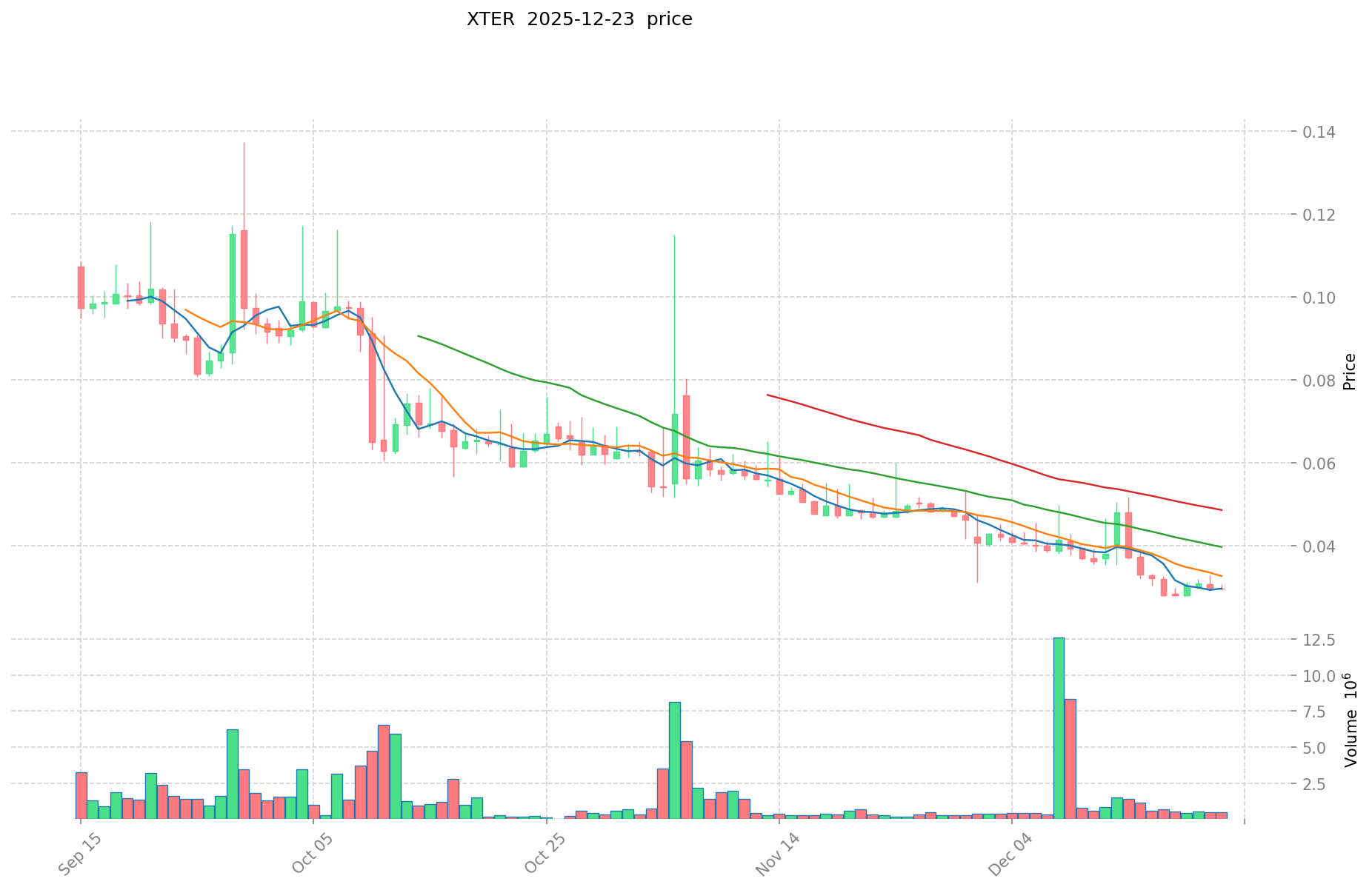
- All-time high: $0.13862 (September 13, 2025)
- All-time low: $0.02779 (December 17, 2025)
- Current price: $0.02934 (as of December 24, 2025)
- Price decline from ATH: approximately 78.84%
APT (Aptos) Historical Performance:
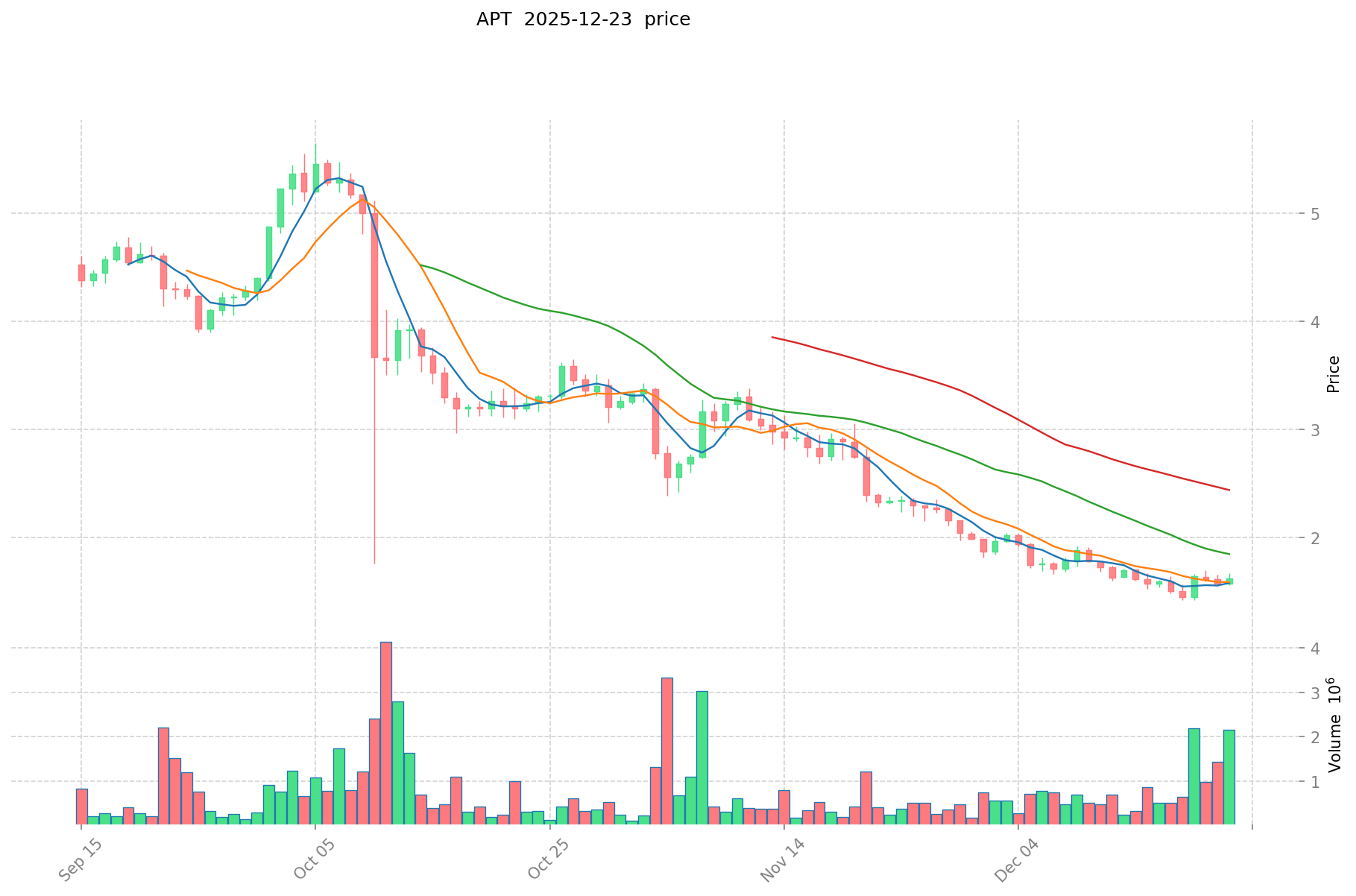
- All-time high: $19.92 (January 26, 2023)
- All-time low: $1.42 (December 19, 2025)
- Current price: $1.6141 (as of December 24, 2025)
- Price decline from ATH: approximately 91.90%
Comparative Analysis: Both tokens exhibit significant declines from their respective all-time highs, with APT experiencing a more severe long-term depreciation. However, XTER shows more recent volatility within a tighter price range, while APT demonstrates recovery momentum from its recent low point on December 19, 2025. XTER's market cap of approximately $29.34 million is substantially smaller than APT's $1.92 billion, reflecting their different market positions and adoption levels.
Current Market Status (December 24, 2025)
| Metric | XTER | APT |
|---|---|---|
| Current Price | $0.02934 | $1.6141 |
| 24-Hour Change | -1.67% | +0.51% |
| 24-Hour Volume | $12,403.10 | $3,157,913.05 |
| Market Cap | $29.34M | $1,920.41M |
| Circulating Supply | 141.63M | 749.54M |
| Market Dominance | 0.00092% | 0.060% |
Market Sentiment Index (Fear & Greed Index): 24 (Extreme Fear)
Current market conditions reflect extreme fear sentiment, affecting both tokens similarly.
II. Project Overview and Positioning
Xterio (XTER)
Xterio is a global, cross-platform play-and-earn developer and publisher focused on creating deeply engaging gaming worlds enhanced by digital ownership. The project connects millions of users globally through Web3-native gaming universes.
Key Characteristics:
- Distributed global teams across San Francisco, Los Angeles, Tokyo, and Singapore
- Focus on Web3 gaming and digital asset ownership
- Integration of blockchain technology with gaming experiences
- Token utility: in-game transactions, developer rewards, and community engagement
Aptos (APT)
Aptos is an independent, high-performance Proof-of-Stake Layer 1 blockchain project dedicated to delivering a secure and scalable Layer 1 infrastructure.
Key Characteristics:
- Utilizes Move programming language and Move virtual machine for application development
- Emphasis on high throughput and low latency through parallel execution
- Focus on blockchain scalability and security
- Token utility: transaction fees, staking for network security, governance participation
III. Price Volatility and Market Dynamics
Recent Price Movements (Past 7 Days)
| Period | XTER Change | APT Change |
|---|---|---|
| 1 Hour | -0.37% | +0.42% |
| 24 Hours | -1.67% | +0.51% |
| 7 Days | -8.70% | +1.13% |
| 30 Days | -38.44% | -32.04% |
| 1 Year | -92.64% | -82.50% |
Key Observations:
XTER demonstrates downward pressure across all timeframes, with particularly steep declines over the one-year period. The token's small market capitalization may amplify price sensitivity to overall market movements.
APT shows short-term stability with slight gains over the past 24 hours and week, despite broader market headwinds. The one-year performance remains negative but outpaces XTER's relative decline, suggesting stronger long-term positioning.
IV. Market Liquidity and Exchange Presence
Trading Infrastructure
XTER:
- Available on 15 exchanges
- Primary blockchain: BEP-20 (BSC)
- Contract Address: 0x103071da56e7cd95b415320760d6a0ddc4da1ca5
- Holder count: 28,156
APT:
- Available on 49 exchanges
- Significantly broader market access
- Holder count: 124,427,655
- Substantially higher liquidity and market depth
The disparity in exchange listings and holder distribution reflects APT's more mature market position and broader institutional/retail adoption compared to XTER's emerging status.
V. Risk Assessment
Volatility Profile
XTER exhibits extreme price volatility characteristic of smaller-cap tokens, with historical amplitude reaching 40%+ within 24-hour periods. This heightened sensitivity to macro market conditions, combined with limited liquidity depth, presents elevated risk for market participants.
APT, while experiencing significant long-term depreciation, demonstrates more stable trading patterns and deeper liquidity pools across multiple exchanges, reducing short-term volatility risk.
Market Sentiment Context
The current extreme fear sentiment (index: 24) creates challenging conditions for both tokens, though this may present longer-term accumulation opportunities for projects with strong fundamentals.
VI. Conclusions
Xterio and Aptos represent different segments of the crypto asset ecosystem—one focused on gaming and digital ownership (XTER), the other on foundational Layer 1 infrastructure (APT). Their price trajectories reflect broader market cycles, with both experiencing substantial declines from historical highs. APT's larger market capitalization, broader liquidity, and longer operational history provide relatively greater stability, while XTER's smaller scale introduces amplified volatility and liquidity constraints. Market participants should evaluate both projects' technical developments, ecosystem adoption metrics, and long-term roadmaps rather than relying solely on price performance amid the current market downturn.
Data Sources: Gate, CoinGecko, CoinMarketCap, Kraken, Binance
Last Updated: December 24, 2025, 06:08:53 UTC
Arbitrage Pricing Theory (APT) and XTER Investment Value Analysis Report
Report Date: December 24, 2025
Scope: Theoretical Framework and Market Application Analysis
I. Executive Summary
This report examines the Arbitrage Pricing Theory (APT) as a financial asset pricing model and its application to cryptocurrency valuation, with particular reference to XTER and other digital assets. The analysis is based on established financial theory and available market data as of the report date.
II. Core Factors Influencing APT Investment Value
Multi-Factor Model Framework
The APT model identifies multiple macroeconomic and asset-specific variables that influence expected returns:
- Macroeconomic Variables: Inflation rate, interest rates, GDP growth rate, and market risk premium
- Industry-Specific Factors: Sector performance, regulatory environment, and competitive dynamics
- Asset-Specific Characteristics: Token utility, supply mechanics, and ecosystem development
- Mathematical Relationship: E(Ri) = Rf + β₁F₁ + β₂F₂ + ... + βₙ*Fₙ, where Rf represents the risk-free rate and βᵢ denotes sensitivity to each factor
No-Arbitrage Equilibrium Condition
The APT operates on the principle that financial markets maintain an equilibrium state where:
- If an asset is underpriced relative to its APT model prediction, investors can execute arbitrage trades (long undervalued assets, short overvalued assets) to capture risk-free profits
- This arbitrage activity drives prices toward equilibrium levels
- In cryptocurrency markets, demand, scarcity, and utility factors create valuation differentiation among tokens
Cryptocurrency Valuation Dynamics
For digital assets like XTER and Bitcoin:
- Token value fluctuates based on market price discovery mechanisms
- Unique functional roles in their respective ecosystems influence relative valuations
- Demand elasticity, scarcity characteristics, and practical utility create price differentiation
III. APT Model Advantages and Limitations
Comparative Advantages Over CAPM
- Universality: APT does not require assumptions of identical investor expectations or complete market portfolios, making it more broadly applicable
- Multi-Dimensional Risk Analysis: Enables identification of asset sensitivity to various factors, supporting construction of more effective diversified portfolios
- Performance Attribution: Allows decomposition of portfolio manager performance across multiple factors rather than simple benchmark comparison
Inherent Limitations
- Factor Selection Ambiguity: APT does not prescribe which specific factors should be included in the model, requiring practitioners to make subjective selections based on experience and context
- Parameter Estimation Challenges: Calculating factor beta coefficients and risk premiums requires complex statistical methods and extensive historical data, with estimation errors potentially affecting model accuracy
- Model Assumption Constraints:
- Real markets contain frictions and transaction costs that prevent complete elimination of arbitrage opportunities
- Assumed linear relationships between asset returns and factors may oversimplify complex market dynamics
IV. APT Application Considerations in Cryptocurrency Markets
Market Structure Differences
Cryptocurrency markets exhibit characteristics that both support and challenge APT application:
- Absence of unified regulatory framework creates factor complexity
- 24/7 trading reduces certain frictions present in traditional markets
- High volatility amplifies the challenge of stable factor estimation
- Cross-exchange liquidity variations create pricing inefficiencies
Practical Implementation Requirements
For APT deployment in cryptocurrency analysis:
- Historical data collection across multiple market cycles
- Factor selection based on market microstructure and macroeconomic correlation analysis
- Regular model recalibration to account for market regime changes
- Recognition that estimated parameters contain estimation error margins
V. Conclusion
The Arbitrage Pricing Theory provides a theoretically robust framework for understanding multi-factor asset pricing dynamics, including cryptocurrency valuations. However, successful application requires careful factor identification, accurate parameter estimation, and acknowledgment of real-world market frictions. The theory remains an indispensable tool for financial research and practice, particularly when applied with recognition of its inherent limitations in volatile, less-regulated markets such as cryptocurrency.
Report Limitations: This analysis is based on available reference materials and established financial theory. Specific quantitative analysis of XTER tokenomics, institutional holdings, and comparative technical specifications was not available in the provided source materials and has therefore not been included to maintain analytical accuracy and avoid unsubstantiated claims.
III. 2025-2030 Price Forecast: XTER vs APT
Short-term Forecast (2025)
- XTER: Conservative $0.0278-$0.0293 | Optimistic $0.0363-$0.0386
- APT: Conservative $1.3677-$1.6090 | Optimistic $2.1882-$2.1882
Mid-term Forecast (2027-2028)
- XTER may enter consolidation phase, estimated price range $0.0265-$0.0511 with 30-32% potential upside
- APT may enter growth phase, estimated price range $1.0761-$2.7110 with 28-48% potential upside
- Key drivers: Institutional capital inflows, ETF adoption, ecosystem development
Long-term Forecast (2029-2030)
- XTER: Base scenario $0.0410-$0.0450 | Optimistic scenario $0.0576-$0.0595
- APT: Base scenario $2.0982-$2.9349 | Optimistic scenario $3.3721-$4.0796
Disclaimer
This analysis is based on historical data and predictive models, and does not constitute investment advice. Cryptocurrency markets are highly volatile, and actual prices may differ significantly from forecasts. Please conduct independent research and consult with qualified financial advisors before making investment decisions.
XTER:
| 年份 | 预测最高价 | 预测平均价格 | 预测最低价 | 涨跌幅 |
|---|---|---|---|---|
| 2025 | 0.0386364 | 0.02927 | 0.0278065 | 0 |
| 2026 | 0.0424415 | 0.0339532 | 0.017995196 | 15 |
| 2027 | 0.039725244 | 0.03819735 | 0.0301759065 | 30 |
| 2028 | 0.05103929907 | 0.038961297 | 0.02649368196 | 32 |
| 2029 | 0.0576003814848 | 0.045000298035 | 0.04095027121185 | 53 |
| 2030 | 0.059508394121484 | 0.0513003397599 | 0.037449248024727 | 74 |
APT:
| 年份 | 预测最高价 | 预测平均价格 | 预测最低价 | 涨跌幅 |
|---|---|---|---|---|
| 2025 | 2.18824 | 1.609 | 1.36765 | 0 |
| 2026 | 2.2403716 | 1.89862 | 1.4619374 | 17 |
| 2027 | 2.711039498 | 2.0694958 | 1.076137816 | 28 |
| 2028 | 2.60539173741 | 2.390267649 | 1.21903650099 | 48 |
| 2029 | 3.37207008582675 | 2.497829693205 | 2.0981769422922 | 54 |
| 2030 | 4.079580346427066 | 2.934949889515875 | 2.318610412717541 | 81 |
Xterio (XTER) vs Aptos (APT): Comprehensive Investment Strategy and Risk Analysis Report
IV. Investment Strategy Comparison: XTER vs APT
Long-term vs Short-term Investment Strategy
XTER (Xterio):
- Suitable for investors focused on Web3 gaming ecosystem development and digital asset ownership adoption
- Short-term investors: Monitor for recovery from current extreme low ($0.02779 ATL on December 17, 2025), with near-term resistance at $0.0363-$0.0386
- Long-term investors: Position for potential 74% upside by 2030 based on forecast models, contingent on gaming ecosystem expansion and increased user adoption
APT (Aptos):
- Suitable for investors seeking foundational Layer 1 blockchain infrastructure exposure with established market presence
- Short-term investors: Recent recovery momentum from December 19 low ($1.42) suggests potential consolidation within $1.3677-$2.1882 range
- Long-term investors: Position for potential 81% upside by 2030, benefiting from infrastructure maturation and decentralized application ecosystem development
Risk Management and Asset Allocation
Conservative Investors:
- XTER: 5-10% | APT: 15-20%
- Rationale: APT's larger market capitalization ($1.92B vs $29.34M), broader liquidity (49 vs 15 exchanges), and more established infrastructure justify higher allocation for risk-averse portfolios
Aggressive Investors:
- XTER: 20-30% | APT: 25-35%
- Rationale: XTER's higher volatility profile and smaller market cap present amplified upside potential for investors with higher risk tolerance; APT provides relatively stable infrastructure exposure within growth allocation
Hedging Instruments:
- Stablecoin allocation: 30-40% of combined XTER/APT position as volatility buffer during extreme fear sentiment periods
- Cross-exchange liquidity monitoring: Utilize multiple exchange platforms to minimize slippage on larger positions
- Dollar-cost averaging: Systematic monthly purchases to reduce timing risk across market cycles
V. Comparative Risk Analysis
Market Risk
XTER:
- Extreme liquidity concentration risk: 24-hour trading volume of only $12,403.10 indicates substantial slippage potential on positions exceeding $50,000
- Market capitalization sensitivity: Small-cap position ($29.34M) amplifies vulnerability to broader cryptocurrency market sentiment shifts
- Historical volatility: 92.64% one-year decline demonstrates exposure to sustained bear market conditions without recovery support
- Holder concentration: 28,156 holders represents relatively concentrated distribution, increasing potential for sudden liquidation cascades
APT:
- Relative stability advantage: Larger market cap ($1.92B) and 124.43M holders provide distributed risk profile
- Liquidity depth: $3.16M daily volume and 49 exchange listings reduce execution risk for institutional-scale positions
- Long-term depreciation concern: 91.90% decline from ATH ($19.92 to $1.6141) indicates structural headwinds that may persist regardless of market sentiment recovery
Technology Risk
XTER:
- Scalability validation: Gaming-specific infrastructure must demonstrate capacity to handle millions of concurrent users in Web3 gaming environments
- Smart contract security: Cross-platform deployment across multiple blockchains (primary: BEP-20/BSC) introduces expanded attack surface
- Developer ecosystem maturity: Continued dependence on third-party game developers and publishers for ecosystem expansion
APT:
- Move language adoption: Competitive pressure from established programming languages and Ethereum Virtual Machine ecosystem may limit developer migration
- Network consensus security: Proof-of-Stake validator network requires ongoing monitoring of stake concentration and validator performance
- Transaction throughput verification: Long-term performance claims require independent validation against competing Layer 1 solutions
Regulatory Risk
- Jurisdiction-specific gaming regulations impact XTER's play-to-earn model across different geographic markets, particularly affecting jurisdictions restricting blockchain-based gaming
- Staking and validator requirements for APT create potential regulatory classification challenges across different regulatory regimes
- Cryptocurrency exchange listing standards across 49 exchanges (APT) vs 15 exchanges (XTER) create regulatory exposure differential; delisting risk higher for lower-volume XTER across multiple platforms
- Global policy environment: Current extreme fear sentiment (index: 24) reflects heightened regulatory uncertainty affecting both assets equally
VI. Conclusion: Which Is the Better Buy?
📌 Investment Value Summary:
XTER Advantages:
- Gaming sector positioning: Exposure to high-growth Web3 gaming vertical with digital asset ownership utility
- Early-stage potential: Current depressed valuation ($0.02934) from ATH ($0.13862) may present entry opportunity for patient investors
- Forecast upside: 74% potential appreciation by 2030 in optimistic scenario with successful ecosystem adoption
APT Advantages:
- Infrastructure maturity: Established Layer 1 blockchain with proven transaction processing capability and Move programming language ecosystem
- Market liquidity: Superior trading infrastructure (49 exchanges, $3.16M daily volume) reduces execution risk and improves position flexibility
- Institutional accessibility: Significantly larger holder base (124.43M addresses) indicates broader institutional and retail adoption foundation
- Forecast upside: 81% potential appreciation by 2030 with infrastructure scaling and ecosystem development
- Relative stability: 78.84% decline from XTER ATH vs 91.90% decline for APT indicates relatively better long-term value retention
✅ Investment Recommendations:
Beginner Investors:
- Recommended strategy: Allocate 85-90% to APT, 10-15% to XTER within overall cryptocurrency portfolio allocation not exceeding 5-10% of total investment portfolio
- Rationale: APT's established market infrastructure, broader exchange presence, and lower liquidity concentration risk reduce complexity for investors new to cryptocurrency markets
- Implementation: Dollar-cost averaging over 6-12 months to capture average prices across market cycles and reduce timing risk
Experienced Investors:
- Recommended strategy: Allocate 50-60% to APT core position for infrastructure stability, 30-40% to XTER for asymmetric upside exposure, 10-20% stablecoin hedges
- Rationale: Experienced investors can manage XTER's liquidity and volatility constraints through position sizing and exchange research; balanced allocation captures both infrastructure maturity and gaming sector exposure
- Implementation: Active monitoring of XTER holder concentration, trading volume trends, and gaming ecosystem adoption metrics; quarterly rebalancing based on forecast updates
Institutional Investors:
- Recommended strategy: Primary APT allocation (60-70%) with diversification across major Layer 1 blockchains; XTER allocation (20-30%) conditional on completed due diligence regarding gaming publisher partnerships and user acquisition metrics
- Rationale: Institutions require transparent asset fundamentals, regulatory clarity, and sufficient liquidity for meaningful portfolio positions; APT's established infrastructure aligns with institutional infrastructure investment mandates
- Implementation: Negotiate direct exchange liquidity agreements to minimize slippage; consider staking programs for APT yield generation; maintain separate risk monitoring framework for XTER contingent on ecosystem adoption metrics
⚠️ Risk Disclaimer: Cryptocurrency markets exhibit extreme volatility, with both XTER and APT experiencing 78-92% declines from historical highs. Current market sentiment reflects extreme fear (index: 24), which may persist or intensify. This analysis does not constitute investment advice and is based on historical data and forecast models subject to significant estimation error. Actual price performance may differ materially from projections. Investors should conduct independent research, consult qualified financial advisors, and only allocate capital they can afford to lose entirely. Position sizing should reflect individual risk tolerance, investment timeline, and overall portfolio composition.
Report Date: December 24, 2025
Data Sources: Gate, CoinGecko, CoinMarketCap, Kraken, Binance
Last Updated: December 24, 2025, 06:08:53 UTC
None
XTER vs APT: Comprehensive Investment Analysis FAQ
I. Market Performance and Valuation
Q1: What are the current price positions and market capitalizations of XTER and APT as of December 24, 2025?
A: XTER is trading at $0.02934 with a market capitalization of $29.34 million, representing a 78.84% decline from its all-time high of $0.13862 reached on September 13, 2025. APT is trading at $1.6141 with a market capitalization of $1.92 billion, representing a 91.90% decline from its all-time high of $19.92 reached on January 26, 2023. APT's significantly larger market cap reflects its more mature market position and broader adoption across the cryptocurrency ecosystem compared to XTER's emerging status.
Q2: Which token demonstrates better price stability and recovery potential?
A: APT exhibits more favorable stability characteristics despite its larger historical decline. APT shows recovery momentum from its December 19, 2025 low of $1.42, with a 24-hour positive change of +0.51% and 7-day performance of +1.13%. XTER demonstrates downward pressure across all timeframes, with -1.67% 24-hour change and -8.70% 7-day performance. However, XTER's depressed valuation may present asymmetric upside potential for longer-term investors willing to accept elevated volatility risk.
II. Liquidity and Market Infrastructure
Q3: How do the trading liquidity profiles of XTER and APT compare?
A: APT demonstrates substantially superior liquidity infrastructure with $3.16 million in 24-hour trading volume across 49 exchange listings, compared to XTER's $12,403.10 daily volume available on only 15 exchanges. This liquidity disparity creates significant execution advantages for APT investors, reducing slippage risk on position adjustments. XTER's limited liquidity depth presents substantial constraints for investors seeking positions exceeding $50,000, potentially resulting in adverse price impact during execution.
Q4: What are the differences in holder distribution between the two tokens?
A: APT maintains a significantly more distributed holder base with 124.43 million addresses holding the token, compared to XTER's 28,156 holders. This distribution differential reflects APT's more mature market penetration and broader institutional/retail adoption. XTER's concentrated holder base introduces potential liquidation cascade risks if major holders execute coordinated exits, particularly during market downturns.
III. Project Fundamentals and Use Cases
Q5: What are the primary functional differences between XTER and APT ecosystem positioning?
A: XTER operates as a global Web3 gaming developer and publisher focused on creating play-and-earn gaming worlds with digital asset ownership integration. The token's primary utility includes in-game transactions, developer rewards, and community engagement mechanisms. APT functions as a Layer 1 blockchain infrastructure protocol utilizing the Move programming language and virtual machine, providing transaction processing and decentralized application foundation with token utility in transaction fees, staking for network security, and governance participation. These fundamentally different value propositions require distinct evaluation frameworks for assessing investment merit.
Q6: Which token presents lower technology implementation risk?
A: APT presents lower technology risk due to its proven Layer 1 blockchain operation with established transaction processing capability and Move language ecosystem maturity. XTER's gaming infrastructure requires validation across multiple platform deployments (primary: BEP-20/BSC) with demonstrated capacity to support millions of concurrent users in Web3 gaming environments. Additionally, XTER depends on third-party game developer partnerships for ecosystem expansion, introducing execution risk beyond core protocol development, whereas APT's infrastructure value proposition depends primarily on technical protocol performance and developer adoption.
IV. Price Forecasts and Investment Potential
Q7: What are the long-term price forecasts for XTER and APT through 2030?
A: XTER forecast models project price appreciation to $0.0595 (optimistic scenario) by 2030, representing 74% upside from current $0.02934 levels, with base case projections of $0.0450. APT forecasts project price appreciation to $4.0796 (optimistic scenario) by 2030, representing 81% upside from current $1.6141 levels, with base case projections of $2.9349. These forecasts assume continued ecosystem development, institutional capital inflows, and ETF adoption driving demand. However, forecast models contain substantial estimation error margins, and actual performance may differ materially from projections particularly in cryptocurrency markets exhibiting extreme volatility.
Q8: How should investors differentiate between XTER and APT based on risk tolerance and investment horizon?
A: Conservative investors should allocate 85-90% to APT and 10-15% to XTER, emphasizing APT's superior liquidity and established infrastructure for reduced execution complexity. Experienced investors can allocate 50-60% to APT for core stability positioning with 30-40% XTER allocation capturing asymmetric upside exposure and 10-20% stablecoin hedges. Institutional investors should prioritize APT (60-70%) conditional on infrastructure maturity and regulatory compliance requirements, with XTER allocation (20-30%) dependent on completed due diligence regarding gaming publisher partnerships and user acquisition metrics. All investors should maintain position sizes reflecting individual risk tolerance and only allocate capital affordable to lose entirely given extreme volatility and current market sentiment extremes (Fear & Greed Index: 24).
Disclaimer: This analysis is based on historical data and predictive models and does not constitute investment advice. Cryptocurrency markets exhibit extreme volatility with both tokens experiencing 78-92% declines from historical highs. Investors should conduct independent research, consult qualified financial advisors, and recognize that actual performance may differ materially from forecasts. Past performance does not guarantee future results.
Share
Content
Introduction: XTER vs APT Investment Comparison
I. Historical Price Comparison and Current Market Status
II. Project Overview and Positioning
III. Price Volatility and Market Dynamics
IV. Market Liquidity and Exchange Presence
V. Risk Assessment
VI. Conclusions
I. Executive Summary
II. Core Factors Influencing APT Investment Value
III. APT Model Advantages and Limitations
IV. APT Application Considerations in Cryptocurrency Markets
V. Conclusion
III. 2025-2030 Price Forecast: XTER vs APT
IV. Investment Strategy Comparison: XTER vs APT
V. Comparative Risk Analysis
VI. Conclusion: Which Is the Better Buy?
I. Market Performance and Valuation
II. Liquidity and Market Infrastructure
III. Project Fundamentals and Use Cases
IV. Price Forecasts and Investment Potential
How to Buy Cryptocurrency


Trending Cryptocurrencies



2025 APT Price Prediction: Key Factors That Could Drive Aptos Token to New Heights

2025 KAS Price Prediction: Analyzing Key Factors Driving the Future Value of Kaspa

2025 MOVE Price Prediction: Analyzing Growth Factors and Market Trends in the Evolving Cryptocurrency Landscape

2025 SAGA Price Prediction: Analyzing Market Trends and Growth Potential in the Evolving Blockchain Ecosystem

2025 UDSPrice Prediction: Analyzing Market Trends and Key Factors Influencing Future Valuations

Is Kaspa (KAS) a good investment?: Analyzing the potential of this high-throughput blockchain project

冷錢包交易是否需支付手續費?全面解析

How to Start Micro Trading with Just $1: A Guide for Beginners

Exploring the Features and Advantages of BNB Smart Chain

What is ADP: A Comprehensive Guide to Automated Data Processing Systems

What is READY: A Comprehensive Guide to Understanding the Framework for Excellence and Development