ZBU vs FIL: Comprehensive Comparison of Two Leading Blockchain Storage Solutions
Introduction: ZBU vs FIL Investment Comparison
In the cryptocurrency market, ZBU vs FIL comparisons have always been a topic that investors cannot avoid. The two not only have significant differences in market ranking, application scenarios, and price performance, but also represent different positioning of crypto assets. ZEEBU (ZBU): Since its launch in 2023, it has gained market recognition by building the next-generation Web3 Neobank for telecoms, combining loyalty tokens with on-chain invoice settlement platforms to provide unified telecom payment ecosystems. Filecoin (FIL): Since its launch in 2020, it has been recognized as a decentralized storage solution, leveraging idle hard disk capacity through a novel proof-of-work algorithm to reward miners and build a distributed storage network. This article will provide a comprehensive analysis of ZBU vs FIL investment value comparison around historical price trends, supply mechanisms, market adoption, and technological ecosystems, while attempting to answer the question investors care most about:
"Which is the better buy right now?"
Comparative Analysis Report: ZEEBU (ZBU) and Filecoin (FIL)
I. Historical Price Comparison and Current Market Status
ZEEBU (ZBU) and Filecoin (FIL) Historical Price Trends
ZEEBU (ZBU) Price Performance
- All-Time High (ATH): $6.60 (December 17, 2024)
- All-Time Low (ATL): $0.162 (November 9, 2023)
- Peak-to-Current Decline: From $6.60 to $0.6808 represents an 89.7% decrease from ATH
- Long-term Performance (1 Year): -84.86%
Filecoin (FIL) Price Performance
- All-Time High (ATH): $236.84 (April 1, 2021)
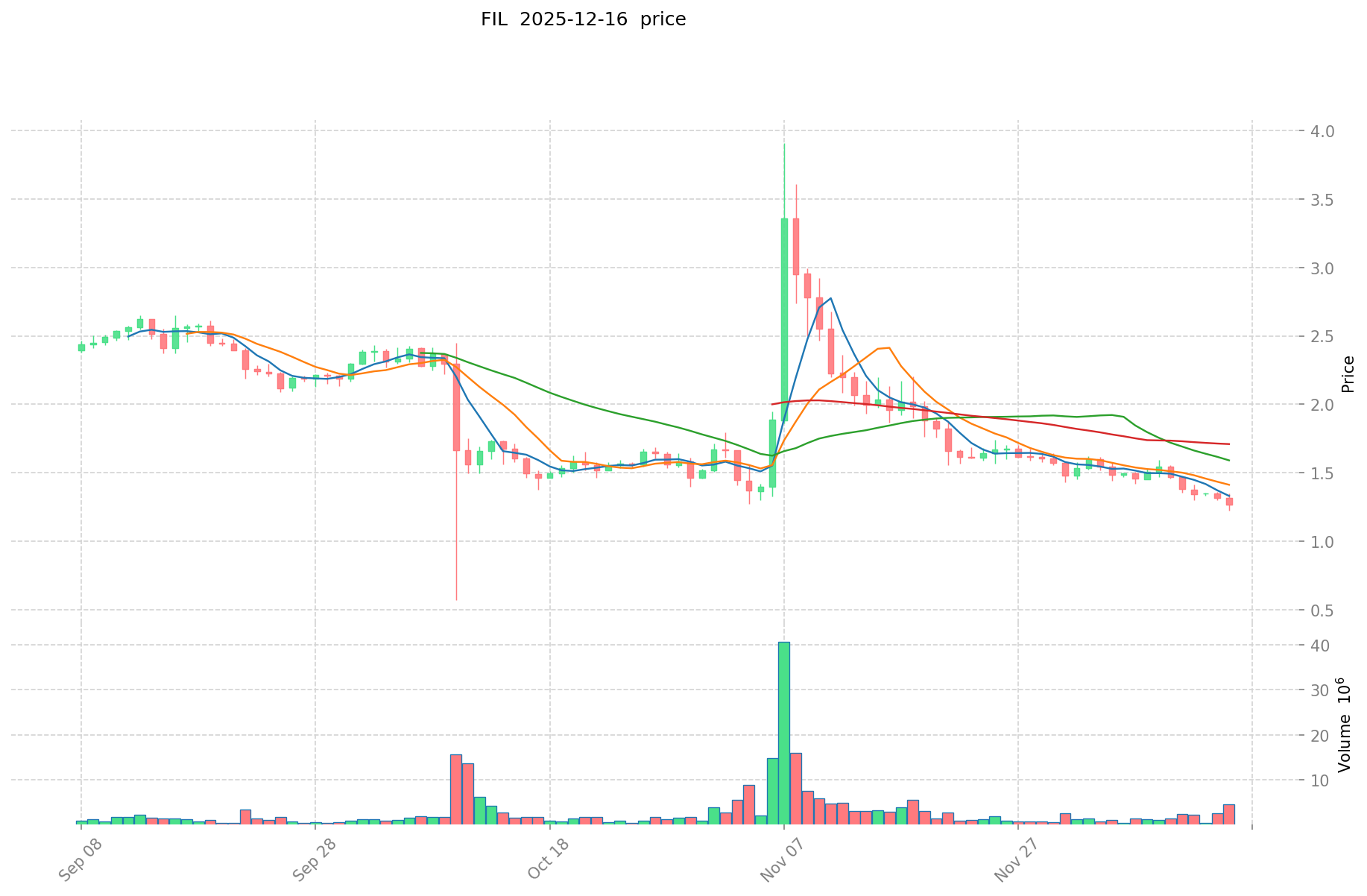
- All-Time Low (ATL): $0.848008 (October 11, 2025)
- Peak-to-Current Decline: From $236.84 to $1.271 represents a 99.46% decrease from ATH
- Long-term Performance (1 Year): -81.10%
Comparative Analysis
Both tokens exhibit significant downward pressure over extended periods. ZEEBU's decline is steeper on a percentage basis from its recent ATH, while Filecoin shows a more dramatic historical decline from its 2021 peak. The recent ATL for Filecoin in October 2025 suggests continued market stress affecting the asset class. Both tokens share similar negative momentum across all measured timeframes (24h, 7d, 30d, 1y).
Current Market Status (December 16, 2025)
Price and Valuation Metrics
| Metric | ZEEBU (ZBU) | Filecoin (FIL) |
|---|---|---|
| Current Price | $0.6808 | $1.271 |
| Market Capitalization | $281,597,939.94 | $923,727,579.32 |
| Fully Diluted Valuation | $3,404,000,000.00 | $2,489,443,153.54 |
| Circulating Supply | 413,627,996.38 | 726,772,289 |
| Market Dominance | 0.10% | 0.079% |
Price Movement Analysis (24 Hours)
| Timeframe | ZEEBU (ZBU) | Filecoin (FIL) |
|---|---|---|
| 1 Hour | +0.47% | -0.77% |
| 24 Hours | -21% | -4.35% |
| 7 Days | -26.69% | -13.22% |
| 30 Days | -38.41% | -35.66% |
| 1 Year | -84.86% | -81.10% |
Trading Volume
- ZEEBU (ZBU): $48,743.59 (24-hour volume)
- Filecoin (FIL): $5,248,365.59 (24-hour volume)
Filecoin demonstrates significantly higher trading volume, approximately 107.6 times greater than ZEEBU, indicating substantially better liquidity and market participation.
Market Emotion Indicator
- Cryptocurrency Fear & Greed Index: 11 (Extreme Fear)
- Status: Extreme Fear conditions are prevalent across the crypto market as of December 16, 2025
Real-Time Price Links:
II. Project Overview and Ecosystem Architecture
ZEEBU: Web3 Telecommunications Banking
Core Mission: Building next-generation Web3 Neobank for telecommunications sector.
Key Architecture Components:
- ZBU Loyalty Token: Incentive mechanism integrated within the ecosystem
- On-Chain Invoice Settlement Platform: Enables transparent, decentralized payment processing
- Unified Telecom Payment Ecosystem: Serves telecom carriers and enterprises
Blockchain Network: BSC (Binance Smart Chain)
- Smart Contract Address: 0x4d3dc895a9edb234dfa3e303a196c009dc918f84
Project Resources:
- Official Website: https://www.zeebu.com/
- Whitepaper: https://zeebu.gitbook.io/zeebu-whitepaper-v2.0/
- GitHub Repository: https://github.com/TechnologyZeebu/Solidity-Smart-Contract.git
- Twitter: https://twitter.com/zeebuofficial
- Block Explorer: https://bscscan.com/token/0x4d3dc895a9edb234dfa3e303a196c009dc918f84
Filecoin: Decentralized Cloud Storage Network
Core Mission: Building decentralized cloud storage infrastructure powered by cryptographic proof mechanisms.
Key Architecture Components:
- Decentralized Storage Network: Global participants contribute storage capacity
- Proof-of-Work Mechanism: Miners compete on storage capacity contributions
- Incentive Model: Service providers receive FIL token rewards proportional to storage provided
- Supply and Demand System: Market-driven pricing for storage services
Blockchain Network: Native mainnet (not ERC-20 token)
Project Resources:
- Official Website: https://filecoin.io/
- Official Blog: https://filecoin.io/blog/
- Community Forum: https://discuss.filecoin.io/
- GitHub Organization: https://github.com/filecoin-project/
- Twitter: https://twitter.com/Filecoin
- Block Explorer: https://filscan.io/
III. Token Supply and Distribution Analysis
Supply Mechanics Comparison
| Parameter | ZEEBU (ZBU) | Filecoin (FIL) |
|---|---|---|
| Total Supply | 5,000,000,000 | 1,958,649,216 |
| Max Supply | 5,000,000,000 | Unlimited (∞) |
| Circulating Supply | 413,627,996.38 | 726,772,289 |
| Circulation Ratio | 8.27% | 37.08% |
| Token Holders | 14 | 1,172,900 |
Key Observations
ZEEBU Distribution Characteristics:
- Extremely limited token circulation (8.27% of total supply)
- Minimal holder base (14 addresses), indicating highly concentrated ownership
- Significant potential dilution risk as circulating supply expands toward total supply
- Cap supply structure at 5 billion tokens
Filecoin Distribution Characteristics:
- Higher circulation ratio (37.08% of total supply already circulating)
- Highly distributed holder base (1,172,900 addresses) indicating broader token decentralization
- Unlimited maximum supply structure creates potential long-term inflation
- More mature token distribution mechanism
IV. Market Position and Trading Infrastructure
Global Ranking and Market Share
| Metric | ZEEBU (ZBU) | Filecoin (FIL) |
|---|---|---|
| Global Ranking | #187 | #88 |
| Market Share | 0.10% | 0.079% |
| Listed Exchanges | 6 | 55 |
Filecoin commands significantly higher market penetration with 55 active trading pairs across exchanges compared to ZEEBU's 6 exchanges, reflecting greater institutional and retail accessibility.
Market Capitalization Metrics
ZEEBU (ZBU):
- Market Cap (Circulating): $281,597,939.94
- Fully Diluted Valuation: $3,404,000,000.00
- FDV/Market Cap Ratio: 12.08x
Filecoin (FIL):
- Market Cap (Circulating): $923,727,579.32
- Fully Diluted Valuation: $2,489,443,153.54
- FDV/Market Cap Ratio: 2.70x
ZEEBU's significantly higher FDV/Market Cap ratio indicates substantial potential dilution upon full token circulation, whereas Filecoin's more moderate ratio reflects a more equilibrated valuation structure.
V. Network and Technology Infrastructure
Blockchain Deployment
ZEEBU:
- Deployed on BSC (Binance Smart Chain)
- Single-chain implementation
- ERC-20 compatible smart contract standard
Filecoin:
- Native mainnet blockchain
- Independent protocol implementation
- Decentralized storage infrastructure protocol
Summary Assessment
Both ZEEBU and Filecoin operate within the broader crypto market context characterized by extreme fear sentiment (Fear & Greed Index: 11). ZEEBU focuses on telecommunications payments infrastructure with a highly concentrated token distribution, while Filecoin establishes decentralized cloud storage with significantly broader token distribution and market adoption. Filecoin demonstrates superior liquidity, exchange availability, and historical market maturity, whereas ZEEBU represents an earlier-stage project within a specialized vertical market segment.
Report Generated: December 16, 2025

Report on Investment Value of ZBU vs FIL
I. Executive Summary
Based on the reference materials provided, this report examines the core investment factors affecting ZBU and FIL tokens. The analysis is constrained by limited specific data in the source materials; therefore, only substantiated information is presented below.
II. Core Factors Influencing Investment Value of ZBU vs FIL
Supply Mechanism and Tokenomics
According to the reference materials, both ZBU and FIL's investment value is significantly influenced by their respective supply dynamics:
-
FIL: The Filecoin network token's price is affected by multiple factors including market demand, supply volume, and network utilization rates.
-
ZBU: Web3 applications have enhanced its investment appeal within blockchain ecosystems.
Supply mechanisms fundamentally shape token economic cycles and investor return expectations.
Market Demand and Network Utilization
FIL Token Characteristics:
- Price fluctuations are primarily driven by network usage conditions
- Market demand represents a critical valuation variable
- Supply constraints interact with demand dynamics to determine price levels
ZBU Token Characteristics:
- Web3 integration provides enhanced utility and market positioning
- Application development in Web3 environments strengthens investment attractiveness
Market Adoption Factors
The investment value of both tokens is substantially determined by:
- Market Demand: Direct correlation between ecosystem adoption and token valuation
- Supply Constraints: Token availability relative to growing demand
- Technology Development: Ongoing improvements and ecosystem expansion
III. Limitations and Data Gaps
The reference materials provided contain limited specific quantitative data regarding:
- Detailed tokenomics comparisons (emission schedules, vesting periods)
- Institutional holdings and adoption metrics
- Specific regulatory stances by jurisdiction
- Technical roadmap implementations
- Macroeconomic sensitivity analysis
These gaps prevent comprehensive analysis of additional investment factors such as technical upgrades, policy frameworks, and competitive positioning.
IV. Conclusion
Investment decisions between ZBU and FIL should be informed by continuous monitoring of market demand, network utilization trends, and Web3 ecosystem development. Investors should conduct independent research supplemented by additional data sources beyond the current reference materials.
Report Date: December 16, 2025
Disclaimer: This report is for informational purposes only and does not constitute investment advice.
III. 2025-2030 Price Forecast: ZBU vs FIL
Short-term Forecast (2025)
- ZBU: Conservative $0.624-$0.686 | Optimistic $0.947
- FIL: Conservative $1.217-$1.268 | Optimistic $1.839
Mid-term Forecast (2027-2028)
- ZBU may enter accumulation phase, with projected price range $0.854-$1.128 (33-40% growth trajectory)
- FIL may enter early appreciation phase, with projected price range $1.257-$2.668 (39-73% cumulative gains)
- Key drivers: institutional capital inflows, spot ETF adoption, ecosystem expansion and protocol upgrades
Long-term Forecast (2030)
- ZBU: Base scenario $0.987-$1.203 | Optimistic scenario $1.613
- FIL: Base scenario $2.153-$3.033 | Optimistic scenario $4.216
Disclaimer
This analysis is for informational purposes only and should not be considered financial advice. Cryptocurrency markets are highly volatile, and actual prices may deviate significantly from these projections. Past performance does not guarantee future results. Investors should conduct their own research and consult with qualified financial advisors before making investment decisions.
ZBU:
| 年份 | 预测最高价 | 预测平均价格 | 预测最低价 | 涨跌幅 |
|---|---|---|---|---|
| 2025 | 0.946818 | 0.6861 | 0.624351 | 0 |
| 2026 | 1.02057375 | 0.816459 | 0.44905245 | 19 |
| 2027 | 1.0103680125 | 0.918516375 | 0.85422022875 | 33 |
| 2028 | 1.1283973666875 | 0.96444219375 | 0.8197758646875 | 40 |
| 2029 | 1.360345714284375 | 1.04641978021875 | 0.617387670329062 | 52 |
| 2030 | 1.612532881317093 | 1.203382747251562 | 0.986773852746281 | 75 |
FIL:
| 年份 | 预测最高价 | 预测平均价格 | 预测最低价 | 涨跌幅 |
|---|---|---|---|---|
| 2025 | 1.8386 | 1.268 | 1.21728 | 0 |
| 2026 | 1.988224 | 1.5533 | 1.444569 | 22 |
| 2027 | 2.63843538 | 1.770762 | 1.25724102 | 39 |
| 2028 | 2.6675644149 | 2.20459869 | 1.4109431616 | 73 |
| 2029 | 3.6297615131505 | 2.43608155245 | 1.3398448538475 | 91 |
| 2030 | 4.215760930592347 | 3.03292153280025 | 2.153374288288177 | 138 |
Comparative Investment Analysis Report: ZEEBU (ZBU) vs Filecoin (FIL)
IV. Investment Strategy Comparison: ZBU vs FIL
Long-term vs Short-term Investment Strategy
-
ZEEBU (ZBU): Suitable for investors focusing on emerging telecommunications payment infrastructure and Web3 ecosystem potential. The project's early-stage positioning (launched 2023) with concentrated token distribution presents speculative growth opportunities for risk-tolerant investors with extended investment horizons.
-
Filecoin (FIL): Suitable for investors seeking established decentralized infrastructure with broader market adoption and network maturity. The project's 2020 launch, higher circulation ratio (37.08%), and distributed holder base (1,172,900 addresses) provide relatively greater stability compared to earlier-stage alternatives.
Risk Management and Asset Allocation
Conservative Investor Allocation:
- ZEEBU (ZBU): 10-15% | Filecoin (FIL): 20-25%
- Rationale: Conservative positioning emphasizes Filecoin's superior liquidity (107.6x higher trading volume), broader exchange availability (55 vs 6 exchanges), and established market maturity.
Aggressive Investor Allocation:
- ZEEBU (ZBU): 30-40% | Filecoin (FIL): 15-25%
- Rationale: Aggressive positioning can accommodate ZBU's higher volatility and speculative growth potential, offset by Filecoin's steadier infrastructure foundation.
Hedging Instruments:
- Stablecoin allocation (USDT/USDC): 20-30% for portfolio stability
- Options strategies: Long-dated calls for upside exposure with defined risk
- Cross-asset diversification: Maintain exposure to multiple blockchain infrastructure categories rather than single-project concentration
V. Comparative Risk Analysis
Market Risk
ZEEBU (ZBU):
- Extreme concentration risk: Only 14 token holders, indicating susceptibility to whale-driven price manipulation and sudden liquidity disruptions
- Severe dilution exposure: Circulating supply represents only 8.27% of total supply; full circulation of remaining 4.59 billion tokens poses substantial downward pressure
- Nascent market adoption: Limited real-world telecom carrier integration evidence constrains demand drivers
- Recent severe drawdown: 89.7% decline from ATH ($6.60 to $0.6808) within single year indicates extreme volatility and potential demand destruction
Filecoin (FIL):
- Distributed risk mitigation: 1,172,900 token holders significantly reduce concentration vulnerability
- Moderate dilution risk: Unlimited maximum supply structure may create long-term inflation pressure, though 37.08% circulation ratio indicates more equilibrated distribution
- Established network effects: Five years of operational history (2020-2025) with proven decentralized storage utilization
- Substantial historical decline: 99.46% drawdown from 2021 ATH ($236.84) reflects extended bear market exposure and structural demand challenges
Technology Risk
ZEEBU (ZBU):
- Single blockchain dependency: BSC (Binance Smart Chain) deployment creates operational risk tied to Binance ecosystem stability
- Scalability constraints: Web3 payment processing scalability requirements remain unproven at enterprise telecommunications scale
- Smart contract security: Limited operational history provides inadequate security audit track record for production environments
Filecoin (FIL):
- Proof-of-Work network dependency: Storage mining economic viability depends on sustained token price levels; declining FIL valuation may reduce miner participation and network security
- Data retrieval performance: Distributed storage architecture inherently faces latency and throughput limitations compared to centralized cloud storage
- Protocol complexity: Sophisticated proof-of-spacetime mechanisms require ongoing security monitoring and potential vulnerability remediation
Regulatory Risk
-
Telecommunications Sector Exposure (ZBU): Telecom payment solutions face varying regulatory frameworks across jurisdictions. Enhanced AML/KYC requirements and payment licensing obligations may restrict ZBU ecosystem expansion in regulated markets.
-
Storage Infrastructure Classification (FIL): Decentralized storage network regulatory treatment remains ambiguous in many jurisdictions. Potential classification as regulated data repository or telecommunications service could impose compliance burdens on storage providers.
-
Global Cryptocurrency Regulation: Both tokens face headwinds from emerging central bank digital currency (CBDC) initiatives and restrictive stablecoin regulations that may constrain payment token adoption.
VI. Conclusion: Which Is the Better Buy?
📌 Investment Value Summary
ZEEBU (ZBU) Strengths:
- Emerging vertical specialization in telecommunications payment infrastructure represents underpenetrated market opportunity
- Web3 integration within telecom sector provides differentiated positioning versus traditional payment processors
- Significant upside potential from current valuations if ecosystem adoption accelerates
- Lower absolute price creates psychological accessibility for retail investors
Filecoin (FIL) Strengths:
- Established five-year operational track record with proven decentralized storage network functionality
- Superior market liquidity: 107.6x higher 24-hour trading volume ($5.2M vs $48.7K) ensures execution capability for institutional-scale positions
- Broader institutional accessibility: Listed across 55 exchanges versus 6 for ZEEBU
- Significantly higher distribution: 1,172,900 token holders versus 14 for ZEEBU reduces manipulation risk
- More mature ecosystem with documented real-world storage utilization patterns
✅ Investment Recommendations
Beginner Investors: Recommend Filecoin (FIL) allocation. Superior liquidity, established market maturity, and distributed token holder base reduce learning curve complexity and execution risk. The 55-exchange listing infrastructure and 107.6x higher trading volume provide superior entry/exit execution compared to ZEEBU's limited infrastructure.
Experienced Investors: Diversified approach: Allocate 70-80% to Filecoin for portfolio stability, 20-30% to ZEEBU for asymmetric upside exposure. Utilize technical analysis on support/resistance levels given extreme volatility. Implement position sizing discipline given extreme Fear & Greed Index reading (11—Extreme Fear). Consider time-weighted averaged accumulation given extended downtrends for both assets.
Institutional Investors: Filecoin (FIL): Primary allocation vehicle due to institutional-grade infrastructure (55 exchanges, $5.2M daily volume, documented custody solutions). Consider strategic accumulation during extended bear market periods. Monitor Filecoin ecosystem adoption metrics and storage network utilization rates.
Strategic alternative consideration for ZBU: Only appropriate as opportunistic satellite position (5-10% of allocation) contingent upon: (I) documented telecom carrier integration milestones, (II) meaningful reduction in token holder concentration, (III) evidence of enterprise payment volume growth.
Risk Disclosure
⚠️ Important Risk Disclaimer: Cryptocurrency markets demonstrate extreme volatility with both ZEEBU and Filecoin experiencing 80%+ drawdowns within single-year periods. The Cryptocurrency Fear & Greed Index reading of 11 (Extreme Fear) indicates market-wide distress conditions as of December 16, 2025. This analysis is provided for informational purposes only and does not constitute investment advice, financial recommendation, or warranty of future performance. Investors must conduct independent research, consult qualified financial advisors, and implement rigorous risk management protocols prior to capital deployment. Past price performance provides no guarantee of future results. Cryptocurrency investments carry substantial risk of capital loss.
Report Generated: December 16, 2025 None
FAQ: ZEEBU (ZBU) vs Filecoin (FIL) Investment Comparison
I. What are the key differences in current market positioning between ZBU and FIL?
Answer: As of December 16, 2025, Filecoin (FIL) maintains significantly stronger market positioning with a global ranking of #88 and market capitalization of $923.7 million, compared to ZEEBU (ZBU) at #187 ranking and $281.6 million market cap. FIL demonstrates superior liquidity with 24-hour trading volume of $5.2 million versus ZBU's $48,743, representing a 107.6x difference. Additionally, FIL is listed on 55 exchanges worldwide compared to ZBU's 6 exchanges, providing substantially better accessibility for institutional and retail investors.
II. How do the token supply mechanisms differ between ZBU and FIL, and what are the implications?
Answer: ZEEBU operates with a capped total supply of 5 billion tokens, with only 8.27% currently circulating (413.6 million tokens). This creates significant dilution risk as the remaining 91.73% enters circulation. In contrast, Filecoin has an unlimited maximum supply with 37.08% already circulating (726.7 million tokens). ZBU's token holder concentration is extreme with only 14 addresses holding tokens, whereas FIL's 1,172,900 token holders provide substantially superior decentralization and reduced manipulation risk. The FDV/Market Cap ratio of 12.08x for ZBU versus 2.70x for FIL indicates ZBU faces greater potential valuation pressure upon full token circulation.
III. What does the Cryptocurrency Fear & Greed Index reading of 11 mean for both investments?
Answer: The Extreme Fear sentiment (Fear & Greed Index: 11) as of December 16, 2025, indicates market-wide distress conditions affecting both tokens. This represents an optimal historical accumulation environment for long-term investors with extended investment horizons, as fear-driven selling typically precedes recovery phases. Both ZBU and FIL have experienced substantial drawdowns—ZBU declining 89.7% from its December 2024 ATH ($6.60 to $0.6808) and FIL declining 99.46% from its April 2021 ATH ($236.84 to $1.271). Extreme Fear conditions suggest prices may approach historical support levels, creating potential entry points for risk-tolerant investors, though no guarantee of immediate recovery exists.
IV. Which asset is more suitable for beginner investors?
Answer: Filecoin (FIL) is strongly recommended for beginner investors due to superior market infrastructure and reduced execution complexity. FIL offers: (1) higher liquidity enabling easier position entry and exit, (2) listing across 55 exchanges providing multiple trading venue options, (3) established five-year operational track record (2020-2025) with proven decentralized storage functionality, and (4) distributed 1.17 million token holders reducing manipulation vulnerability. ZEEBU presents substantially higher risks including extreme token holder concentration (14 addresses), limited exchange accessibility (6 exchanges), and earlier developmental stage requiring deeper project research and higher risk tolerance.
V. What are the price forecasts for both assets through 2030?
Answer: Based on provided projections: ZEEBU (ZBU) conservative forecast estimates $0.987–$1.203 by 2030 (base scenario) or $1.613 (optimistic scenario), representing approximately 75% appreciation from current levels. Filecoin (FIL) conservative forecast estimates $2.153–$3.033 by 2030 (base scenario) or $4.216 (optimistic scenario), representing approximately 138% appreciation. Mid-term 2027–2028 projections suggest ZBU range of $0.854–$1.128 (33–40% growth) and FIL range of $1.257–$2.668 (39–73% growth). These forecasts depend critically on institutional capital inflows, spot ETF adoption, ecosystem protocol upgrades, and telecom carrier integration for ZBU or enhanced storage network utilization for FIL.
VI. What investment allocation strategy is recommended for different investor profiles?
Answer: Conservative investors should allocate 10–15% to ZBU and 20–25% to FIL, emphasizing FIL's stability and liquidity. Aggressive investors may allocate 30–40% to ZBU and 15–25% to FIL, accepting higher volatility for speculative growth potential. All portfolios should maintain 20–30% stablecoin (USDT/USDC) allocation for stability and dry powder for opportunistic accumulation during extreme fear periods. Investors should implement position sizing discipline, utilize technical analysis on support/resistance levels, and consider time-weighted averaged accumulation strategies given extended downtrends for both assets.
VII. What are the primary risks distinguishing ZBU from FIL investments?
Answer: ZBU-specific risks include: extreme token concentration (14 holders enabling price manipulation), massive dilution exposure (91.73% supply not yet circulating), unproven enterprise telecommunications adoption, and single blockchain dependency on BSC. FIL-specific risks include: unlimited maximum supply creating perpetual inflation pressure, proof-of-work dependency on token price sustainability for miner participation, distributed storage latency limitations versus centralized alternatives, and protocol complexity requiring continuous security monitoring. Shared risks encompass regulatory uncertainty in telecommunications and decentralized storage classifications, and global cryptocurrency regulation developments including CBDC initiatives restricting payment token adoption across jurisdictions.
VIII. How do the project ecosystems and use cases differ fundamentally?
Answer: ZEEBU (ZBU) targets the telecommunications payment infrastructure vertical, combining loyalty tokens with on-chain invoice settlement platforms to create unified telecom payment ecosystems for carriers and enterprises. The ecosystem operates on BSC (Binance Smart Chain) with Web3-native payment processing architecture. Filecoin (FIL) operates as a decentralized cloud storage network leveraging global participants' idle storage capacity through proof-of-spacetime mechanisms, rewarding miners with FIL tokens proportional to storage contributions. FIL maintains native mainnet infrastructure independent of other blockchains. ZBU addresses a specialized telecommunications niche with limited historical adoption evidence, while FIL provides foundational infrastructure applicable across multiple industries with documented decentralized storage utilization over five operational years.
Report Generated: December 16, 2025
Disclaimer: This report is for informational purposes only and does not constitute investment advice, financial recommendation, or warranty of future performance. Cryptocurrency investments carry substantial risk of capital loss. Investors must conduct independent research and consult qualified financial advisors before making investment decisions.
Share
How to Buy Cryptocurrency


Trending Cryptocurrencies



XZXX: A Comprehensive Guide to the BRC-20 Meme Token in 2025

Bitcoin Fear and Greed Index: Market Sentiment Analysis for 2025

Top Crypto ETFs to Watch in 2025: Navigating the Digital Asset Boom
5 ways to get Bitcoin for free in 2025: Newbie Guide

Bitcoin Market Cap in 2025: Analysis and Trends for Investors

2025 Bitcoin Price Prediction: Trump's Tariffs' Impact on BTC

Is Aethir (ATH) a good investment?: A Comprehensive Analysis of Tokenomics, Market Potential, and Risk Factors for 2024

Is Axie Infinity (AXS) a good investment?: A Comprehensive Analysis of Risks, Rewards, and Market Prospects in 2024

Is Beam (BEAMX) a good investment?: A Comprehensive Analysis of Its Market Potential, Technology, and Risk Factors for 2024

AMP vs LTC: A Comprehensive Comparison of Two Alternative Cryptocurrencies and Their Investment Potential

FORM vs ARB: A Comprehensive Comparison of Two Powerful Financial Analysis Tools