This comprehensive comparison analyzes ZKL and FLOW, two distinct blockchain solutions with different technological foundations and market positioning. ZKL, launched in July 2024, focuses on multi-chain liquidity aggregation using zero-knowledge rollup technology, while FLOW, established in September 2020, serves as a platform for gaming and digital assets. The article examines historical price trends, tokenomics, trading volumes available on Gate, institutional adoption, and technical ecosystems to guide investment decisions. Current market conditions show ZKL trading at $0.00136 with limited liquidity, while FLOW trades at $0.0507 with relatively better trading volume. Long-term price forecasts through 2031 suggest potential growth for both assets, though both carry substantial volatility and regulatory risks. The analysis provides tailored investment strategies for conservative, aggressive, and institutional investors, emphasizing the importance of risk management and diversification.
Introduction: ZKL vs FLOW Investment Comparison
In the cryptocurrency market, the comparison between ZKL and FLOW has consistently been a topic of interest among investors. Both assets exhibit notable differences in market capitalization ranking, application scenarios, and price performance, representing distinct positioning within the crypto asset landscape.
ZKL: Launched in July 2024, zkLink has positioned itself as a multi-chain aggregation infrastructure utilizing ZK-Rollup technology to address liquidity fragmentation across different blockchain networks. The project offers two core solutions—zkLink Nova and zkLink X—using zero-knowledge technology to unify liquidity access across connected blockchains and rollups.
FLOW: Introduced in September 2020, Flow has established itself as a platform for next-generation games, applications, and digital assets. Developed by creators of popular applications on existing encrypted networks, Flow is designed for mainstream adoption and is recognized as the only blockchain integrating usability improvements into the protocol layer.
This article will comprehensively analyze the investment value comparison between ZKL and FLOW, focusing on historical price trends, supply mechanisms, institutional adoption, technical ecosystems, and future forecasts, attempting to address the question investors care about most:
"Which is the better buy right now?"
I. Historical Price Comparison and Current Market Status
Historical Price Trends of ZKL and FLOW
-
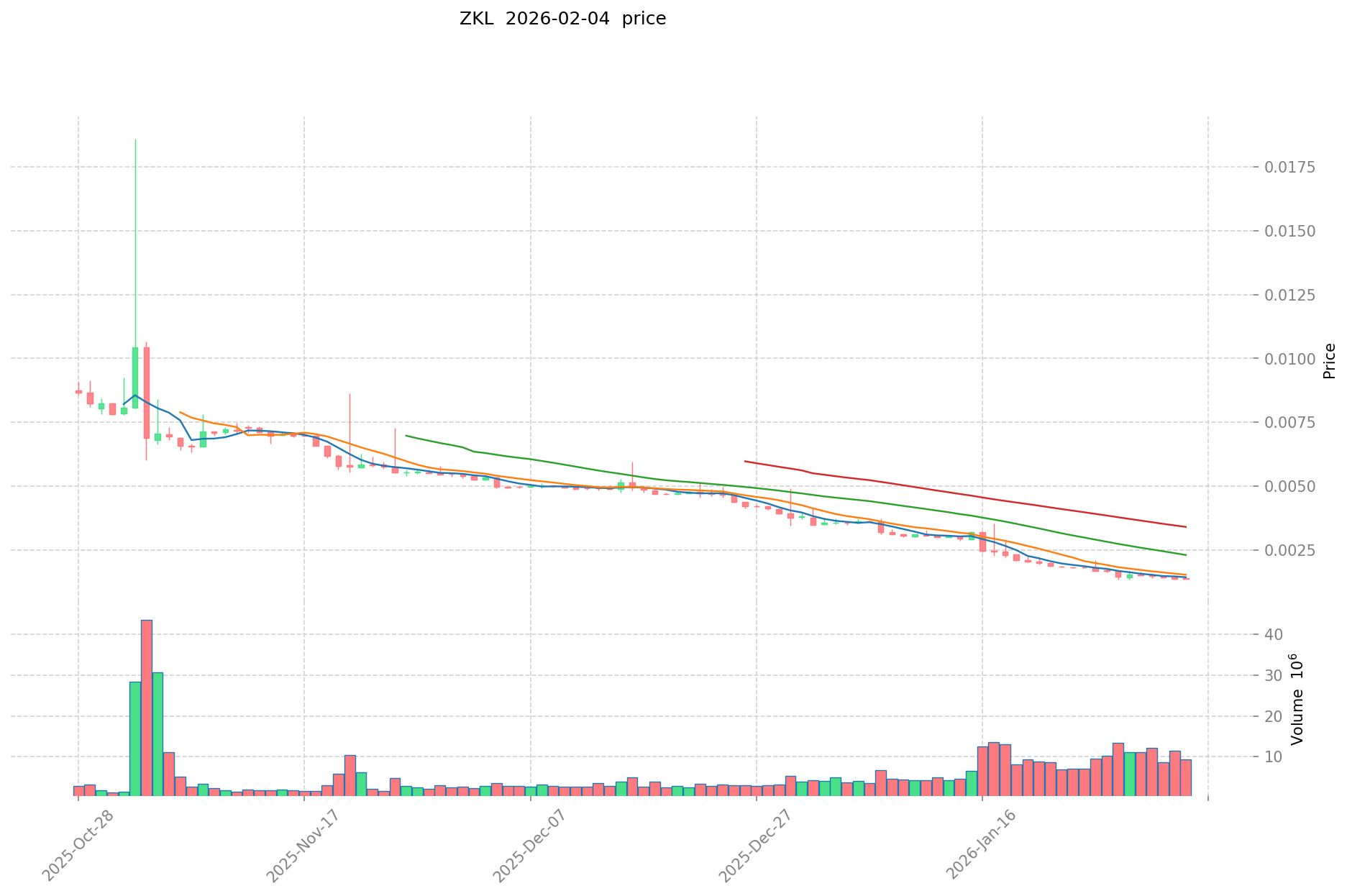
2024: ZKL experienced significant price volatility following its mainnet launch in July 2024, reaching an all-time high of $0.76698 on July 22, 2024. Subsequently, the price declined substantially over the following months.
-
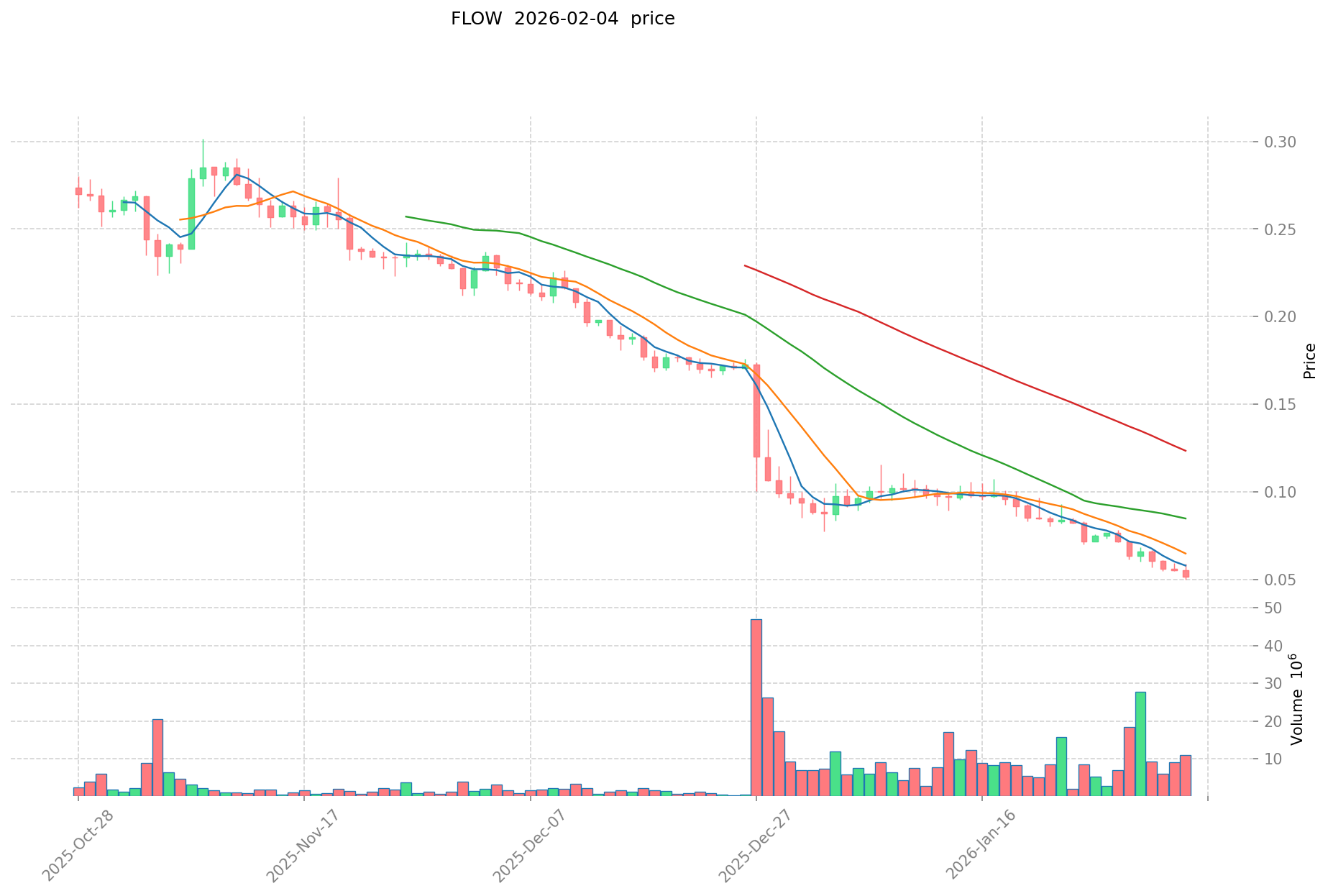
2021: FLOW recorded its all-time high of $42.4 on April 5, 2021, driven by strong market interest in NFT platforms and blockchain gaming applications during the broader crypto bull market cycle.
-
Comparative Analysis: During the 2024-2026 market cycle, ZKL declined from its peak of $0.76698 to a recorded low of $0.001337 on January 28, 2026, representing a decrease of approximately 99.8%. In contrast, FLOW fell from its 2021 high of $42.4 to $0.04818036 on February 4, 2026, marking a decline of approximately 99.9% from its peak.
Current Market Status (February 5, 2026)
- ZKL Current Price: $0.00136
- FLOW Current Price: $0.0507
- 24-Hour Trading Volume: ZKL recorded $17,140.50 compared to FLOW's $313,573.40
- Market Sentiment Index (Fear & Greed Index): 14 (Extreme Fear)
View real-time prices:
II. Core Factors Influencing ZKL vs FLOW Investment Value
Supply Mechanism Comparison (Tokenomics)
-
ZKL: According to available information, zkLink implemented a token unlock delay affecting 40.5% of total ZKL token supply, with unlocking postponed to begin on April 22, 2025. This decision impacts early private round investors, team members, and advisors' token allocation. The delay aims to strengthen the company's position in the competitive Web3 landscape.
-
FLOW: Specific supply mechanism details are not available in the provided materials.
-
📌 Historical Pattern: Token distribution strategies and unlock schedules may influence market perception and price dynamics through supply-side adjustments.
Institutional Adoption and Market Application
-
Institutional Holdings: Information regarding comparative institutional preference between ZKL and FLOW is not available in the provided materials.
-
Enterprise Adoption: Specific details about ZKL or FLOW's applications in cross-border payments, settlements, or investment portfolios are not available in the provided materials.
-
National Policies: Regulatory attitudes from different jurisdictions toward these two projects are not available in the provided materials.
Technology Development and Ecosystem Building
-
ZKL Technology: The unlock delay decision mentioned above was positioned as a strategic move to strengthen zkLink's competitive stance in the Web3 sector, though specific technical upgrade details are not available in the provided materials.
-
FLOW Technology: Information regarding FLOW's technical development and potential impact is not available in the provided materials.
-
Ecosystem Comparison: Details about DeFi, NFT, payment systems, or smart contract implementation for either project are not available in the provided materials.
Macroeconomic Environment and Market Cycles
-
Performance Under Inflation: Comparative anti-inflation characteristics between ZKL and FLOW are not available in the provided materials.
-
Macroeconomic Monetary Policy: Information regarding how interest rates or dollar index movements affect these two projects is not available in the provided materials.
-
Geopolitical Factors: Details about cross-border transaction demand or international situation impacts on either project are not available in the provided materials.
III. 2026-2031 Price Forecast: ZKL vs FLOW
Short-term Forecast (2026)
- ZKL: Conservative $0.00070668 - $0.001359 | Optimistic $0.00070668 - $0.00141336
- FLOW: Conservative $0.0360112 - $0.05072 | Optimistic $0.0360112 - $0.0588352
Medium-term Forecast (2028-2029)
- ZKL may enter a gradual growth phase, with projected price range of $0.001403784486 - $0.002208392667 in 2028, potentially reaching $0.001822951109655 - $0.002136577107015 by 2029
- FLOW may enter a moderate expansion phase, with projected price range of $0.0409736448 - $0.0801396288 in 2028, potentially reaching $0.043522446528 - $0.074409344064 by 2029
- Key drivers: institutional capital inflows, ETF developments, ecosystem expansion
Long-term Forecast (2031)
- ZKL: Baseline scenario $0.00112271148478 - $0.002079095342186 | Optimistic scenario $0.00112271148478 - $0.002224632016139
- FLOW: Baseline scenario $0.06981979678138 - $0.07844920986672 | Optimistic scenario $0.06981979678138 - $0.085509638754724
View detailed price predictions for ZKL and FLOW
Disclaimer
ZKL:
| Year |
Predicted High Price |
Predicted Average Price |
Predicted Low Price |
Price Change |
| 2026 |
0.00141336 |
0.001359 |
0.00070668 |
0 |
| 2027 |
0.0020376846 |
0.00138618 |
0.0008732934 |
1 |
| 2028 |
0.002208392667 |
0.0017119323 |
0.001403784486 |
25 |
| 2029 |
0.002136577107015 |
0.0019601624835 |
0.001822951109655 |
44 |
| 2030 |
0.002109820889115 |
0.002048369795257 |
0.001413375158727 |
50 |
| 2031 |
0.002224632016139 |
0.002079095342186 |
0.00112271148478 |
52 |
FLOW:
| Year |
Predicted High Price |
Predicted Average Price |
Predicted Low Price |
Price Change |
| 2026 |
0.0588352 |
0.05072 |
0.0360112 |
0 |
| 2027 |
0.06573312 |
0.0547776 |
0.053134272 |
7 |
| 2028 |
0.0801396288 |
0.06025536 |
0.0409736448 |
18 |
| 2029 |
0.074409344064 |
0.0701974944 |
0.043522446528 |
37 |
| 2030 |
0.08459500050144 |
0.072303419232 |
0.0686882482704 |
41 |
| 2031 |
0.085509638754724 |
0.07844920986672 |
0.06981979678138 |
53 |
IV. Investment Strategy Comparison: ZKL vs FLOW
Long-term vs Short-term Investment Strategies
-
ZKL: May appeal to investors interested in emerging multi-chain aggregation infrastructure and zero-knowledge technology applications. The project's focus on addressing liquidity fragmentation across blockchain networks positions it within the developing Web3 infrastructure sector. Given its July 2024 launch and subsequent price volatility, ZKL may be considered by investors with higher risk tolerance seeking exposure to early-stage blockchain infrastructure projects.
-
FLOW: May suit investors seeking exposure to established blockchain gaming and NFT platform infrastructure. Launched in September 2020, FLOW has a longer operational history in the market. Its positioning as a platform for next-generation applications and digital assets may attract those interested in the gaming and digital collectibles sectors within the cryptocurrency ecosystem.
Risk Management and Asset Allocation
-
Conservative Investors: A cautious approach might involve limited exposure to either asset, potentially allocating 10-20% to FLOW given its longer market presence, and 5-10% to ZKL given its earlier development stage. The remainder could be allocated to more established cryptocurrencies or traditional assets.
-
Aggressive Investors: Those with higher risk tolerance might consider allocating 30-40% to ZKL for potential upside from infrastructure development, and 25-35% to FLOW for gaming and NFT sector exposure. Such allocations assume acceptance of substantial volatility and potential loss scenarios.
-
Hedging Tools: Portfolio risk management approaches may include: stablecoin allocation for liquidity preservation, derivatives instruments where available for downside protection, and diversification across multiple cryptocurrency sectors to reduce concentration risk.
V. Potential Risk Comparison
Market Risks
-
ZKL: As a relatively new project launched in July 2024, ZKL faces uncertainties related to market acceptance of its multi-chain aggregation solutions. The substantial price decline from its all-time high of $0.76698 to current levels around $0.00136 reflects significant market volatility. Limited trading volume of $17,140.50 as of February 5, 2026, indicates lower liquidity, which may result in increased price sensitivity to large transactions.
-
FLOW: Despite its longer market history since September 2020, FLOW has experienced a considerable decline from its April 2021 peak of $42.4 to current levels around $0.0507. While trading volume of $313,573.40 suggests relatively better liquidity compared to ZKL, the cryptocurrency remains subject to broader market sentiment shifts, particularly those affecting gaming and NFT sectors. Market cycles and shifting investor interest in blockchain gaming applications represent ongoing considerations.
Technical Risks
-
ZKL: The project's reliance on zero-knowledge rollup technology for multi-chain liquidity aggregation introduces technical complexity. Potential challenges may include network scalability as adoption increases, interoperability maintenance across multiple blockchain networks, and the execution of its dual-solution approach (zkLink Nova and zkLink X). The token unlock delay affecting 40.5% of supply, with unlocking beginning April 22, 2025, introduces supply-side dynamics that may influence price behavior.
-
FLOW: As a blockchain platform designed for mainstream application adoption, FLOW faces technical considerations related to network capacity, transaction throughput, and maintaining usability improvements integrated at the protocol layer. The platform's ability to support next-generation games and applications depends on continuous technical development and ecosystem stability.
Regulatory Risks
- Both ZKL and FLOW operate within the evolving global cryptocurrency regulatory landscape. Potential regulatory developments may affect:
- Classification of tokens under securities regulations in various jurisdictions
- Compliance requirements for cross-chain transaction infrastructure (particularly relevant for ZKL's multi-chain aggregation model)
- Gaming and NFT platform regulations (particularly relevant for FLOW's core use cases)
- Tax treatment and reporting requirements for token holders and ecosystem participants
- International coordination on cryptocurrency oversight, which may impact cross-border functionality
VI. Conclusion: Which Is the Better Buy?
📌 Investment Value Summary:
-
ZKL Characteristics: Represents exposure to multi-chain infrastructure development and zero-knowledge technology implementation. The project's focus on liquidity aggregation across blockchain networks addresses a recognized challenge in the fragmented cryptocurrency ecosystem. However, its early development stage, limited trading volume, and substantial price decline from peak levels indicate elevated risk factors.
-
FLOW Characteristics: Offers exposure to blockchain gaming and NFT platform infrastructure with a longer operational track record since September 2020. The platform's design for mainstream adoption and integration of usability improvements at the protocol layer represents its core positioning. Trading volume indicates relatively better liquidity compared to ZKL, though significant price decline from historical peaks remains a consideration.
✅ Investment Considerations:
-
Newer Investors: Those new to cryptocurrency markets should approach both assets with caution given their substantial volatility and decline from peak values. If considering exposure, starting with smaller allocations while developing understanding of market dynamics, project fundamentals, and risk management principles would be prudent. Priority should be given to education and portfolio diversification across multiple asset classes.
-
Experienced Investors: Those with established cryptocurrency market experience may evaluate both projects based on specific thesis alignment. ZKL may fit portfolios seeking infrastructure development exposure, while FLOW may suit those targeting gaming and NFT sector participation. Position sizing should reflect risk tolerance, existing portfolio composition, and recognition of both projects' price history and current market conditions.
-
Institutional Participants: Organizations considering cryptocurrency allocation should conduct comprehensive due diligence including technical architecture assessment, team evaluation, competitive landscape analysis, and regulatory compliance review. Both projects present distinct risk-return profiles requiring evaluation against institutional investment criteria, liquidity requirements, and fiduciary responsibilities.
⚠️ Risk Notice: The cryptocurrency market exhibits extreme volatility. Both ZKL and FLOW have experienced substantial price declines from historical peaks, with ZKL declining approximately 99.8% and FLOW declining approximately 99.9% from their respective highs. Current market sentiment indicators show "Extreme Fear" conditions. This analysis does not constitute investment advice. All cryptocurrency investments carry risk of partial or total capital loss. Individuals should conduct independent research, consider their financial situation, and consult qualified advisors before making investment decisions.
VII. FAQ
Q1: What are the main differences between ZKL and FLOW's core technologies?
ZKL focuses on multi-chain liquidity aggregation using zero-knowledge rollup (ZK-Rollup) technology, while FLOW is a Layer-1 blockchain designed for gaming and NFT applications with usability improvements integrated at the protocol layer. ZKL addresses liquidity fragmentation across different blockchain networks through its zkLink Nova and zkLink X solutions, enabling unified liquidity access across connected chains. FLOW, developed by creators of popular applications on existing encrypted networks, prioritizes mainstream adoption through its protocol-level design optimizations. The fundamental distinction lies in their purposes: ZKL serves as infrastructure for cross-chain interoperability, whereas FLOW functions as a complete blockchain platform for decentralized applications.
Q2: How do the tokenomics of ZKL and FLOW differ?
ZKL implemented a token unlock delay affecting 40.5% of total supply, with unlocking postponed to begin on April 22, 2025, impacting early private round investors, team members, and advisors. This strategic decision aims to strengthen the project's competitive position in the Web3 landscape and may influence supply-side dynamics. Unfortunately, specific supply mechanism details for FLOW are not available in the provided materials, limiting direct tokenomics comparison. The ZKL unlock schedule represents a significant consideration for potential investors, as the substantial delayed supply entering circulation could impact price behavior depending on market conditions at the time of unlock.
Q3: Which project has better liquidity and trading volume?
FLOW demonstrates significantly better liquidity with a 24-hour trading volume of $313,573.40 compared to ZKL's $17,140.50 as of February 5, 2026. This approximately 18x difference in trading volume indicates that FLOW offers easier entry and exit opportunities with potentially lower slippage for transactions. Higher liquidity generally reduces price impact from individual trades and may indicate broader market participation. However, both projects currently show relatively limited trading volumes compared to major cryptocurrencies, suggesting that investors should exercise caution regarding order size and execution strategy. Lower liquidity environments can result in increased price volatility and wider bid-ask spreads.
Q4: What are the price performance trajectories of ZKL and FLOW from their peaks?
Both projects have experienced severe price declines from their respective all-time highs. ZKL declined approximately 99.8% from its peak of $0.76698 (July 22, 2024) to $0.00136 (current price), while FLOW fell approximately 99.9% from its high of $42.4 (April 5, 2021) to $0.0507 (current price). ZKL's decline occurred over a shorter timeframe following its July 2024 mainnet launch, whereas FLOW's decline spans nearly five years since its 2021 peak during the NFT and gaming boom. These substantial drawdowns reflect broader cryptocurrency market cycles, sector-specific challenges, and project-specific factors. The extreme price declines underscore the high-risk nature of both investments.
Q5: What are the projected price ranges for ZKL and FLOW by 2031?
Based on available forecasts, ZKL's 2031 price projections range from $0.00112271148478 (low) to $0.002224632016139 (high), representing potential appreciation of approximately 52% from current levels under baseline scenarios. FLOW's 2031 projections range from $0.06981979678138 (low) to $0.085509638754724 (high), suggesting potential growth of approximately 53% from current prices. These long-term forecasts assume continued ecosystem development, institutional adoption, and favorable market conditions. However, cryptocurrency price predictions carry substantial uncertainty, and actual outcomes may vary significantly from projections due to market dynamics, competitive developments, regulatory changes, and macroeconomic factors that cannot be fully anticipated.
Q6: Which project is more suitable for conservative investors?
Neither ZKL nor FLOW would typically be considered appropriate for conservative investors given their extreme volatility, substantial historical price declines, and current market conditions showing "Extreme Fear" sentiment. However, if a conservative investor seeks limited cryptocurrency exposure, FLOW may present relatively lower risk due to its longer operational history (since September 2020), higher trading liquidity, and established presence in the blockchain gaming sector. A cautious approach might involve allocating only 10-20% of cryptocurrency portfolio allocation to FLOW, and 5-10% to ZKL given its earlier development stage. Conservative investors should prioritize capital preservation through diversification across asset classes, with cryptocurrency representing only a small portion of overall portfolio allocation.
Q7: What are the primary regulatory risks facing ZKL and FLOW?
Both projects face evolving regulatory challenges across multiple jurisdictions. Key regulatory considerations include potential classification of their tokens under securities regulations, which could impose registration and compliance requirements. For ZKL, its cross-chain transaction infrastructure may attract scrutiny regarding anti-money laundering (AML) and know-your-customer (KYC) compliance, particularly as multi-chain transactions could complicate regulatory oversight. FLOW's focus on gaming and NFT platforms may face specific regulations targeting digital collectibles, in-game assets, and gambling-related activities in various jurisdictions. Both projects must navigate international coordination on cryptocurrency oversight, tax treatment variations, and reporting requirements that differ across countries. Regulatory developments could significantly impact operational capabilities, user accessibility, and market valuation.
Q8: How do market cycles affect ZKL versus FLOW differently?
Market cycles impact ZKL and FLOW through different sectoral exposures. ZKL's performance correlates with broader infrastructure development trends, institutional adoption of cross-chain solutions, and general market appetite for Web3 innovation. As a newer project launched during the 2024 cycle, ZKL has yet to experience a complete bull-bear cycle, making its response patterns less established. FLOW's performance historically tied to NFT and blockchain gaming enthusiasm, sectors that experienced significant boom-bust dynamics during 2021-2022. FLOW may benefit from gaming sector recoveries and renewed NFT market interest, while remaining vulnerable to shifts in consumer preferences and competitive pressures from alternative gaming platforms. Both projects remain susceptible to broader cryptocurrency market sentiment, Bitcoin price movements, and macroeconomic conditions affecting risk asset allocation.
* The information is not intended to be and does not constitute financial advice or any other recommendation of any sort offered or endorsed by Gate.