Latest Overview of the 2026 Crude Oil Market
As 2026 begins, global energy markets are once again in the spotlight due to escalating geopolitical tensions. In early March, military actions by the United States and Israel against Iran led to a rapid escalation of regional conflict, immediately disrupting the global oil supply chain. This expansion of hostilities caused international oil prices to spike sharply in a short period.
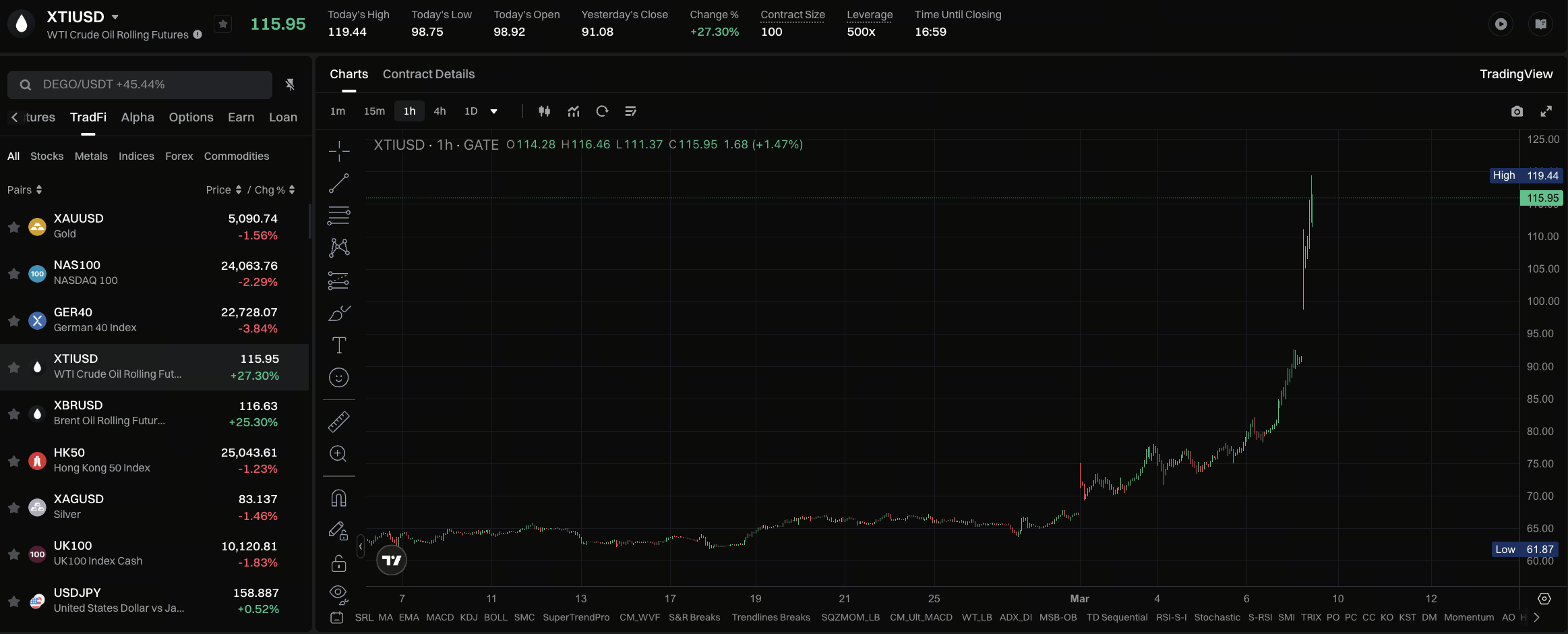
Data from Gate Markets indicates that the international benchmark Brent crude price briefly exceeded $110 per barrel—a multi-year high—and approached $117 in some trading sessions. Simultaneously, concerns over supply disruptions intensified. Several Middle Eastern oil producers cut output due to security threats, some oil and gas facilities were attacked, and global oil transport operations were impacted.
In just a matter of days, oil prices surged by over 20%, underscoring the energy market’s acute sensitivity to geopolitical risk. However, from a full-year perspective, oil price trends remain highly uncertain. The current rally primarily reflects a risk premium rather than a fundamental shift in long-term supply-demand dynamics.
Middle East Conflict: The Core Driver Behind Oil Price Spikes
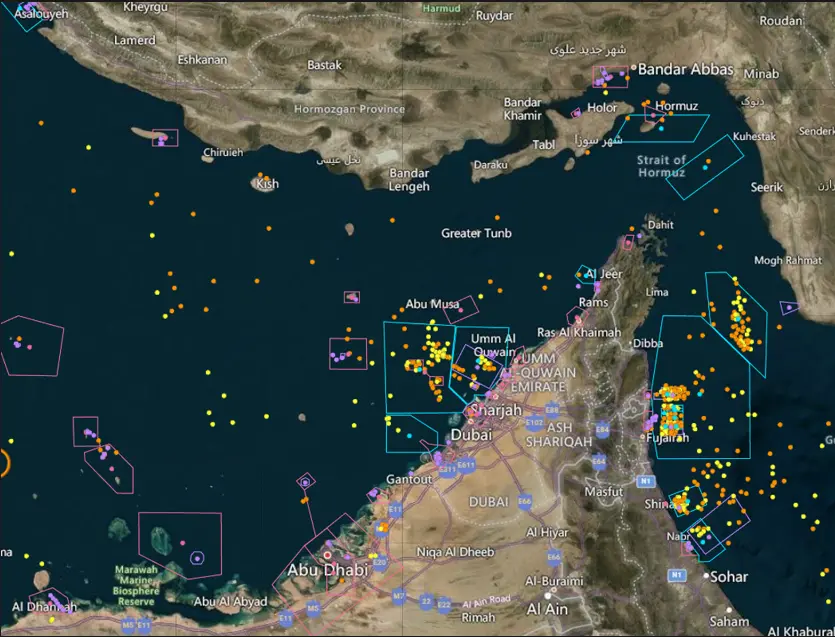
The direct catalyst for this oil surge is the disruption of the energy supply chain due to military conflict in the Middle East. The region has long been central to global oil supply—especially the vital Strait of Hormuz, which handles roughly 20% of the world’s oil shipments. Any interruption in this passage rapidly reverberates through global energy markets.
The most pressing concerns currently include:
-
Shipping restrictions in the Strait of Hormuz
-
Attacks on oilfields or refineries in the Gulf region
-
Forced reductions in regional oil and gas production
-
Sharp increases in tanker insurance and shipping costs
Some shipping firms have already suspended tanker traffic through the strait, causing notable strain across the global oil logistics network.
Historically, geopolitical conflict has been a key driver of short-term oil price surges, as seen in events such as:
The market environment in 2026 is, to some extent, mirroring these characteristics.
Supply & Demand: The Underlying Fundamentals for Medium- and Long-Term Oil Prices
While geopolitics fuel short-term price spikes, medium- and long-term crude prices are still dictated mainly by supply and demand fundamentals.
On the supply side, global oil production continues a gradual recovery:
-
U.S. shale output remains on an upward trend
-
OPEC+ retains a degree of spare capacity
-
Non-OPEC countries are expanding production
On the demand side, global economic growth remains the key variable.
International research indicates that if worldwide economic growth remains steady, oil demand will continue to rise in 2026, albeit at a slower pace than the previous decade.
Additionally, the ongoing energy transition and expansion of renewables are gradually eroding oil’s long-term demand growth potential.
Viewed structurally, the current rally is primarily a short-term swing driven by geopolitical risk.
Institutional Consensus Forecasts for 2026 Oil Prices
Before the recent escalation, most institutions maintained a cautious outlook on 2026 oil prices.
According to multiple industry surveys, analysts generally expect:
Some investment banks even suggest that, should global supply continue to grow, prices could remain in a relatively moderate range throughout 2026.
For example, certain forecasts put the annual average price of Brent crude near $60 per barrel.
This suggests that oil prices above $100 today are likely a transient spike driven by short-term events.
Three Scenarios: Paths to $70, $120, and $150 Oil
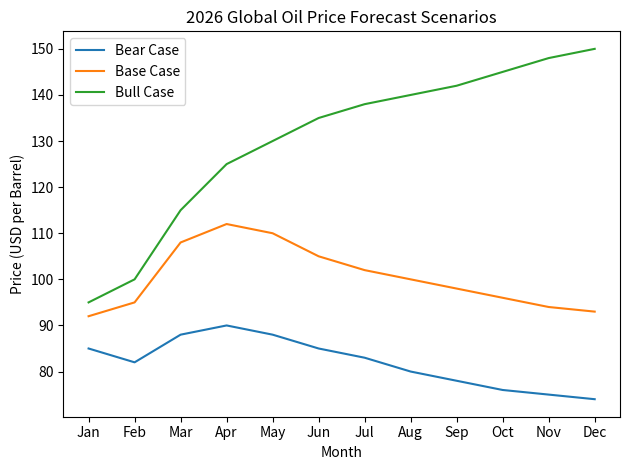
Synthesizing current market conditions, three potential scenarios for oil prices emerge.
Scenario 1: Easing Conflict ($70–90)
If tensions in the Middle East de-escalate in the coming months:
Oil prices could gradually return to the $70–90 range. Most institutions view this as the neutral base case.
Scenario 2: Prolonged Conflict ($100–120)
If the conflict persists without further escalation:
-
Ongoing disruptions to Middle East supply
-
Rising transportation costs
-
Sustained market risk premium
Oil prices may hold in the $100–120 range for an extended period. In this scenario, global inflationary pressure would intensify.
Scenario 3: Supply Crisis ($150+)
In the event of an extreme outcome, such as:
-
A prolonged closure of the Strait of Hormuz
-
Production interruptions across multiple oil producers
-
A widening global supply gap
Oil prices could break above $150, and in extreme cases, even approach $200. However, this scenario remains relatively unlikely.
Impact of Oil Price Surges on the Global Economy & Financial Markets
Rising oil prices affect more than just the energy sector—they trigger broad ripple effects across the global economy.
-
Inflation pressure: Higher energy costs drive up transportation and manufacturing expenses, which ultimately impact consumer prices.
-
Economic growth risk: Elevated oil prices may suppress consumption and industrial activity.
Financial markets also react, for example:
-
Heightened stock market volatility
-
Gains in energy sector equities
-
Downward pressure on airlines and transportation stocks
Recently, such trends have already been observed, with notable declines in U.S. equity futures and Asian markets following the oil price rally.
Investment & Market Risk Advisory
Despite the recent surge in oil prices, a rational and measured outlook remains essential.
-
Geopolitical events are highly unpredictable—conflict can escalate quickly or de-escalate just as fast.
-
Higher oil prices often incentivize increased supply. When prices are elevated, shale producers and OPEC members typically boost output, capping further price increases.
-
High prices can also destroy demand; if energy costs become excessive, the global economy may slow, reducing oil consumption.
Thus, short-term volatility does not necessarily reflect a long-term trend. Investors should remain vigilant regarding:
-
Sudden geopolitical shocks
-
The risk of global economic recession
-
Shifts in energy policy
-
Price swings fueled by speculative capital
Conclusion
The 2026 crude oil market stands at a highly uncertain juncture. In the short term, Middle East tensions have fueled a notable risk premium, pushing prices above $100. Over the full year, however, supply and demand fundamentals may bring prices back to more sustainable levels.
Future oil price trends will hinge on three critical factors: geopolitical developments, the global economic cycle, and the speed at which supply recovers. Until these variables gain clarity, the crude oil market is likely to remain highly volatile.







