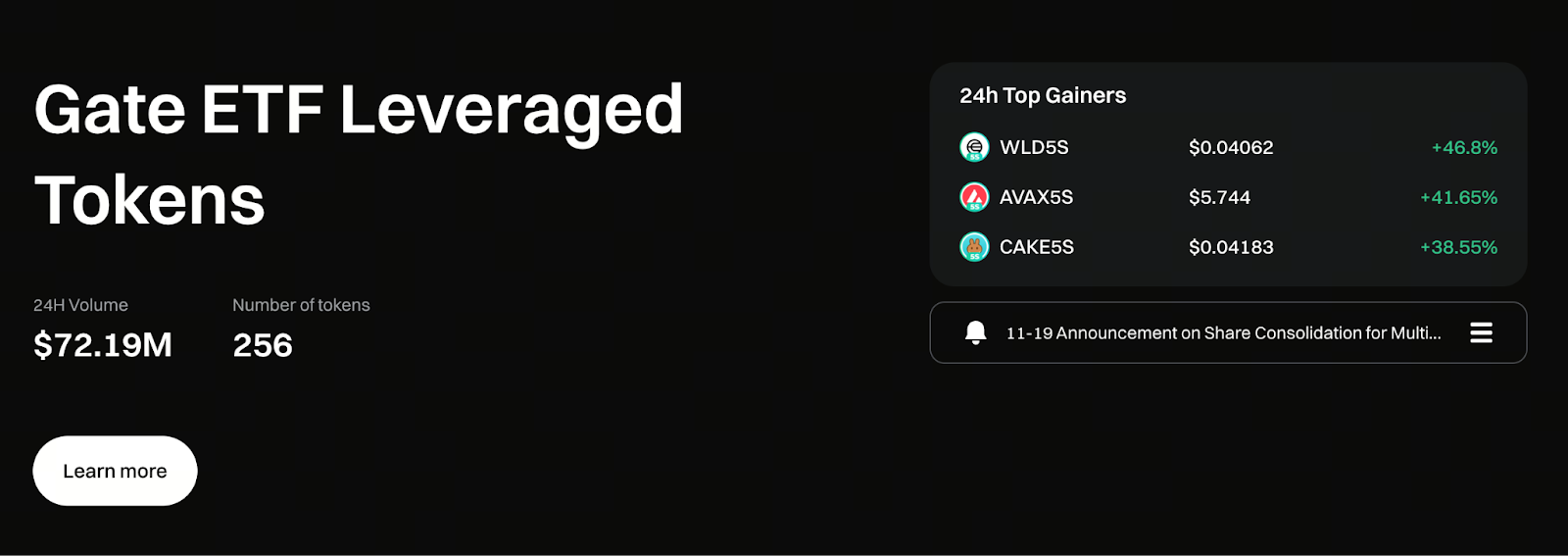
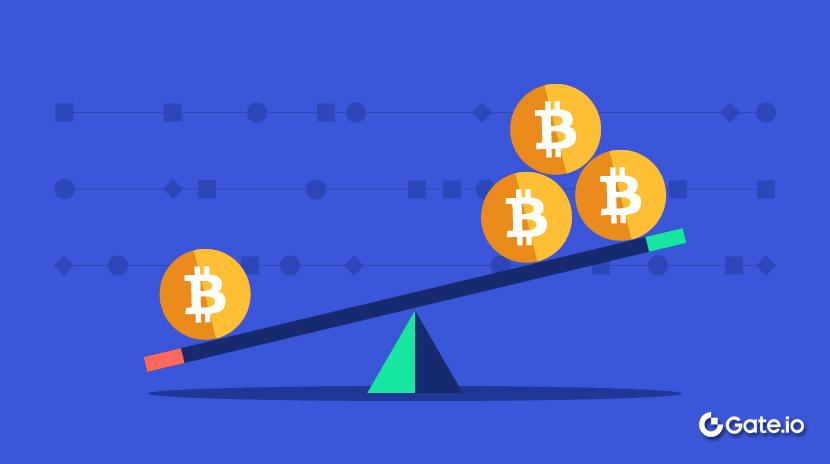
Leveraged ETFs have progressed from simple index trackers to sophisticated strategy instruments. They maintain a fixed leverage multiple—such as 3x or 5x—by managing positions in perpetual contracts. This structure enables users to magnify asset price movements through spot trading, eliminating the need for borrowing or margin maintenance and effectively mitigating the risk of forced liquidation.
Gate Leveraged ETFs and the Evolution of ETFs
ETFs were originally designed to bundle various assets into a single tradable product, enabling investors to diversify risk, track the market, and reduce transaction costs by trading them like stocks. As market strategies have grown more diverse, investors have sought more than passive tracking. Products with directional exposure and leverage have gained popularity, bringing leveraged ETFs into the mainstream.
What Are Gate Leveraged ETF Tokens?
Gate’s Leveraged ETF Tokens are derivatives that maintain a fixed leverage ratio using perpetual contract positions. Unlike traditional contracts, you don’t need to manage margin, adjust leverage, or handle positions yourself—the system automates all of these processes. By simply buying or selling spot tokens, you gain leveraged exposure without facing the common risk of liquidation found in contract trading.
Maintaining leverage through perpetual contract positions
Each leveraged ETF token is backed by a corresponding perpetual contract position, ensuring products maintain fixed leverage such as 3x or 5x.
Daily system rebalancing
The system automatically adjusts positions when the market moves, restoring leverage to the target level and preventing drift caused by volatility.
Simple, spot-like trading
Trading is as straightforward as spot transactions, with no need to use any contract interfaces, greatly reducing the barrier to entry.
Daily management fee deduction
The platform deducts a 0.1% management fee daily to cover rebalancing, hedging, and transaction costs.
Four Key Advantages of Using Gate Leveraged ETFs
Amplify market trends
When market direction is clear, leverage can significantly boost returns.
Eliminate liquidation risk
The system maintains all positions, so you won’t be forced to liquidate due to insufficient margin.
Built-in compounding effect
When the market moves in your favor, the rebalancing mechanism increases positions, allowing returns to compound over time.
User-friendly leveraged tool
Trading is just like spot trading, with no need for borrowing or complex contract operations, making leveraged ETFs one of the most accessible products for beginners.
Potential Risks of Leveraged ETFs
Magnified volatility
Losses, like gains, are also amplified by leverage.
Value erosion in sideways markets
Rebalancing in range-bound markets can increase costs and lead to subpar long-term performance.
Leverage returns may not be perfectly proportional
Due to rebalancing frequency and market volatility, actual performance may differ from the “expected multiple.”
Costs reduce final returns
This includes daily management fees, hedging expenses, and rebalancing transaction fees.
Leveraged ETFs are better suited for short-term or trending markets and are not recommended for long-term holding.
Purpose of the Management Fee
To maintain leverage, the platform must rebalance, hedge, and trade in perpetual contract markets, which incurs the following costs:
Contract transaction fees
Funding rates
Slippage
The daily 0.1% fee charged by Gate covers these operational costs. This rate is relatively low compared to similar products, and the platform absorbs some of these costs itself.
Summary
Leveraged ETFs let users participate in amplified market moves without engaging in complex contract trading or facing liquidation risk. They offer intuitive operation, fixed leverage, and transparent costs, but also carry risks like amplified volatility and value erosion from rebalancing. If you want to boost returns in clear trends or short-term strategies, leveraged ETFs are a simplified tool, but they still require careful use.
Author: Allen
Disclaimer
* The information is not intended to be and does not constitute financial advice or any other recommendation of any sort offered or endorsed by Gate.
* This article may not be reproduced, transmitted or copied without referencing Gate. Contravention is an infringement of Copyright Act and may be subject to legal action.
Fartcoin (FARTCOIN) is a representative meme coin within the Solana ecosystem based on an AI-driven narrative. Its core concept originated from an experiment aimed at exploring the "boundaries between AI Agents and humor." More than just a digital asset with social attributes, the project deeply couples absurd humor culture with on-chain financial logic by integrating autonomous AI interaction models.
Analyze current gold price trends alongside authoritative five-year forecasts, integrating an evaluation of market risks and opportunities. This gives investors insight into the potential trajectory of gold prices and the main drivers expected to shape the market over the next five years.
MetFi is a decentralized metaverse and web3 incubator that utilizes NFTs to share investment returns with MetFi NFT holders and members of its community. As of 2025, MetFi trades at $0.225266 USD with a $47.7M market cap, offering AI-driven trading, blockchain learn-to-earn games, and ERC-404 airdrops through its Marine Moguls project for early claim rights to promising Web3 startups.
ETF leveraged tokens are derivatives that enable investors to boost their profits using leverage, while eliminating liquidation risk. These products trade just like spot assets, but deliver the amplified returns typically associated with leveraged contracts. Even if users misjudge market trends, liquidation does not occur, making ETF leveraged tokens much more accessible for mainstream participants.
In 2025, crypto ETFs expanded to alternative assets such as Solana, XRP, and DOGE, with mainstream asset management firms rushing to submit applications. This article provides a detailed analysis of the current status of ETF applications, the likelihood of approval, and their potential impact, outlining the key path for crypto assets to integrate into the traditional financial system.
This week, BTC prices hit multiple new highs, reaching a 7-day peak of $94,643.6, with buying pressure continuing to strengthen. ETH showed relative weakness, with a weekly decline of 4.93%, remaining in a weak oscillating trend overall. Crypto asset management company Bitwise registered a Solana ETF in Delaware, USA, following its earlier application for an XRP ETF. USDT's market cap surpassed $130 billion, marking a historical high and reflecting increased capital inflow into the crypto market. Cryptocurrency lending platform Polter Finance suffered a hacker attack, resulting in a $12 million loss. Meanwhile, the crypto gambling platform Monkey Tilt completed a $30 million financing round, led by Pantera Capital.