Bitcoin “Diamond Hands” Selling Hits a Record High as Research Warns: The Extreme Bull Runs of 2017 and 2021 Are Unlikely to Repeat
What Are Diamond Hands
Diamond Hands is a widely used term in the crypto market, describing long-term, unwavering holders—those who choose not to sell their assets easily, even during sharp price swings and dramatic shifts in market sentiment.
This idea is often contrasted with Paper Hands, which refers to short-term participants who quickly sell their assets during downturns or periods of panic.
In bull market cycles, Diamond Hands behavior becomes especially significant, as concentrated movements by long-term holders are often seen as a major signal of a market turning point.
With advanced on-chain analytics tools, research institutions can track the flow of old coins entering circulation by analyzing UTXO age distribution and the reactivation of long-dormant coins. This enables a quantitative assessment of Diamond Hands behavior, moving beyond mere sentiment analysis.
2024–2025: Why Diamond Hands Selling Reached Record Highs
CryptoQuant’s latest on-chain research shows that during 2024–2025, the amount of bitcoin held for over two years that re-entered the market and was sold hit an all-time high.
Data indicates that once BTC broke above approximately $40,000, a large volume of long-dormant bitcoin was activated and sent to exchanges or settlement venues. This trend has persisted, not appeared sporadically, drawing attention to shifts in long-term holder behavior.
The research suggests this is more about long-term investors reassessing their risk exposure, rather than speculative selling driven purely by price sentiment.
This distinction matters, since traditionally, large-scale selling by Diamond Hands is viewed as a sign that a bull market is ending. But today’s market environment differs markedly from previous cycles.
Key Differences from the 2017 and 2021 Bull Markets
In the 2017 and 2021 bitcoin bull markets, the market shared several consistent features:
- Prices rose exponentially within a short period
- Retail FOMO sentiment reached extreme levels
- Media and social platforms relentlessly amplified the “new high” narrative
- This led to the classic “rapid surge—sharp correction” market cycle
By contrast, the current environment for Diamond Hands selling is distinctly different:
First, price volatility is much lower: the market is mostly consolidating and trading within ranges, without the extreme upward moves seen in past cycles.
Second, speculative fervor has cooled: search trends, social media buzz, and retail participation have not reached the overheated levels typical of late-stage bull markets.
Third, selling is happening at earlier price levels: long-term holders began selling around $40,000, rather than waiting for cycle peaks.
These differences show that today’s selling behavior reflects changes in market structure, not just a repeat of previous bull runs.
Evolving Mindset Among Long-Term Holders
Diamond Hands selling does not necessarily mean a market bubble is bursting; it may actually signal more mature investment behavior.
Many long-term holders have extremely low cost bases and, after multiple market cycles, have realized several times or even orders of magnitude in paper gains. Choosing to take profits in stages is a rational approach to asset management.
After weathering multiple bull and bear cycles, investors now have a stronger grasp of the risks associated with sharp corrections. They’re more likely to take profits in batches and adjust positions dynamically, rather than holding indefinitely and relying on market sentiment.
Compared to the old “just buy, never sell” narrative, today’s long-term holders put more emphasis on asset allocation and risk control, not emotional conviction holding.
Objective Assessment of Future Trends
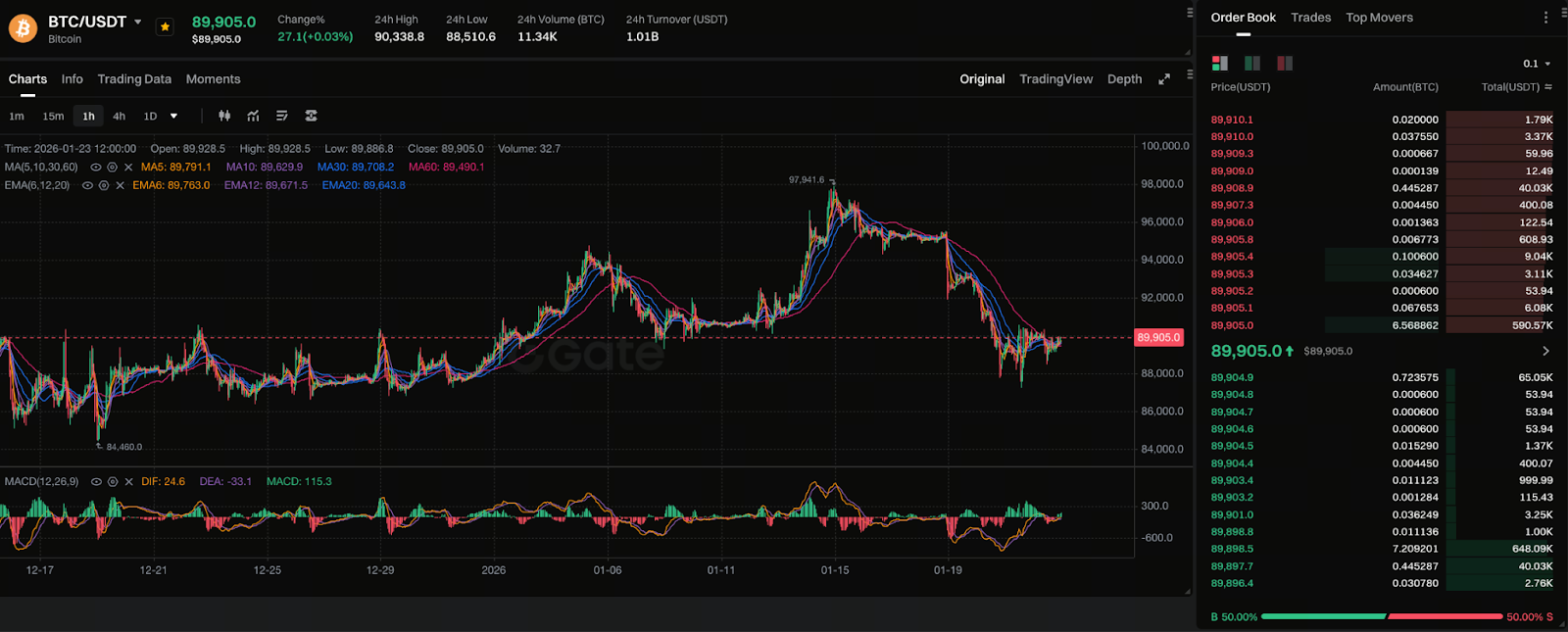
Chart: https://www.gate.com/trade/BTC_USDT
The latest on-chain data shows Diamond Hands selling has eased from the 2024–2025 peak, but hasn’t fully reversed.
Looking ahead to 2026, the market could take one of two paths:
- Begin a new mid-term accumulation phase, with institutions and long-term capital gradually absorbing circulating supply
- Or experience short-term, episodic volatility due to supply-demand mismatches
Analysis shows that determining market direction requires a holistic approach, not reliance on any single indicator:
- On-chain fund flows
- Exchange reserve changes
- Derivatives positions and leverage structure
- Macro liquidity and policy environment
Interpreting Diamond Hands behavior in isolation can lead to oversimplified conclusions.
How Investors Should Interpret On-Chain Signals
On-chain data is a vital tool for understanding market structure, but it is fundamentally descriptive—not a direct trading signal.
Diamond Hands selling may reflect rational profit-taking or shifting risk appetite, but its significance must be considered within the broader market context. When making investment decisions, it’s essential to factor in price trends, macro environment, and your own risk tolerance.
Conclusion
The bitcoin market continues to evolve, with participant structure, sources of capital, and behavioral logic all now different from earlier stages. Historical cycles provide useful reference points, but will not be mechanically repeated. At this stage, understanding why long-term holders act is more important than simply judging whether they act.
Share
Content


Related Articles

Gold Price Forecast for the Next Five Years: 2026–2030 Trend Outlook and Investment Implications, Could It Reach $6,000?

Crypto Future Profit Calculator: How to Calculate Your Potential Gains

Crypto Futures Calculator: Easily Estimate Your Profits & Risks

What is Oasis Network (ROSE)?

The $50M Crypto Scam Nobody Is Talking About