Buy Signals in a Major Market Crash — Rich Dad Poor Dad Author on Gold, Silver, and Bitcoin
I. Why Kiyosaki Continues to Warn of an “Ultimate Market Crash”
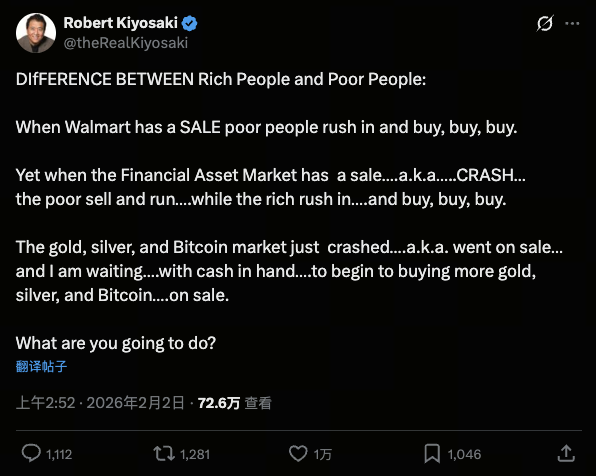
Image: https://x.com/theRealKiyosaki/status/2018034648262324254
Robert Kiyosaki, author of “Rich Dad Poor Dad,” is recognized for his outspoken and radical macroeconomic stances. Recently, he reiterated his warning through public channels that the global financial system is nearing a structural collapse, and confirmed he is actively preparing to increase his holdings in gold, silver, and Bitcoin.
According to Kiyosaki, today’s global economic challenges stem not from cyclical recessions but from the compounded risks of high debt, elevated inflation, and persistent erosion of monetary credit. He has repeatedly criticized governments for their prolonged reliance on loose monetary policies, expanding balance sheets to sustain growth. This approach undermines fiat currency purchasing power and fosters systemic instability in highly leveraged environments.
II. Macroeconomic Factors Behind Gold, Silver, and Bitcoin Pullbacks
Recent market trends show that gold, silver, and Bitcoin have all experienced varying degrees of price corrections. High interest rates have temporarily suppressed non-yielding assets, while declining global risk appetite has led capital to seek defensive positions, triggering concentrated short-term selling pressure.
Kiyosaki maintains that these adjustments do not signal a reversal in the broader trend, but rather represent normal fluctuations within a long-term cycle. He consistently emphasizes that the most attractive asset allocation opportunities often emerge when market sentiment is at its lowest and high-quality assets face heavy sell-offs.
III. The “Hard Asset” Thesis and Kiyosaki’s Long-Term Outlook
Kiyosaki’s assessments of gold, silver, and Bitcoin are rooted in the “hard asset” thesis.
He asserts that gold and silver possess intrinsic scarcity and enduring monetary properties, serving as value anchors amid ongoing fiat depreciation. Bitcoin, in turn, is viewed as a scarce digital asset, with its fixed issuance mechanism imparting “digital gold” characteristics.
Kiyosaki has previously issued highly aggressive long-term price targets, sparking widespread debate. It is important to note that these projections reflect his views on the trajectory of the monetary system rather than precise short-term price forecasts.
IV. Current Price Levels in Historical Context
Historically, gold and silver tend to attract renewed investor interest during financial crises, periods of high inflation, or when monetary credit is impaired. Bitcoin, since its inception, has repeatedly rebounded strongly after deep corrections.
From this perspective, current prices remain well below historical highs, forming part of the rationale behind Kiyosaki’s “discount zone” concept. However, historical data also shows that declines are often accompanied by sharp volatility, and there is no absolute certainty in identifying the optimal entry point.
V. How Individual Investors Should Approach “Crash Buying” Rationally
For individual investors, Kiyosaki’s views are best used as a macroeconomic framework rather than direct trading instructions. More prudent approaches include phased allocation, diversified asset portfolios, and careful assessment of personal risk tolerance and liquidity needs.
Overall, there is ongoing debate over whether the market is truly on the verge of a systemic crash. Nevertheless, Kiyosaki’s perspective on hard assets and monetary credit offers investors a long-term outlook and encourages market participants to reexamine the fundamental logic of asset allocation.
Share
Content
I. Why Kiyosaki Continues to Warn of an “Ultimate Market Crash”
II. Macroeconomic Factors Behind Gold, Silver, and Bitcoin Pullbacks
III. The “Hard Asset” Thesis and Kiyosaki’s Long-Term Outlook
IV. Current Price Levels in Historical Context
V. How Individual Investors Should Approach “Crash Buying” Rationally


Related Articles

Gold Price Forecast for the Next Five Years: 2026–2030 Trend Outlook and Investment Implications, Could It Reach $6,000?

Crypto Future Profit Calculator: How to Calculate Your Potential Gains

Crypto Futures Calculator: Easily Estimate Your Profits & Risks

What is Oasis Network (ROSE)?

The $50M Crypto Scam Nobody Is Talking About