Gate Leveraged ETFs Reimagined: From Passive Exposure to Active Strategy
ETFs Evolve with Shifting Market Dynamics
Historically, ETFs have been regarded as instruments that lower trading frequency. Their primary value lies in risk diversification and volatility smoothing, enabling investors to access markets with minimal intervention. As the market landscape shifts toward heightened volatility and rapid, short-term reversals become commonplace, the traditional approach of trading time for returns can no longer satisfy traders who demand efficiency and precise timing.
In this changing environment, capital management is no longer just about how long you hold an asset—it’s about your ability to adjust exposure instantly. ETFs are no longer limited to passive allocation; they’re being reimagined and restructured as tools for executing active trading strategies.
Leveraged ETFs Fill the Gap Between Spot and Derivatives
In fast-moving markets, single-exposure spot positions often fail to capture the full value of trading insights, while derivatives trading comes with steep learning curves and immediate risk controls. Leveraged ETFs sit perfectly between these two—they retain the familiar mechanics of spot trading but allow price movements to have a greater impact on capital. For most traders, leveraged ETFs aren’t a replacement for spot or derivatives; instead, they serve as amplification tools that balance intuitive trading with strategic efficiency.
Key Design Features of Gate Leveraged ETF Tokens
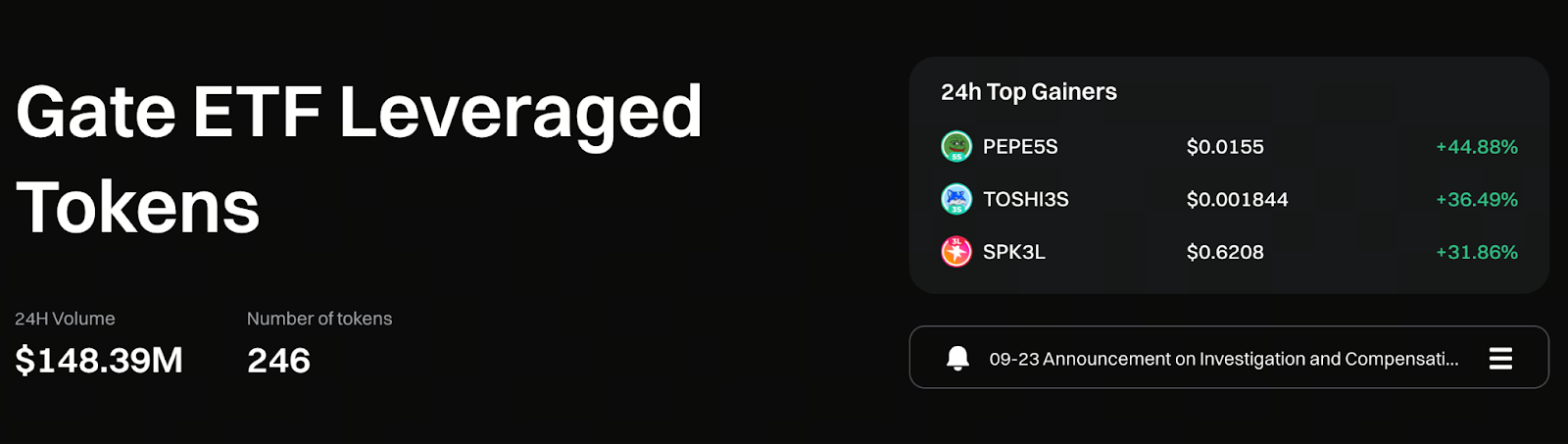
Gate Leveraged ETF tokens derive their actual exposure from corresponding perpetual contract positions, all managed automatically by the system. This means users experience trading much like regular token transactions, without the complexities of derivatives trading.
Within this framework, traders are relieved from handling:
- Margin and maintenance calculations
- Forced liquidation risk management
- Loan and funding rate fluctuations
- Position adjustments and rebalancing timing
Start trading Gate ETF leveraged tokens now: https://www.gate.com/leveraged-etf
Rebalancing Mechanisms Sustain Leveraged Exposure
Leveraged ETFs are dynamic by design. To keep actual exposure within the intended leverage range, the system regularly rebalances underlying contract positions. These adjustments are seamless for users but are essential for the product’s long-term viability. As a result, leveraged ETFs operate as continuously running dynamic strategies, not just simple price multipliers. Their performance depends on market trends and volatility patterns, allowing traders to focus on the most important questions: Is there a trend, and are entry and exit points well-timed?
Amplify Market Participation Without Using Derivatives
For some traders, the main challenge isn’t leverage itself, but the need for constant, real-time risk management in derivatives trading. Leveraged ETFs don’t eliminate risk—they translate it into a more intuitive form, with price fluctuations directly impacting the token’s net asset value.
This design frees traders from facing liquidations or forced closures, letting them refocus on trend analysis and capital allocation while reducing psychological stress from operational management.
Capital Efficiency Grows as Market Direction Clarifies
In trending or clearly directional markets, leveraged ETFs can magnify price movements, boosting capital efficiency over the same time frame. With rebalancing mechanisms in place, these products may achieve a compounding effect in trending markets. That’s why leveraged ETFs are often used as transitional tools before moving to full leverage strategies—they let traders test their risk tolerance without taking on the full risk management burden of derivatives from the start.
Structural Limitations Every Trader Should Know
Leveraged ETFs aren’t advantageous in all market conditions. In choppy, trendless markets, rebalancing mechanisms can gradually erode net asset value, causing actual performance to diverge from expectations. Final returns aren’t simply the underlying asset’s price change multiplied by the leverage factor—trading costs, volatility, and price paths all play a role. For this reason, leveraged ETFs are generally not considered suitable for long-term holding.
Daily Management Fee: Purpose and Function
Gate Leveraged ETFs charge a daily management fee of 0.1% to cover the essential costs of stable operations, including:
- Opening and closing perpetual contract positions
- Funding rate expenses
- Hedging and position adjustment costs
- Slippage during rebalancing
These fees aren’t an added burden—they’re fundamental to ensuring the structural stability of leveraged ETFs over the long term.
Best Practices for Leveraged ETF Usage
Leveraged ETFs are not passive investment vehicles. They’re designed as strategy execution modules, best suited for traders with clear market outlooks, defined entry and exit plans, and the ability to handle short-term volatility—not for buy-and-hold investing. Only by fully understanding their structure, costs, and intended use cases can traders unlock the true capital efficiency benefits of leveraged ETFs.
Conclusion
Leveraged ETFs don’t make trading easier—they make strategy execution more direct. They amplify both price swings and the impact of every decision. For traders who can keep pace with the market and proactively manage risk, Gate Leveraged ETFs are powerful tools for enhancing capital efficiency. But overlooking their structural features and cost implications can lead to taking on more risk than expected—sometimes without even realizing it.
Share
Content
ETFs Evolve with Shifting Market Dynamics
Leveraged ETFs Fill the Gap Between Spot and Derivatives
Key Design Features of Gate Leveraged ETF Tokens
Rebalancing Mechanisms Sustain Leveraged Exposure
Amplify Market Participation Without Using Derivatives
Capital Efficiency Grows as Market Direction Clarifies
Structural Limitations Every Trader Should Know
Daily Management Fee: Purpose and Function
Best Practices for Leveraged ETF Usage
Conclusion


Related Articles

What is MetFi? All You Need to Know About METFI (2025 Update)

Gold Price Forecast for the Next Five Years: 2026–2030 Trend Outlook and Investment Implications, Could It Reach $6,000?
Every U.S. Crypto ETF You Need to Know About in 2025

What are Leveraged ETF Tokens?

Gate Research: BTC Hits New Highs, Bitwise Files Solana ETF, Stablecoin Exceeds $190B