Gate Research: TradFi Asset Perps, Gate Macro Perpetuals’ Infra-Level Advantage
Summary
- Macro assets being incorporated into the crypto-derivatives framework for trading reflects real demand; crypto-native traders need macro-exposure tools that are stablecoin-denominated, composable, and executable over wider time windows.
- Gate continues to advance a dual-track parallel strategy: on one hand, Gate TradFi (MT5 + CFD) undertakes a professional trading system that is closer to traditional rules; on the other hand, macro perpetual contracts settled in USDT undertake the immediate hedging and rebalancing needs within contract accounts, forming account-level infrastructure-grade supplementation.
- As of mid-February, Gate’s macro perpetuals have formed a five-category matrix covering stocks, metals, indices, forex, and commodities, with cumulative trading volume exceeding $33 billion.
I. Introduction
Entering 2026, incorporating macro assets into the crypto derivatives trading framework is becoming a real market demand. On one hand, crypto native traders need macro exposure instruments that are stablecoin denominated, composable, and schedulable 7×24, enabling fast hedging and rebalancing during weekend risk events, unexpected news, and cross market volatility. On the other hand, market makers and platforms need more controllable pricing, risk management, and parameter adjustment mechanisms in order for macro assets to operate stably and at scale within the perpetual futures framework.
Gate not only provides TradFi trading instruments for macro trading but also further breaks macro trading into two complementary paths and settles them into account level infrastructure:
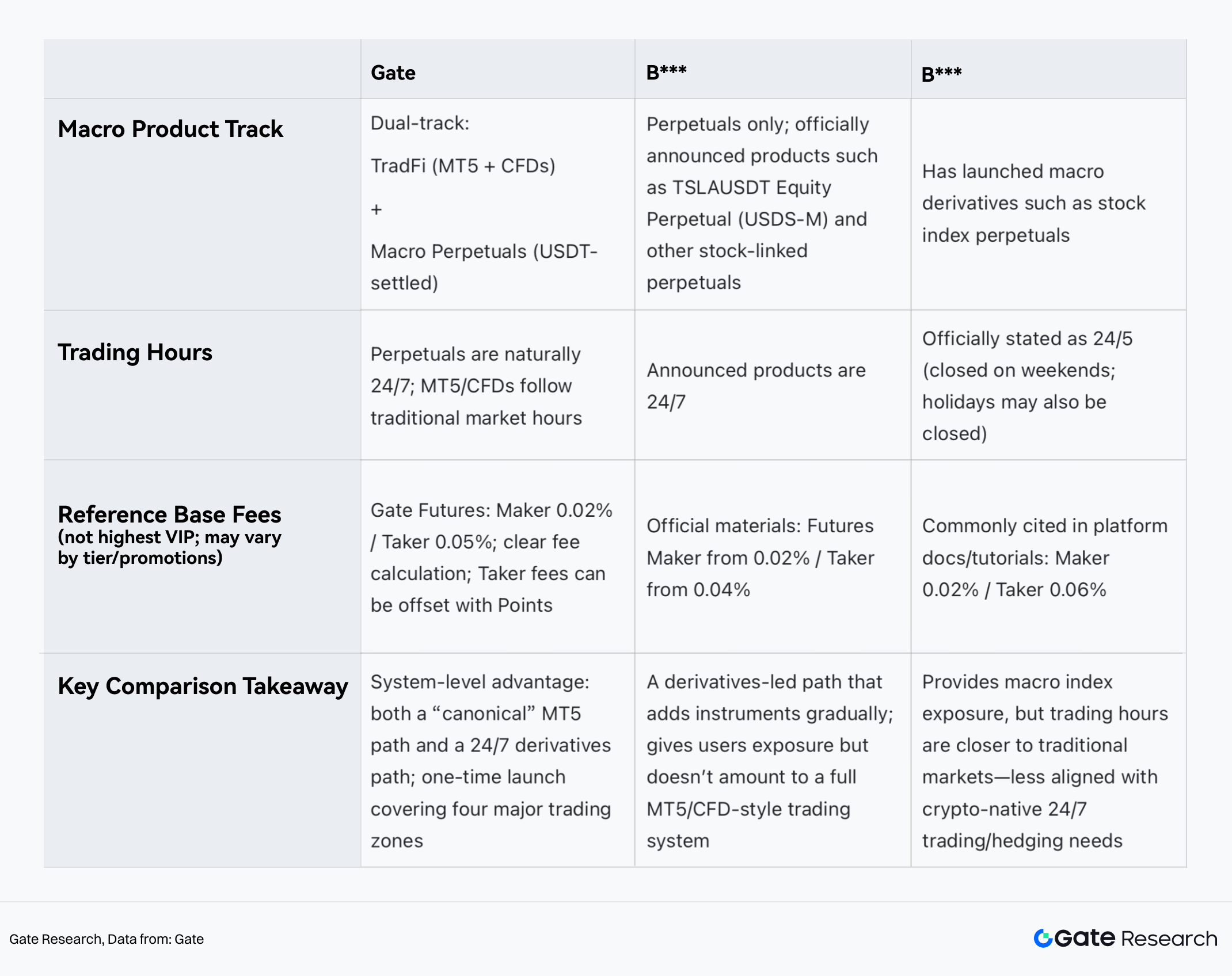
- Gate TradFi (MT5 + CFD): a traditional derivatives system path that emphasizes a TradFi like rule set, cost structure, and trading experience. As of mid February, cumulative trading volume for Gate TradFi has exceeded $33 billion.
- Macro perpetual contracts (USDT settled): a crypto native path within the perpetual futures framework, turning macro assets such as stocks, metals, indices, forex, and commodities into USDT settled perpetual tools that can be directly managed within contract accounts, with rapid expansion of the instrument matrix in Jan–Feb 2026.
These two are not substitutes. TradFi provides a professional entry point closer to traditional market rules, while macro perpetuals offer a macro risk management toolbox that aligns better with crypto position management habits and can be executed in wider time windows. Together they cover two core user groups and two trading workflows.
II. The Importance of Macro Perp
For crypto traders, the core pain point in macro risk management is not information access but whether hedging and rebalancing can be completed at critical moments, and whether execution can occur within the same account framework with low friction.
Releasing macro trading windows from time-period restrictions is the direct reason macro perpetuals are moving to the forefront. Traditional TradFi systems including MT5 and CFD usually have fixed trading sessions and market-close rules. This is normal for traditional traders, but for crypto traders the price reactions of macro events often occur outside traditional trading hours, such as weekend risk events, sudden geopolitical shocks, key announcements, or rapid market sentiment reversals. At these moments the crypto market often moves first while traditional markets may still be closed, making it difficult for traders to hedge using familiar traditional derivative tools.
Therefore, turning macro assets such as indices, forex, commodities, and metals into perpetuals essentially accomplishes three things at the same time:
- Turn macro assets into risk tools that can be deployed at any time. Traders can open exposure, reduce net exposure, and hedge portfolio drawdowns at any moment without being constrained by traditional trading hours. It should be emphasized that when external reference markets are closed, liquidity and pricing mechanics may differ from normal conditions, and strategies often require more prudent take-profit and stop-loss settings and careful control of leverage and position size.
- Integrate macro hedging into the position-management system of the crypto market. A large number of crypto derivatives users are accustomed to managing margin, leverage, risk control, and strategy capital within a single account system. Macro perpetuals can be incorporated more easily into the same margin and risk control framework, significantly reducing the friction of opening a separate TradFi account or learning a separate rule set, making hedging and rebalancing a natural extension within the contract system.
- Turn macro assets from “occasionally checked” into a sustainable tradable category. Once macro assets are stablecoin-denominated and placed within a perpetual-futures framework, they can more easily support portfolio hedging linked to BTC and ETH exposure, event-driven immediate rebalancing, and strategy reuse with the same take-profit, stop-loss, risk-control parameters, and capital-management discipline. This allows macro trading to shift from ad-hoc emergency actions into a strategy module that can be executed on a continuous basis.
With demand-side and mechanism-side constraints now clear, whether macro perpetuals can truly scale depends on product-matrix coverage and mechanism design.
III. Products and Mechanisms
3.1 Product Matrix
For macro perpetual contracts to be genuinely usable, the key is broad category coverage and a complete structure. This means not only gold and silver but also indices, major currency pairs, and industrial metals that represent macro cycles and shifts in risk appetite.
As of February 11, Gate has launched more than 70+ USDT-settled macro perpetual contracts across multiple sections, covering five major asset classes: (1) Stocks section: more than 45 popular stock perpetual contracts (2) Metals section: more than 10 metal perpetual contracts, covering gold, silver, and industrial metals such as aluminum, copper, nickel, and lead (3) Indices section: more than 10 major index perpetual contracts. In addition to large indices such as the Dow Jones, Nasdaq, and S&P, the lineup also covers small-cap US2000, regional markets such as TW88 (Taiwan market) and AUS200 (Australia market), and the VIX index which directly reflects fear and risk premiums (4) Forex section: 3 major currency-pair perpetual contracts, such as EURUSD perpetual and GBPUSD perpetual (5) Commodities section: 2 crude-oil perpetual contracts, WTI crude oil and Brent crude oil
3.2 Key Points at the Mechanism Level
The biggest difference between macro assets and crypto assets is that external reference markets usually have fixed trading sessions. How macro perpetuals handle the relationship between external market trading hours and pricing continuity is the core mechanism-level issue. Gate provides a key mechanism for this. For index-type assets, when the external market is not trading, the product will enter a Price Hold state and continue to use the last valid quote.
This means traders can still manage risk during external market closures, but they must factor liquidity changes and gap risks into expectations. In other words, traders need to pay closer attention to the trading status of external reference markets and apply more prudent take-profit and stop-loss rules and position-management discipline to cope with depth changes and amplified volatility during closure windows. At the same time, 7×24 trading is not a simple replication of continuous spot quotes. It prioritizes tool availability. When risk occurs, giving traders at least one actionable hedging or rebalancing tool within a contract framework is the core value of perpetual contracts. However, when the reference market is closed, pricing continuity and depth structure differ from normal conditions, and strategies need to reduce leverage, shrink position size, or adopt stricter risk control accordingly.
Beyond pricing mechanics, the way positions are organized also determines whether strategies can be executed in hedging, rebalancing, and risk-management scenarios. To address this, Gate provides support for a split-position mode. Under this mode, the same contract market can hold both long and short positions simultaneously, and traders can combine cross-margin and isolated-margin positions. In isolated-margin mode, long and short positions can be set with different leverage levels, enabling a more precise match to the risk budget and execution needs of different strategies. More specifically:
- The same market can support up to four positions at the same time: cross-margin long, cross-margin short, isolated-margin long, and isolated-margin short.
- The same market supports mixed cross-margin and isolated-margin positions. In isolated-margin mode, long and short positions can be configured with different leverage. Leverage settings for isolated and cross-margin positions are independent and do not affect each other.
This mechanism makes macro perpetuals easier to integrate into portfolio risk control and strategy systems. Traders can organize directional positions and hedging positions under the same instrument, and by using the independent leverage of isolated-margin positions, they can map event risk, liquidity risk, and gap risk into position parameters in a more controllable manner.
3.3 Cost Structure
Contract users are often most concerned about fees. In terms of fee calculation and deduction rules, Gate provides a standard framework that contract users are familiar with and that can be systematized into strategies.
- Fee formula: trading fee = position value × Maker or Taker fee rate
- Maker and Taker definitions: Maker provides liquidity and Taker consumes liquidity. Maker fees cannot be deducted with Points and Taker fees can be deducted with Points.
Gate perpetuals use a tiered fee structure that changes with VIP level. The VIP0 base rate is Maker 0.020% and Taker 0.050%. Points or higher VIP levels can be used to reduce costs. Taker fees can be deducted with Points and Points deduction is calculated at a fixed 0.075%. Under specific discount conditions the combined effective fee can be as low as 0.0225% according to the page display.
3.4 Core Advantages
In the industry, many platforms tend to fall into two extremes when laying out macro assets. Some list only a few symbols for category display. Others list the symbols but the trading framework, cost structure, and risk control experience are not suitable for real trading. For macro perpetuals to function properly, three elements are required: category structure, trading framework, and usable cost and risk control. Gate’s actions in macro perpetual products are essentially about building all three at the same time.
- Complete structure: a full set of macro core assets that can cover major narratives and hedging needs From stocks and indices to forex and then crude oil and industrial metals, this structure allows users to perform systematic rotation and hedging rather than trading only a single category such as gold.
- Familiar framework: USDT settlement and perpetual contract format that fit the trading habits of crypto derivatives users For contract users, this delivery method is naturally more intuitive. A unified margin system, unified order placement and risk control habits, and a unified position management logic make macro trading no longer a separate system but a natural extension within the contract framework.
- Costs that are controllable and explainable: the Gate contract fee system is reused, making strategies easier to scale and replicate
IV. Typical Uses of Macro Perpetual Strategies
With Gate perpetual contracts, several types of usage can be implemented in ways that fit the habits of contract users. This does not constitute investment advice.
4.1 Portfolio drawdown hedging: using indices or volatility to manage risk temperature
- When the market enters a risk-off phase, index short positions plus long volatility positions such as VIX, BVIX, or EVIX can provide an expression closer to systemic risk hedging.
- When crypto volatility rises but direction is unclear, volatility contracts can be used as insurance-like protection, though leverage and liquidity must be monitored carefully.
4.2 Weekend event-driven situations
When major events occur on weekends and traditional equity index futures cannot be traded, Gate macro perpetuals provide an emergency hedging channel within the contract framework. However, traders must respect Price Hold and liquidity-change risks. In other words, this is a tool oriented toward risk management rather than a high-frequency execution window that pursues optimal fill quality.
4.3 Cross-regional rotation
Regional markets can be used as one of the strategy factors. When index products expand to Australia, Taiwan, and Hong Kong China-related markets such as AUS200, TW88, and HSCHKD, they are no longer just single market exposures but factor pools for regional rotation, shifts in risk appetite, and correlation trading with crypto assets.
V. Conclusion: Systematic Dual-Track Integration
The industry does not lack attempts to make macro assets tradable, but most platforms either follow a traditional market rhythm (24/5 with closures and holidays) or pursue a fragmented approach of listing a few derivative symbols.
Gate’s unique advantage lies in systematic integration. Macro trading is turned into an account-level infrastructure. The upper layer simultaneously covers the orthodox trading system of MT5 and CFD and a macro perpetual toolbox that can be executed 7×24. Combined with clear fee and cost disclosure, macro trading becomes a capability module that users can rely on over the long term.
At the same time, Gate provides specialized channels and fee incentives for market-making teams, offering long-term supply-side support for depth and liquidity. In addition, some macro contracts are also supported on Gate Perp DEX, indicating that Gate is extending the macro risk-management toolbox into broader on-chain trading scenarios.
Gate Research is a comprehensive blockchain and crypto research platform that provides readers with in-depth content, including technical analysis, hot insights, market reviews, industry research, trend forecasts, and macroeconomic policy analysis.
Disclaimer
Investing in the cryptocurrency market involves high risk. Users are advised to conduct independent research and fully understand the nature of the assets and products before making any investment decisions. Gate is not responsible for any losses or damages arising from such investment decisions.
Share
Content


Related Articles

Gate Research: 2024 Cryptocurrency Market Review and 2025 Trend Forecast

Gate Research: BTC Breaks $100K Milestone, November Crypto Trading Volume Exceeds $10 Trillion For First Time

Gate Research-A Study on the Correlation Between Memecoin and Bitcoin Prices
Gate Research: Web3 Industry Funding Report - November 2024

Gate Research: October Crypto Market Review