Trends and Impact of Precious Metals Integrating with TradFi and Blockchain
For thousands of years, precious metals such as gold and silver have been regarded as reliable stores of value and core hedging assets against inflation. Historically, many countries adopted the gold standard or pegged their currencies to gold, with central banks holding large gold reserves to support currency credibility. Even after the US dollar detached from gold in the 1970s, gold remains a vital reserve asset and risk hedging tool for many countries, with global central bank gold reserves still constituting a significant portion of total foreign exchange reserves.
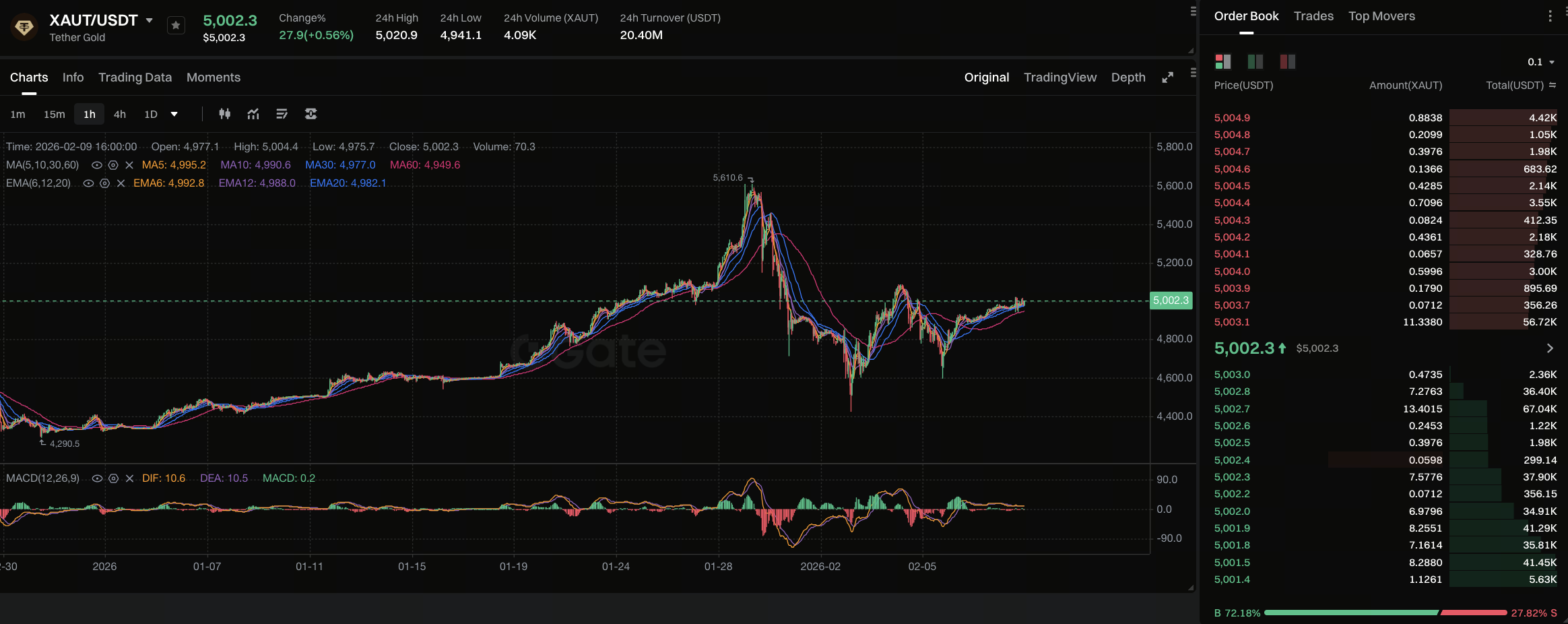
Image: https://www.gate.com/trade/XAUT_USDT
Entering 2025–2026, the precious metals market has continued its upward momentum from previous years, displaying even greater volatility. In 2025 and early 2026, gold prices repeatedly hit record highs, with spot prices breaking $5,600/oz. Silver saw even more pronounced gains, reaching $80–$120/oz or higher during the year. Major global institutions forecast continued upside potential for precious metals in 2026; some expect gold to fluctuate and rise within the $5,000–$6,000+ range, while silver may move into even higher price bands.
However, this cycle is not a simple one-way rally. Recently, the market has experienced “roller-coaster” fluctuations—precious metal prices surged rapidly and then saw sharp short-term corrections due to factors such as dollar movements, changing interest rate expectations, and speculative capital flows, causing significant volatility and risk warnings at the trading level.
Overall, amid global macroeconomic uncertainty, monetary policy divergence, and intertwined geopolitical risks, precious metals’ traditional role as safe haven and risk hedge assets has been reinforced. Their price movements reflect complex market judgments on value storage attributes versus short-term liquidity dynamics. Against this backdrop, gold and silver are not only core assets in the traditional financial system—their interactions with macro policy, capital allocation, and other asset classes (such as stocks or crypto assets) are increasingly drawing attention.
Role and Mechanisms of Traditional Financial Institutions in Precious Metals Investment
In the traditional financial system, banks, exchanges, and funds play a crucial role in precious metals investment. On one hand, commercial banks provide services for individual and institutional investors through precious metal trading and accumulation accounts. For example, Bank of China offers a “precious metals accumulation” service: customers open accounts via online banking or branches and can buy or redeem precious metals in units of grams or yuan per agreement. Upon reaching a certain amount, clients may apply to withdraw physical gold or silver. Industrial and Commercial Bank of China (ICBC), China Construction Bank, etc., also offer similar “account precious metals” and “physical gold deferred” products, allowing depositors to invest in gold without buying physical bars. These banking services make it easier for retail investors to access the precious metals market but still require them to bear price volatility and bank counterparty risk.
On the other hand, there are several key precious metal investment tools in financial markets:
Gold ETFs (Exchange-Traded Funds): These aim to track gold prices. Investors can buy or sell ETF shares on exchanges like stocks. As ICBC explains: Gold ETFs are issued by fund companies that purchase physical gold through compliant channels; custodian banks hold the gold, and fund shares are issued based on these holdings. Buying fund shares indirectly holds corresponding gold. The most renowned globally is the SPDR Gold Trust (GLD), with assets in the tens of billions USD. Gold ETFs offer convenience, low fees (management fees around 0.4%), high liquidity, and transparency—allowing ordinary investors to participate without holding physical gold. During the 2008 financial crisis, gold ETFs helped investors diversify risks and achieve positive returns amid stock market crashes.
Gold Futures Markets: On futures exchanges such as CME (COMEX), Shanghai Futures Exchange, etc., investors can trade standardized gold futures contracts. Futures contracts allow investors to agree on buying or selling gold at a predetermined price on a future date. At COMEX, a standard gold futures contract typically represents 100 ounces of gold. By posting margin (using smaller capital to control larger positions), investors can go long or short on gold to hedge price fluctuations or speculate. Contracts can specify physical delivery or cash settlement; most positions are settled by price difference rather than actual delivery at expiration. Futures markets offer strong leverage and risk management tools but also carry margin call risk and price volatility risk.
Overall, the traditional financial system supports precious metals investment through multiple channels: bank counters, online accounts, ETFs, and futures. Banks handle issuance, custody, and trading services for precious metal products; ETF and futures markets provide public liquidity and price discovery mechanisms.
Blockchain-Driven Precious Metals Tokenization: Advantages and Challenges
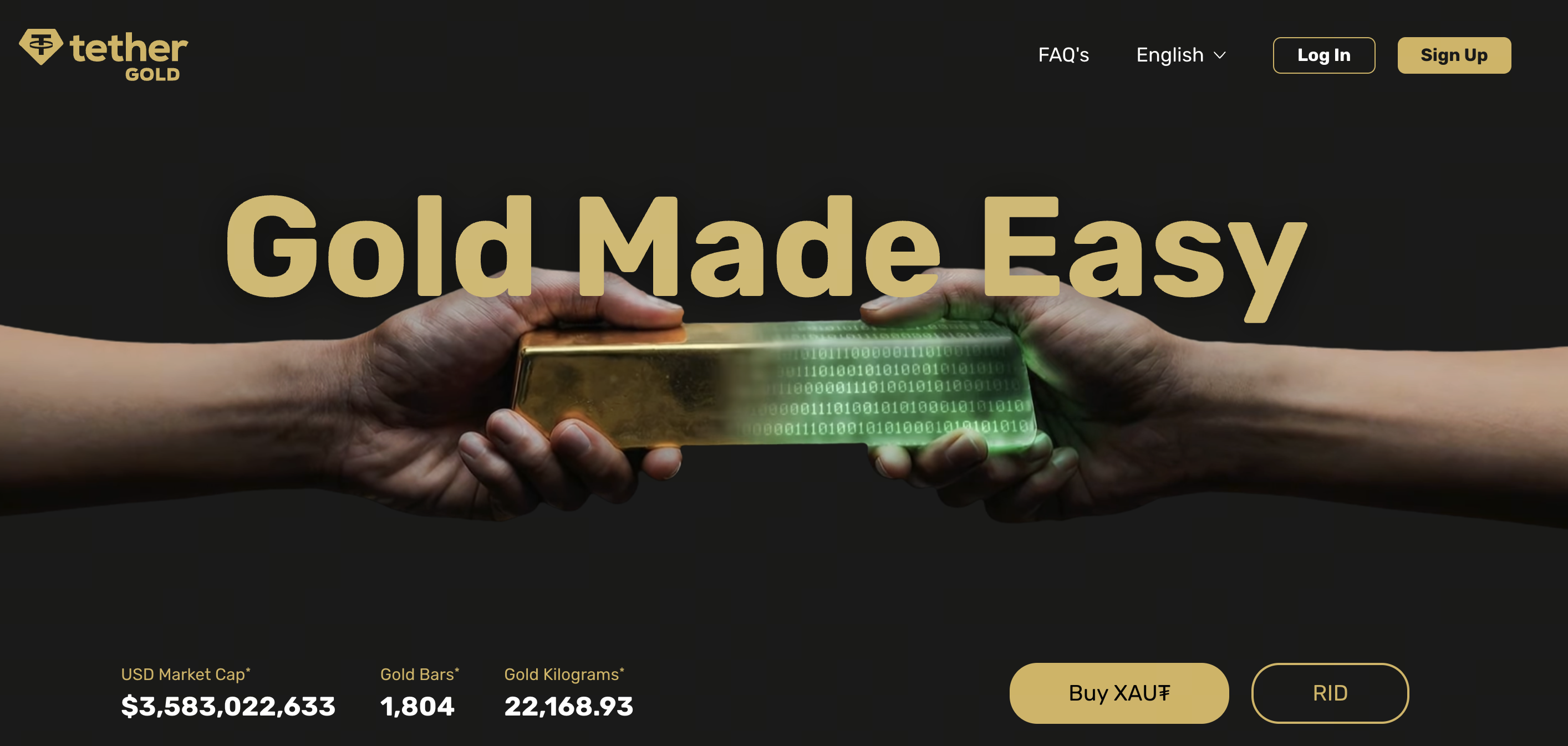
Image: https://gold.tether.to/
Blockchain technology has given rise to precious metals tokenization—mapping physical metals as digital tokens on-chain backed 1:1 by actual reserves. In short, each gold token represents a certain amount of certified physical gold (e.g., 1 ounce or 1 gram depending on issuance design) stored in professional vaults in London, Switzerland, etc. Investors holding these tokens indirectly own corresponding shares of physical gold. The tokenization process involves: issuer purchases and stores physical metal; independent audits and reserve reports; minting equivalent tokens on-chain; users buy/sell tokens on exchanges or transfer peer-to-peer; holders (meeting minimum amounts) may redeem physical bars.
Convenience: Tokenized precious metals improve traditional physical investment in several ways. First is fractional ownership—investors can buy small shares of gold for just tens of dollars without purchasing whole bars. Second is 24/7 liquidity—tokens trade around the clock globally on crypto exchanges unrestricted by traditional trading hours. Additionally, tokenization shifts storage and insurance costs to issuers or fee structures—issuers bear storage/insurance expenses—reducing investment costs. The blockchain’s immutable ledger and regular audits enhance transparency/security, lowering risks of forgery or misappropriation. More importantly, tokens can be used directly in DeFi ecosystems—for example as loan collateral or yield farming—granting gold new financial attributes.
Challenges & Risks: However, tokenization carries risks too. First is counterparty risk—investors must trust that issuers truly hold adequate physical metal; even audit reports cannot fully eliminate trust gaps. Regulatory uncertainty persists—different countries have varying legal status and redemption rules for tokenized assets. Furthermore, token markets’ liquidity may occasionally deviate from spot prices (tracking errors); arbitrageurs can correct prices via trading but short-term opportunities/costs may cause adverse impacts. Some tokens have high minimum redemption thresholds (e.g., PAXG requires at least 430 ounces), unfriendly for ordinary investors. Finally, smart contracts may have technical flaws or security vulnerabilities—rare but not negligible risks.
Overall, blockchain makes precious metals investment more flexible and modern—it “combines gold’s stability with blockchain efficiency.” Latest data shows tokenized gold trading volume reached $178 billion in 2025–2026, surpassing most traditional gold ETFs—reflecting rapid growth and recognition of this new investment model.
Traditional vs Blockchain: Comparing Efficiency, Security & Liquidity
Traditional precious metals investment and blockchain token investment each have strengths regarding efficiency, security, and liquidity.
| Dimension |
Traditional Precious Metals Investment (Physical Gold / Gold ETFs) |
Blockchain Tokenized Precious Metals (PAXG / XAUT, etc.) |
| Trading Efficiency |
Trading is limited to exchange hours; ETFs and spot typically settle on a T+1 / T+2 basis |
Real-time on-chain settlement, near-instant completion with no waiting period |
| Trading Hours |
Restricted to exchange schedules (e.g., U.S. equities 9:30–16:00 ET) |
24/7 continuous trading, including weekends and holidays |
| Liquidity Depth |
Large market size and strong depth (GLD ≈ $60B, IAU ≈ $30B) |
Smaller scale (PAXG and XAUT ≈ $2B each) but steadily growing |
| Price Deviation |
Highly correlated with London gold and COMEX prices |
Maintains minimal deviation from spot gold via arbitrage mechanisms |
| Market Reaction Speed |
Slower response to sudden events; no trading during market closures |
Positions can be adjusted immediately after macro events (e.g., post-Fed meetings) |
| Cost Structure |
Annual management fees around 0.2–0.4%; physical gold also incurs fabrication, storage, and insurance costs |
No storage fees (covered by issuers); requires gas fees + trading fees |
| Accessibility |
Typically requires brokerage accounts and banking access |
Only requires a crypto wallet or exchange account; globally accessible |
| Transparency |
Relies on custodians and regulatory disclosures |
On-chain verifiable with periodic audits, enhancing transparency |
| Security Risks |
Strong regulation and relatively low systemic credit risk, though bank/broker risks remain |
Smart contract risks, issuer credit risk, and regulatory uncertainty |
| Suitable Users |
Long-term allocators and institutional investors |
High-liquidity traders, cross-market participants, and crypto-native users |
Overall, blockchain tokenized precious metals significantly complement traditional investments in trading efficiency, market accessibility, and time flexibility; while traditional gold ETFs retain advantages in liquidity depth and risk control thanks to established market scale and mature regulation. The two modes are not simply substitutes—they form a complementary relationship across different trading needs, risk preferences, and usage scenarios.
Tokenized Precious Metals Project Case Studies
Several major precious metal token projects are active on the market:
PAX Gold (PAXG): Issued by US-based Paxos Trust Company under New York Department of Financial Services (NYDFS) regulation. Each PAXG token corresponds to 1 ounce of London Good Delivery standard LBMA pure gold bar. Paxos commits to monthly audit reports of holdings; gold is stored in London LBMA-recognized vaults. Key features: no minimum purchase requirement; no extra custody fees (though trading/redemption may incur costs); redemption for physical bars available via official channels (with minimums and settlement process). According to Paxos, PAXG transactions settle almost instantly on-chain versus T+2 days for typical ETFs. PAXG holders can convert tokens into LBMA physical bars anytime—making PAXG one of the most regulated and well-structured digital gold assets currently.
Tether Gold (XAU₮): Issued by stablecoin company Tether since early 2020; each XAU₮ represents 1 ounce of pure gold stored in Swiss vaults (London Good Delivery standard). XAU₮ circulates on Ethereum/Tron chains; users may redeem bars or transfer tokens between platforms. As of early 2026, XAU₮ market cap is ~$2.6 billion. With Tether’s vast USDT user base, XAU₮ has relatively high liquidity—appealing to traders seeking “paper gold” alternatives. Like PAXG, XAU₮ is backed 1:1 by physical gold with regular audits but differs in regulation (PAXG is US-regulated; XAU₮ issued by Cayman Islands entity).
Perth Mint Gold Token (PMGT): Launched by Australia’s Perth Mint (government-owned). Each PMGT token represents 1 ounce of physical gold stored at Perth Mint and is guaranteed by Western Australia government. PMGT has no storage/management fees; redeemable for Mint products; holdings are publicly verifiable. PMGT debuted in 2019 with high hopes as the first government-backed gold token but its issuance/activity has dropped sharply due to regulatory/operational issues—recently even pausing updates. Still, PMGT shows that government agencies have tried innovating by combining blockchain with precious metals investment.
Other Projects: Besides those above, other tokenized metal projects include S&P Goldman Sachs-backed tokens, Aurus Gold (AWG), CACHE Gold (CGT), etc. For example AWG tokens each represent 1 gram of 99.99% pure gold aiming for smaller denominations; CGT also uses grams as units backing physical gold emphasizing real-time settlement/proof-of-holdings. These projects are smaller in value/liquidity but enrich the tokenized precious metals ecosystem.
How Investors Choose: Traditional vs Blockchain Precious Metal Tools
Ordinary investors should consider risk tolerance, transaction convenience, holding costs when selecting precious metal investment tools. For those preferring simple low-risk options, traditional channels such as buying physical bars or ETF shares via brokerage accounts are more straightforward. Traditional ETF workflows are familiar with clear regulation; trading fees are transparent. For example, investors who do not wish to handle digital assets can buy GLD/IAU ETF shares via A-shares/HK stocks/US markets for returns tied to gold prices without worrying about wallet security or private key management.
By contrast, investors familiar with blockchain/crypto trading find tokenized precious metals attractive. As one crypto analyst noted: “PAXG offers instant settlement and round-the-clock trading; traditional ETFs operate like stocks with limited hours.” For those needing high liquidity/fast response to markets, gold tokens can be traded/transferred anytime globally; tokens also enable DeFi activities (lending/yield)—offering extra income for those willing to accept crypto market volatility risks. Note that token prices are influenced by both USD gold price and crypto market sentiment—volatility may exceed physical gold/ETFs. Thus investors should weigh returns/risk: those versed in crypto who want innovative finance may consider small allocations to tokenized products; those prioritizing stable returns with little digital asset experience should stick with traditional channels.
Gate TradFi & Precious Metals Section: Entry Designed for “Real-World Investors”
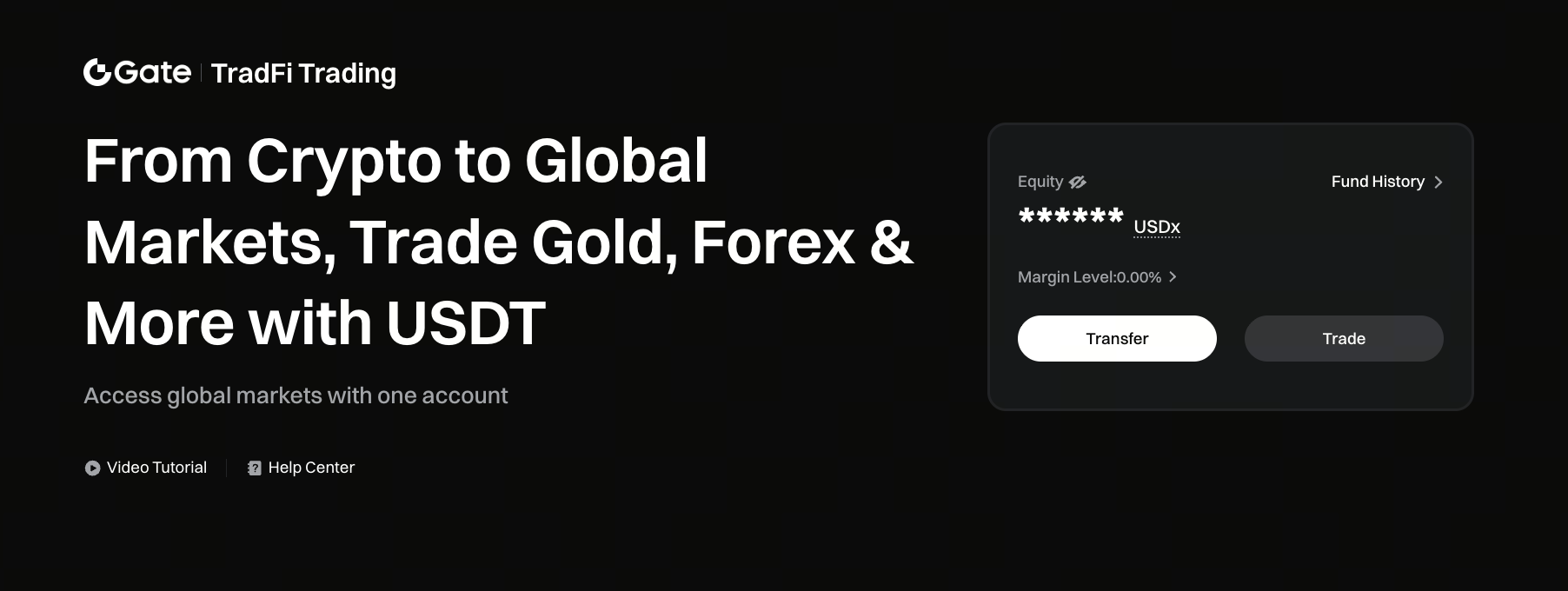
Image: https://www.gate.com/tradfi
At this stage some platforms are offering precious metals sections closer to TradFi logic—the core aim is not to reconstruct gold’s value system but reshape participation methods for ordinary investors. Gate TradFi’s precious metals section exemplifies products focusing on “financial usability” rather than “technical narrative.”
Usage scenarios target investors wanting exposure to markets like gold/silver but unwilling to deal with bank processes or deeply understand on-chain custody/compliance structures. Here precious metals are packaged as intuitive financial assets—no physical delivery required; no need to grasp complex derivatives mechanics—the focus is trading/allocation as core use cases.
Importantly this TradFi precious metals section does not attempt to change inherent risk attributes but platformizes them—turning precious metals from “low-frequency/long-term allocation assets” into tool-type assets that can flexibly fit portfolio management needs. For ordinary investors the value lies not in decentralization but clear risk structure, controlled entry thresholds, predictable liquidity.
On a macro level Gate TradFi’s precious metals section reflects a broader trend: between TradFi & crypto finance the market is forming a “middle-layer solution”—neither fully reliant on traditional banking nor requiring full on-chain adoption but providing a practical compromise between both worlds.
Future Outlook: Pathways & Risks for Precious Metals Integrating TradFi & Blockchain
Looking ahead the integration of precious metals with TradFi/blockchain is set to deepen further. As more institutions (like BlackRock) explore asset tokenization we expect new regulated issuers/types of metal tokens (platinum/palladium). Traditional institutions may gradually offer tokenized metals within their service portfolios—for instance direct trading of gold tokens via brokerage accounts. As regulation clarifies more institutional capital/high-net-worth investors will enter this space; technology improvements such as more reliable off-chain oracles/decentralized custody could further reduce counterparty risk.
Risks remain though—regulatory changes are primary: different countries’ stances may impose strict rules limiting issuance/trading/redemption of tokens. Trust/audit stay central—as noted above holding tokens means trusting issuers’ custody/redemption promises; audits help but do not fully close trust gaps. Technical risks (smart contract flaws/hacks) and market risks (crypto volatility) must also be considered. Academic research finds that while tokenized gold prices closely track physical gold with high efficiency now—the market is still nascent so investors should be cautious viewing it as “converting gold into a continuous globally accessible digital format” rather than fully replacing traditional channels.
In summary tokenized precious metals digitize ancient value storage methods—offering new balanced choices between tradition/innovation for investors. They retain the scarcity/universal appeal of gold/silver while greatly boosting liquidity/accessibility/trading efficiency. Over the next decade this market could grow into hundreds of billions USD or more—but investors should flexibly allocate among various traditional/blockchain-based tools according to their needs/risk preferences and approach this transformative trend prudently.







