In today’s blockchain industry, data has gradually become one of the core bottlenecks. Traditional databases are efficient, but they lack trust. Blockchains are trustworthy, but they are not suitable for storing complex data structures. DKG fills this gap by combining “graph structure + distributed network + blockchain anchoring,” resolving the tension between data trust and data usability.
From a broader digital asset and AI perspective, the value of OriginTrail lies in the fact that it is not merely a storage network, but a “knowledge layer” that provides structured and verifiable data infrastructure for AI, DeFi, and enterprise applications.
Basic Concept and Structure of OriginTrail DKG
The core of OriginTrail DKG can be understood as a “decentralized knowledge graph network.” Its goal is not simply to store data, but to organize data into “knowledge relationships” that machines can understand. Compared with traditional data systems, it places greater emphasis on connectivity and semantic expression between data points, giving information “interpretability” rather than merely “readability.”
At the structural level, a knowledge graph builds a data network through “Entities + Relationships.” For example, a product is not just an isolated data point. It can also be linked to its manufacturer, logistics route, certification information, and more, forming an interconnected network. This structure upgrades data from “isolated records” into “reasoning-ready knowledge,” which is also what distinguishes it from traditional data models.
In OriginTrail, this structured data is packaged as Knowledge Assets. A Knowledge Asset contains not only the data itself, but also its context, relationships, and verification information, allowing it to be discovered, verified, and reused across the network. This design gives data properties similar to a “digital asset,” meaning it can be referenced, combined, and even commercialized.
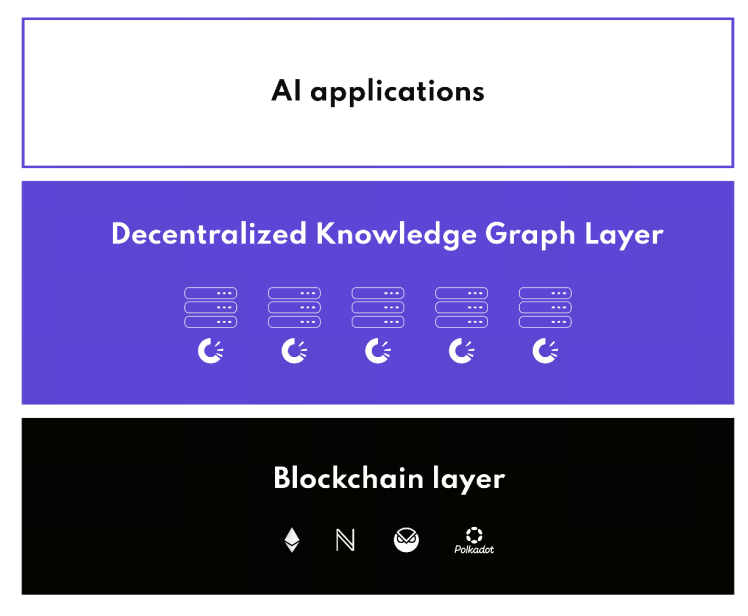
These Knowledge Assets are further organized into Paranets, where different Paranets can form independent data ecosystems around specific fields, such as supply chains or AI data. At the same time, DKG integrates with multiple blockchains to support cross-chain verification and data anchoring. This allows the system to be decentralized, verifiable, and capable of cross-network collaboration. For deeper analysis, this can be extended to the definition of decentralized knowledge graphs and the evolution of Web3 data structures.
Source: origintrail.io
Differences Between DKG, Traditional Databases, and Blockchains
The key to understanding DKG is to clarify its “position” in the data architecture. It is neither a replacement for traditional databases nor an extension of blockchain, but a new layer between the two: the “knowledge layer.”
Traditional databases, such as SQL or NoSQL systems, mainly solve the problem of efficient data storage and querying. Their strengths lie in performance and mature tooling. However, their core limitation is that data is controlled by centralized organizations, making it difficult for external parties to verify authenticity or integrity. This problem is especially clear in cross-organization collaboration.
Blockchain solves the problem from another angle. Through decentralized consensus mechanisms, it ensures data immutability and traceability. However, blockchain data structures are relatively simple and usually focus on transactions or state. They are not well suited to expressing complex entity relationships or semantic information, making it difficult for blockchains to directly support complex data applications.
DKG combines the strengths of both:
It uses knowledge graphs to express complex relational data, while using blockchain to record key data fingerprints, achieving both “structured expression + verifiability.” Simply put, databases store “data,” blockchains store “state,” and DKG stores “knowledge relationships.” This three-layer structure makes it an important part of Web3 data infrastructure and can be further explored through the differences between blockchain and data storage architectures, as well as the design of Web3 data infrastructure.
OriginTrail Data Publishing and Storage Process
In OriginTrail DKG, data publishing is a standardized and verifiable process, not a simple upload. The core goal of the entire process is to ensure that once data enters the network, it has both structured expression and verifiability, as well as traceability.
The first step is data structuring. Raw data is converted into a knowledge graph format, defining its entities, attributes, and relationships. This step is equivalent to turning “raw information” into “machine-understandable knowledge,” laying the foundation for later querying and reuse.
The second step is Knowledge Asset generation. The structured data is packaged as a Knowledge Asset and assigned a unique cryptographic hash. This hash acts as the data’s “fingerprint,” used later to verify its integrity and consistency.
The third step is on-chain anchoring and off-chain storage. Key data fingerprints are recorded on the blockchain, while the actual data is stored in a distributed node network. This design avoids the high storage cost of blockchains while still ensuring that the data cannot be tampered with.
The complete process is: data creation → structuring → Knowledge Asset generation → on-chain anchoring → distributed storage. This mechanism balances “on-chain verification + off-chain scalability,” giving DKG both the trustworthiness of blockchain and the scalability of a data network. For a deeper understanding, this can be extended to data on-chain anchoring, off-chain storage mechanisms, and verifiable data publishing workflows.
How the Node Network Collaborates and Verifies Data
DKG depends on a decentralized node network to operate. The core responsibilities of nodes include storing Knowledge Assets, providing query services, and verifying data integrity. Data is usually replicated across multiple nodes to improve availability and censorship resistance.
Table still loading. Please wait until it finishes loading before trying to copy it again.
For data verification, nodes use hash checks and protocol rules to ensure that data has not been tampered with, while network mechanisms maintain consistency.
This form of collaboration is essentially a “distributed data service network.” Unlike traditional blockchain consensus mechanisms, it focuses more on data availability and reliability.
This can be further extended to the decentralized node collaboration mechanism and data consistency and verification models.
DKG Query and Data Access Mechanism
One of DKG’s key advantages is its query capability. Because data is organized in the form of a knowledge graph, users can retrieve information through semantic queries rather than simple lookups. For example, they can query a product’s “supply chain path” instead of a single field.
During access, the system provides data source and verification information, allowing users to judge whether the data is trustworthy.
This mechanism enables a “discoverable + verifiable” data access model and forms an important foundation for AI applications. For deeper analysis, it can be examined together with the graph database query mechanism and verifiable data access model.
Advantages and Potential Limitations of DKG
Overall, DKG has several clear advantages. First, it enables data verifiability, allowing information to be trusted. Second, it supports structured knowledge expression, making data more suitable for AI and complex applications. Finally, its decentralized design strengthens data ownership and censorship resistance.
At the same time, it also has limitations.
Knowledge graph structures are relatively complex and require higher standards for data modeling. Network performance depends on node scale. In some scenarios, query efficiency and cost must be carefully balanced.
These factors make DKG more suitable for “high-value data networks” rather than every data scenario. Further analysis can be extended to the advantages and disadvantages of decentralized data networks and Web3 data scalability issues.
Summary
OriginTrail DKG is, in essence, a Web3 data infrastructure that combines knowledge graphs, blockchain, and distributed storage. Through structured data expression, on-chain verification, and a decentralized network, it enables data discoverability, verifiability, and ownership management.
Compared with traditional databases or blockchains, DKG is not a replacement, but a complementary layer. It builds a “knowledge layer above data.” As AI and Web3 continue to develop, this model may become an important part of future data networks.
FAQ
-
What is OriginTrail DKG?
OriginTrail DKG is a decentralized knowledge graph network used to organize data in a structured way and enable verifiability and data ownership management through blockchain.
-
How does OriginTrail DKG ensure data trust?
DKG records data hashes on the blockchain and uses a distributed node network for storage and verification, ensuring that data is tamper-resistant and traceable.
-
What is the difference between DKG and blockchain?
Blockchain is mainly used to record transactions and state, while DKG is used to organize and query structured knowledge data. They play different roles in the Web3 architecture.
-
Can DKG replace traditional databases?
DKG cannot fully replace traditional databases, but it can serve as a complement in high-value data scenarios that require verifiability and complex relationship modeling.
-
Why is DKG important for AI and Web3?
DKG provides structured and trusted data sources, allowing AI to reason based on high-quality data while giving Web3 applications reliable data infrastructure.