As market cycles speed up, how can Gate Leveraged ETFs serve as a new tool for strategic traders?
Investment Logic Evolves with Market Cycles
Volatility in the crypto market is accelerating. Trends no longer play out over extended periods; instead, market direction shifts rapidly, and both sentiment and prices swing in short bursts. In this environment, the classic buy-and-hold approach—waiting for time to generate returns—offers diminishing capital efficiency.
Capital management now centers on the ability to adjust exposure instantly, rather than simply holding for longer periods. This shift is redefining the role of ETFs in the market.
ETF as a Trading Module
Traditionally, ETFs have represented passive investing, tracking the market and minimizing trading frequency. In today’s high-volatility environment, however, ETFs are evolving into modular tools that allow direct participation in market cycles. Leveraged ETFs, in particular, have re-emerged as products of interest—not just amplifying gains and losses, but serving as a middle ground for strategy-driven traders between spot and derivatives.
A Third Path Between Spot and Derivatives
For most traders:
- Spot trading: Straightforward and transparent risks, but limited leverage
- Derivatives trading: Highly efficient with flexible leverage, but involves margin requirements, forced liquidation, and intense real-time risk management
Leveraged ETFs fill this gap. They maintain the mechanics of spot trading while enabling price movements to have a multiplied impact on capital, allowing users to implement leverage strategies without directly entering the derivatives market.
Gate Leveraged ETF Token Design Principles
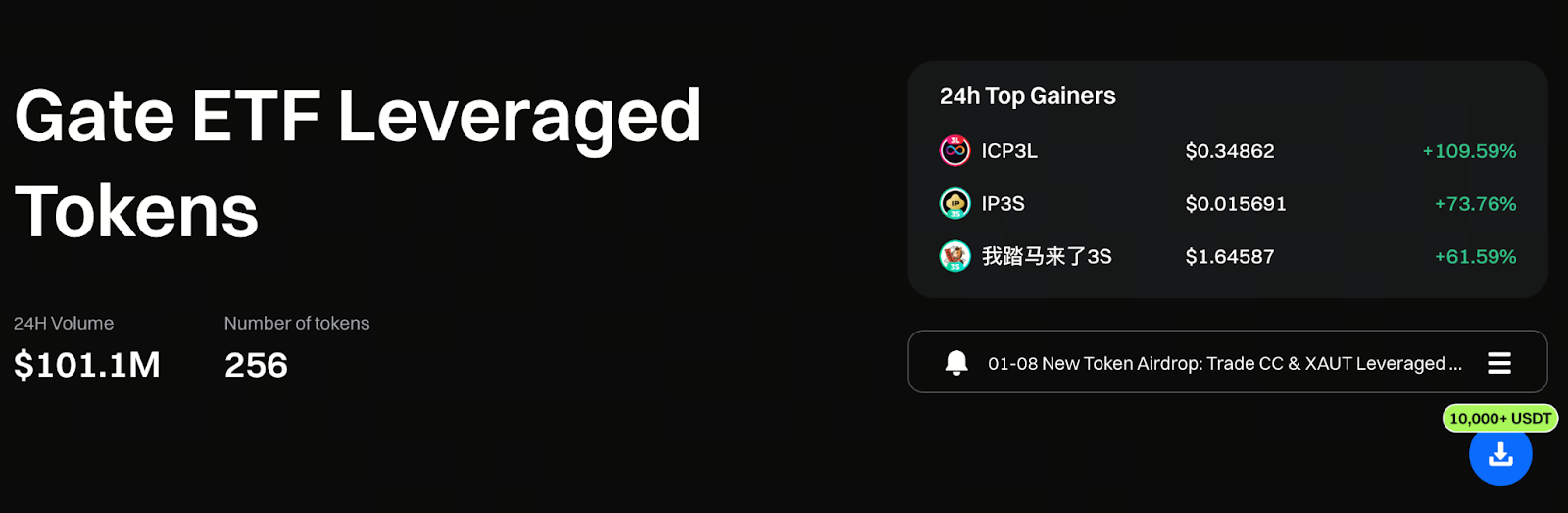
Gate leveraged ETF tokens are built by establishing leveraged positions through perpetual contracts. All contract-level operations are executed automatically by the system.
For users, the trading experience is just like spot tokens, with no need to manage:
- Margin and maintenance calculations
- Real-time risk management due to forced liquidation
- Fluctuating funding rates
- Position sizing or timing adjustments
The leverage effect is fully embedded in the product structure, so traders can focus on market direction and strategy timing.
Start trading Gate ETF leveraged tokens: https://www.gate.com/leveraged-etf
Rebalancing Mechanism
Leveraged ETFs are not simple multipliers. To prevent actual exposure from drifting away from the target leverage due to market volatility, the system regularly rebalances the underlying contract positions to restore leverage to its intended range. While this process is invisible to users, it significantly impacts results. Therefore, leveraged ETF performance is not just asset movement times leverage—it is shaped by:
- Market path
- Volatility structure
- Market rhythm
These factors make leveraged ETFs better suited as tactical tools rather than long-term holdings.
Amplification Strategies Without Derivatives
For some traders, the real hurdle is not leverage itself, but the risk of forced liquidation and margin calls in derivatives trading. Leveraged ETFs do not eliminate market risk—they convert it into direct price volatility, reflected in the token’s net value. Even during brief market reversals, the system does not force an exit, enabling smoother strategy execution and more manageable psychological stress.
Amplified Capital Efficiency
In clear, trending markets, leveraged ETFs allow capital to work more efficiently within the same timeframe. With the rebalancing mechanism, performance during favorable trends often resembles rolling accumulation. As such, leveraged ETFs are widely used as transitional tools before adopting full leverage strategies, letting users test their tolerance for volatility without bearing the full risk management burden of derivatives.
Structural Constraints and Potential Costs
In ranging or oscillating markets, the rebalancing mechanism may gradually erode net asset value, causing actual results to diverge from intuitive expectations. Additionally:
- Final returns are not simply the leverage multiple
- Trading costs, volatility, and price path all affect outcomes
These features mean leveraged ETFs are generally not used as long-term allocation assets.
Why Is a Management Fee Required?
Gate leveraged ETFs charge a daily management fee of about 0.1% to support normal product operations, including:
- Opening and closing costs for perpetual contracts
- Funding rate expenditures
- Position adjustments and hedging requirements
- Trading losses from rebalancing
These costs are not extra charges—they are essential to ensure the product’s long-term stability.
Who Should Use Leveraged ETFs?
Leveraged ETFs are not passive investment vehicles. They are tactical modules best suited for:
- Traders with clear directional views
- Those with defined entry and exit plans
- Strategies that can withstand short-term volatility
Only by fully understanding their structure, costs, and limitations can leveraged ETFs truly enhance capital efficiency.
Conclusion
Gate leveraged ETFs do not make trading easier—they make strategy execution more direct. They amplify both market moves and the importance of every decision. For traders who understand market cycles and actively manage risk, leveraged ETFs serve as an effective bridge between spot trading and leverage strategies. However, overlooking their structural features and cost implications can result in taking on more risk than anticipated.
Share
Content
Investment Logic Evolves with Market Cycles
ETF as a Trading Module
A Third Path Between Spot and Derivatives
Gate Leveraged ETF Token Design Principles
Rebalancing Mechanism
Amplification Strategies Without Derivatives
Amplified Capital Efficiency
Structural Constraints and Potential Costs
Why Is a Management Fee Required?
Who Should Use Leveraged ETFs?
Conclusion


Related Articles

What is MetFi? All You Need to Know About METFI (2025 Update)

Gold Price Forecast for the Next Five Years: 2026–2030 Trend Outlook and Investment Implications, Could It Reach $6,000?
Every U.S. Crypto ETF You Need to Know About in 2025
What are Leveraged ETF Tokens?

Gate Research: BTC Hits New Highs, Bitwise Files Solana ETF, Stablecoin Exceeds $190B