


Immutable Contribution Vault (ICV): The On-Chain Collaboration Layer for AI Development
In multi party AI development environments, traditional workflows often lack fair and sustainable revenue sharing mechanisms. This leads to value concentration, difficulty in measuring contributions, and weak incentives for open source participation. Through on-chain records, service NFTs, and automated revenue sharing, ICV redefines trust and incentives in collaborative development. It improves transparency and auditability across AI ecosystems and allows developers, data providers, and testers to share long term returns from AI commercialization, laying the foundation for an on-chain AI labor market.
This article introduces the background and core design logic of ICV, explains how it is embedded into the AI agent development workflow of Virtuals Protocol, describes how service NFTs turn contributions into assets and enable automated revenue distribution, compares ICV with collaboration models such as GitHub and DAOs, and explores its implications for future on-chain AI collaboration and open development economies. The goal is to help readers fully understand the role of ICV in the convergence of AI and Web3.
Background of ICV: Contributions Are Hard to Quantify and Reward
The success of AI models often depends on collaboration among many participants, including researchers, data providers, developers, and testers. However, traditional development processes lack transparent and sustainable revenue sharing mechanisms, causing most value to ultimately concentrate in platforms or companies.
This situation creates several long term problems:
- Contributors struggle to prove their real impact
- Revenue distribution relies on centralized decision making
- Open source participation lacks long term incentives
The goal of ICV is to transform these previously vague contribution relationships into verifiable and quantifiable on-chain records. In practical implementation, Virtuals Protocol combines ICV with the IAO (Initial Agent Offering) mechanism, turning AI agents directly into investable and tradable on-chain assets. This ensures that development contributions are not only recorded but also integrated into real on-chain economic cycles.
Core Design of ICV: Immutable On-Chain Contribution Records
The core concept of Immutable Contribution Vault (ICV) is that contribution equals asset. Every model update, data submission, or feature iteration is written on chain, forming a permanent and tamper resistant contribution record. This allows development activity itself to become a traceable and quantifiable on-chain asset.
The greatest value of immutable records lies in rebuilding trust mechanisms. Anyone can trace the evolution of an AI system and clearly identify the actual contributors behind each capability improvement. This prevents black box development and unclear accountability. At the same time, ICV fundamentally changes AI development itself. Development actions become on-chain events. Contribution processes are transparent and verifiable. Historical records become public assets that can be referenced and rewarded. AI development shifts from closed research to an open ecosystem that is auditable, collaborative, and revenue sharing.
How Virtuals Protocol Uses On-Chain Contributions to Reshape AI Collaboration

(Source: Virtuals Protocol)
Within the architecture of Virtuals Protocol, ICV is not just a conceptual layer. It is directly embedded into the entire AI agent development workflow. Each AI agent is treated as an independent on-chain economic entity. From expanding model capabilities to integrating tool modules and adjusting behavior strategies, all development activities must be submitted as on-chain events and written into ICV.
This means developers are no longer simply submitting code to a platform. They are accumulating verifiable value contributions for an AI economic entity with asset characteristics. Through this design, Virtuals Protocol converts collaboration records that were previously scattered across GitHub, document systems, and internal processes into traceable, quantifiable, and rewardable on-chain contribution assets. AI development shifts from platform driven project management to a shared economic entity built by collaborators, making every participant part of the AI growth curve.
Service NFTs: Turning AI Development Contributions into Assets
Within the ICV framework, each contribution can be minted as a service NFT. These NFTs are not just records but entitlement certificates to future revenue. For example, a developer may receive an NFT for designing a critical algorithm. A data provider may receive another type of NFT for contributing high quality datasets.
Common contribution types include:
- Model module development
- Training datasets
- Plugins and tools
- AI behavior design
Through NFT based representation, contributor effort can generate ongoing value throughout the entire lifecycle of an AI system.
How Revenue Distribution Operates Automatically
When an AI agent begins generating revenue, the revenue sharing mechanism of ICV is activated. All income first enters the agent wallet, after which smart contracts automatically distribute revenue based on contribution records. This automated settlement introduces several important changes. It removes opacity from manual distribution and ensures contributors receive long term returns rather than one time compensation.
The revenue sharing process can be summarized in three core steps. After an AI agent generates real on-chain revenue, the system calculates each participant’s contribution weight based on records stored in ICV and completes revenue distribution instantly through smart contracts.
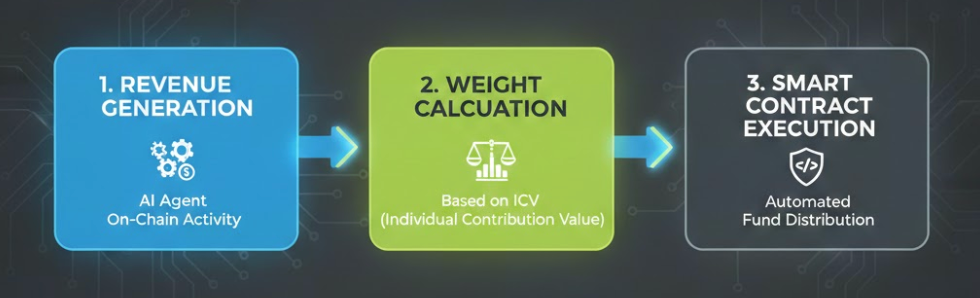
This mechanism upgrades open source collaboration from an idealistic community practice to an economic incentive model that is measurable, settleable, and sustainable. Contributors can directly share in the value created by AI commercialization.
Differences Between ICV and GitHub or DAO Models
GitHub reshaped collaboration in software development. DAOs transformed organizational governance. However, both primarily operate at the collaboration or decision making layer and do not fully solve the core problem of converting contributions into actual revenue. The key innovation of ICV is directly linking collaboration behavior with economic returns, making contribution itself a priced asset.
From a design perspective, the differences are clear. GitHub can comprehensively record contribution history but lacks native value distribution mechanisms. DAOs focus on governance and voting rather than productivity and revenue creation. ICV establishes a direct relationship between contribution and income, ensuring that every development action corresponds to real economic returns.
This design allows AI development to move beyond idealistic open source collaboration and evolve into an economic collaboration system that is quantifiable, rewardable, and sustainable.
Outlook: The Early Shape of an On-Chain AI Labor Market
When contributions can be precisely quantified and directly converted into holdable assets, AI ecosystems can give rise to an entirely new type of on-chain labor market. Developers are no longer limited to a single company or platform. They can participate freely in multiple AI projects and accumulate long term income streams through ongoing contributions.
Under this architecture, future scenarios may include AI model module marketplaces organized by function and capability, data provider economies built around high quality training datasets, and AI tool developer ecosystems led by individuals or small teams. Innovation no longer depends on closed platforms operated by large technology companies.
Summary
ICV redefines value distribution in AI development. Through on-chain records and NFT based contribution assetization, it establishes a transparent, verifiable, and sustainable collaborative economic model. When every contribution can continuously generate returns, AI ecosystems can shift from company dominated development to community co creation. Virtuals Protocol is attempting to drive this structural transformation.
Share
Content
Background of ICV: Contributions Are Hard to Quantify and Reward
Core Design of ICV: Immutable On-Chain Contribution Records
How Virtuals Protocol Uses On-Chain Contributions to Reshape AI Collaboration
Service NFTs: Turning AI Development Contributions into Assets
How Revenue Distribution Operates Automatically
Differences Between ICV and GitHub or DAO Models
Outlook: The Early Shape of an On-Chain AI Labor Market
Summary


Related Articles

The Future of Cross-Chain Bridges: Full-Chain Interoperability Becomes Inevitable, Liquidity Bridges Will Decline

Solana Need L2s And Appchains?

Sui: How are users leveraging its speed, security, & scalability?

Navigating the Zero Knowledge Landscape

What is Tronscan and How Can You Use it in 2025?
