Kalshi Eyes Expansion of Its Business Landscape
Kalshi, a trading platform centered on event prediction, is reportedly planning to introduce cryptocurrency Perpetual Futures—signaling that its offerings may soon extend beyond simple yes/no event contracts.
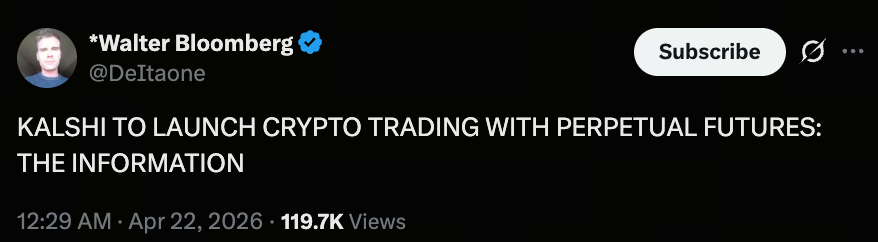
(Source: DeItaone)
This strategic shift highlights Kalshi’s ambition to move into more traditional financial trading arenas, aiming to attract a broader spectrum of investors.
What Are Perpetual Futures?
Perpetual Futures (Perps) are a widely used derivative in the crypto market, characterized by:
-
No expiration date, allowing positions to be held indefinitely
-
The ability for traders to speculate on both rising and falling prices
-
The frequent use of leverage to amplify returns
Unlike traditional futures, Perpetual Futures do not require scheduled settlements or rollovers, making them particularly well-suited for short-term and High Frequency trading strategies.
First popularized by BitMEX, Perpetual Futures have become a mainstream instrument in the crypto derivatives market.
From Event Prediction to a Continuous Trading Marketplace

(Source: Kalshi)
Historically, Kalshi’s core products have been event contracts—binary trades on whether a specific economic indicator or policy outcome will occur.
The introduction of Perpetual Futures would mark a significant evolution for the platform:
-
A shift from event outcomes to pure price volatility
-
A move from discrete trading to a continuous marketplace
-
More frequent trading opportunities for participants
These changes are expected to draw increased interest from professional traders and institutional investors.
A key differentiator for Kalshi is its regulation by the Commodity Futures Trading Commission (CFTC), which gives it several advantages should it launch crypto Perpetual Futures:
-
Stronger regulatory compliance
-
Greater appeal to institutional capital
-
The potential to serve as a legal, domestic alternative
By contrast, many existing Perpetual Futures trading platforms are based offshore, operating under more relaxed regulatory regimes.
Market Context: Growing Regulation and Demand
In recent years, US regulators have increased their focus on the crypto derivatives market, seeking to channel more trading activity back to domestic platforms. In this environment, Perpetual Futures could gradually enter a compliant framework. Platforms must balance innovation with regulatory obligations, and Kalshi’s moves underscore this ongoing shift.
Why Are Perpetual Futures So Popular?
Perpetual Futures have gained rapid popularity due to several key factors:
-
Flexible trading mechanisms
-
Support for Two-Way strategies
-
The ability to use leverage for greater capital efficiency
However, these advantages come with heightened risks, including price volatility and the potential for Liquidation.
Summary
If Kalshi succeeds in launching crypto Perpetual Futures, it will signal a transformation from a prediction marketplace to a fully-fledged financial trading platform. As regulatory clarity improves and market demand rises, compliant and innovative products like these may shape the future trajectory of the crypto derivatives industry.







