Michael Saylor Introduces Digital Credit Vision With STRC as a New Yield Asset

Last Updated 2026-03-30 08:30:40
Reading Time: 4m
In recent years, Bitcoin has evolved from a speculative asset to an integral part of institutional portfolios. At the Digital Asset Summit in New York, Michael Saylor—founder of Strategy (formerly MicroStrategy)—introduced the Digital Credit concept and unveiled his company's STRC preferred stock offering. Designed as a low-volatility, high-return investment vehicle, the product seeks to bridge Bitcoin assets with the fixed-income marketplace, providing traditional investors with a new portfolio allocation opportunity.

From Software Company to Bitcoin Giant

Over the past six years, Michael Saylor has transformed Strategy from an enterprise software firm into one of the world’s largest institutional Bitcoin holders.

As of now, the company holds over 762,000 Bitcoins, valued at tens of billions of dollars. This approach has earned Strategy significant attention in the crypto market and established Saylor as a key driver of institutional Bitcoin adoption.

Saylor believes Bitcoin is more than just a store of value; he sees it as a new foundation for financial infrastructure that can support a wide range of financial products.

STRC: Integrating Crypto Assets with Fixed Income
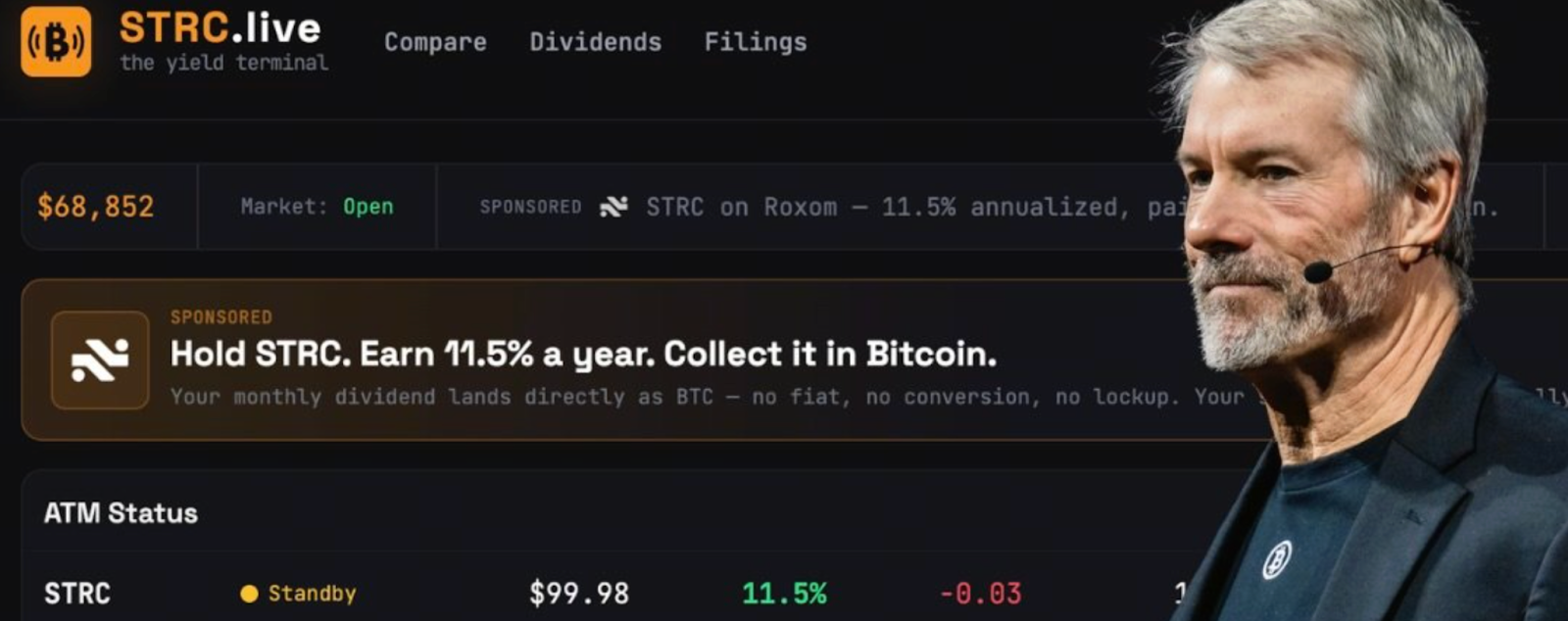
STRC: Integrating Crypto Assets with Fixed Income (Source: RoxomTV)

During his presentation, Saylor highlighted Strategy’s STRC preferred stock product. Nicknamed “Stretch,” STRC is designed as an asset suitable for fixed income portfolios.

Key features of STRC include:

  • Annual Percentage Yield (APY): approximately 11.5%
  • Volatility: around 2%
  • Sharpe Ratio (risk-adjusted return): close to 4
  • Notional size: about $5 billion
  • Average daily liquidity: roughly $224 million

With its market size and trading liquidity, STRC is now accessible to institutional investors.

Saylor argues that a financial instrument with such a strong risk-return profile should, in theory, be included in a broad range of investment portfolios.

Three-Layer Structure: Saylor’s Digital Asset Model

At the event, Saylor presented a three-layer framework to illustrate the future of digital financial markets.

This model comprises three distinct layers:

  1. Digital Equity

This layer captures the upside potential of assets but comes with higher volatility. Examples include Bitcoin-related equities or high-growth assets.

  1. Digital Capital

This middle layer carries a balanced level of risk and return, positioned between equity and credit assets.

  1. Digital Credit

Saylor sees this as the most promising layer. These assets aim to deliver stable returns with very low volatility, relying on the long-term appreciation of underlying Bitcoin holdings.

In his charts, the price curve for digital credit remains nearly flat, while the underlying Bitcoin assets steadily gain value.

Volatility Compared to Traditional Assets

When comparing volatility across asset classes, STRC stands out for its relative stability.

Saylor’s data shows STRC’s volatility is even lower than that of bonds, the S&P 500 Index, gold, Microsoft, Google, and even Bitcoin itself. This performance makes STRC exceptional in terms of risk-adjusted returns.

Saylor notes that STRC’s Sharpe Ratio ranks at the forefront of the market—potentially in the top 1%, or even the top 0.1%, of publicly traded securities worldwide.

Institutional Capital and the Crypto Market Gap

In recent years, institutional investors have returned to the Bitcoin market through regulated products such as US Bitcoin spot ETFs. This year, these ETFs have experienced continuous capital inflows. However, Saylor points out that crypto allocations in assets managed by US financial advisors remain below 0.5%, highlighting significant untapped growth potential. Products like STRC, which offer yield, may be more appealing to traditional investors.

Market Skepticism and Potential Risks

Despite STRC’s status as an innovative financial instrument, it has faced some market skepticism.

Some analysts have questioned whether the product’s yield can be maintained long-term, citing several key factors:

  • Whether Bitcoin prices continue to rise
  • Whether Strategy can continue to raise capital on favorable terms
  • How the product performs during market downturns

If the market endures a prolonged slump, this capital-market-dependent model could face significant pressure.

Conclusion

Michael Saylor’s digital credit concept seeks to bridge Bitcoin with the traditional fixed income market, creating new asset classes for investors. STRC exemplifies this approach, offering low volatility and high yield to attract institutional capital seeking stable returns. While this model still faces the test of future market cycles, it highlights the growing maturity and multi-layered structure of crypto finance.

Author:  Allen
Disclaimer
* The information is not intended to be and does not constitute financial advice or any other recommendation of any sort offered or endorsed by Gate.
* This article may not be reproduced, transmitted or copied without referencing Gate. Contravention is an infringement of Copyright Act and may be subject to legal action.

Share

Crypto Calendar
Tokens Unlock
Wormhole will unlock 1,280,000,000 W tokens on April 3rd, constituting approximately 28.39% of the currently circulating supply.
W
-7.32%
2026-04-02
Tokens Unlock
Pyth Network will unlock 2,130,000,000 PYTH tokens on May 19th, constituting approximately 36.96% of the currently circulating supply.
PYTH
2.25%
2026-05-18
Tokens Unlock
Pump.fun will unlock 82,500,000,000 PUMP tokens on July 12th, constituting approximately 23.31% of the currently circulating supply.
PUMP
-3.37%
2026-07-11
Tokens Unlock
Succinct will unlock 208,330,000 PROVE tokens on August 5th, constituting approximately 104.17% of the currently circulating supply.
PROVE
2026-08-04
sign up guide logosign up guide logo
sign up guide content imgsign up guide content img
Sign Up

Related Articles

In-depth Explanation of Yala: Building a Modular DeFi Yield Aggregator with $YU Stablecoin as a Medium
Beginner

In-depth Explanation of Yala: Building a Modular DeFi Yield Aggregator with $YU Stablecoin as a Medium

Yala inherits the security and decentralization of Bitcoin while using a modular protocol framework with the $YU stablecoin as a medium of exchange and store of value. It seamlessly connects Bitcoin with major ecosystems, allowing Bitcoin holders to earn yield from various DeFi protocols.
2026-03-24 11:55:44
The Future of Cross-Chain Bridges: Full-Chain Interoperability Becomes Inevitable, Liquidity Bridges Will Decline
Beginner

The Future of Cross-Chain Bridges: Full-Chain Interoperability Becomes Inevitable, Liquidity Bridges Will Decline

This article explores the development trends, applications, and prospects of cross-chain bridges.
2026-03-24 11:52:54
Solana Need L2s And Appchains?
Advanced

Solana Need L2s And Appchains?

Solana faces both opportunities and challenges in its development. Recently, severe network congestion has led to a high transaction failure rate and increased fees. Consequently, some have suggested using Layer 2 and appchain technologies to address this issue. This article explores the feasibility of this strategy.
2026-03-24 11:54:39
Sui: How are users leveraging its speed, security, & scalability?
Intermediate

Sui: How are users leveraging its speed, security, & scalability?

Sui is a PoS L1 blockchain with a novel architecture whose object-centric model enables parallelization of transactions through verifier level scaling. In this research paper the unique features of the Sui blockchain will be introduced, the economic prospects of SUI tokens will be presented, and it will be explained how investors can learn about which dApps are driving the use of the chain through the Sui application campaign.
2026-03-24 11:54:36
Navigating the Zero Knowledge Landscape
Advanced

Navigating the Zero Knowledge Landscape

This article introduces the technical principles, framework, and applications of Zero-Knowledge (ZK) technology, covering aspects from privacy, identity (ID), decentralized exchanges (DEX), to oracles.
2026-03-24 11:53:01
What is Tronscan and How Can You Use it in 2025?
Beginner

What is Tronscan and How Can You Use it in 2025?

Tronscan is a blockchain explorer that goes beyond the basics, offering wallet management, token tracking, smart contract insights, and governance participation. By 2025, it has evolved with enhanced security features, expanded analytics, cross-chain integration, and improved mobile experience. The platform now includes advanced biometric authentication, real-time transaction monitoring, and a comprehensive DeFi dashboard. Developers benefit from AI-powered smart contract analysis and improved testing environments, while users enjoy a unified multi-chain portfolio view and gesture-based navigation on mobile devices.
2026-03-24 11:52:42





