Pandu Pandas (PANDU) represents an emerging category of Web3 projects that merge artificial intelligence with blockchain technology, attracting users through interactive experiences rather than purely asset ownership. As AI technology advances rapidly, more projects are embedding large language models into on-chain applications, allowing users not only to “hold assets” but also to “use products.”
Within this trend, Pandu Pandas is categorized as an AI + Crypto application-layer project. Its focus is not on building foundational models or computational infrastructure, but on creating sustained interaction through an AI Companion system. This approach reflects a broader shift in Web3, from financial tools toward user-centric products, while also highlighting AI’s evolving role in the crypto ecosystem.
What is Pandu Pandas (PANDU)?
As a blockchain-based AI Companion project, Pandu Pandas integrates NFTs, token mechanisms, and meme culture into a unified interactive ecosystem. Its core objective is to build long-term relationships between users and AI characters, rather than offering one-time functional services.
Structurally, Pandu Pandas consists of three key components: an AI interaction system, on-chain identity (NFTs), and an incentive mechanism (PANDU Token). The AI generates content and drives interaction, NFTs define user identity and permissions, and the token facilitates circulation and incentives within the ecosystem.
Compared to traditional meme coins, Pandu Pandas go beyond community-driven virality by enhancing user engagement through real product functionality, creating more complex and meaningful use cases.

How Does Pandu Pandas Work? Core Module: AI Companion
AI Companion is the central feature of Pandu Pandas. At its core, it is an intelligent interaction system capable of contextual understanding and memory. Users communicate with AI characters through text or voice, while the system continuously adapts its responses based on user preferences.
A typical interaction follows several stages. First, the system performs semantic analysis and intent recognition on user input. Then, it constructs context using historical conversation data. Next, it generates a response through a language model, which is delivered in text or voice format. Throughout this process, key interaction data is recorded to improve future conversations.
Unlike traditional chatbots, AI Companion emphasizes continuity and personalization. Its goal is not to provide isolated answers, but to simulate a sense of companionship, creating interactions that feel coherent and context-aware over time.
Technical Architecture: PanduOS and Modular AI Systems
The technical foundation of Pandu Pandas is often described as a modular AI architecture, where core systems such as PanduOS integrate various functional modules to ensure flexibility and scalability.
This architecture typically includes several submodules:
-
Cognitive module, responsible for language understanding and generation
-
Voice module, enabling speech input and output
-
Creation module, generating images or other content
-
Data module, recording user behavior and preferences
The advantage of modular design lies in its adaptability. New interaction modes can be added, and generation capabilities can be improved over time. By combining AI systems with blockchain, certain data and identity elements can be linked to on-chain assets, forming a more stable and persistent user ecosystem.
Token and NFT Economy: The PANDU Model
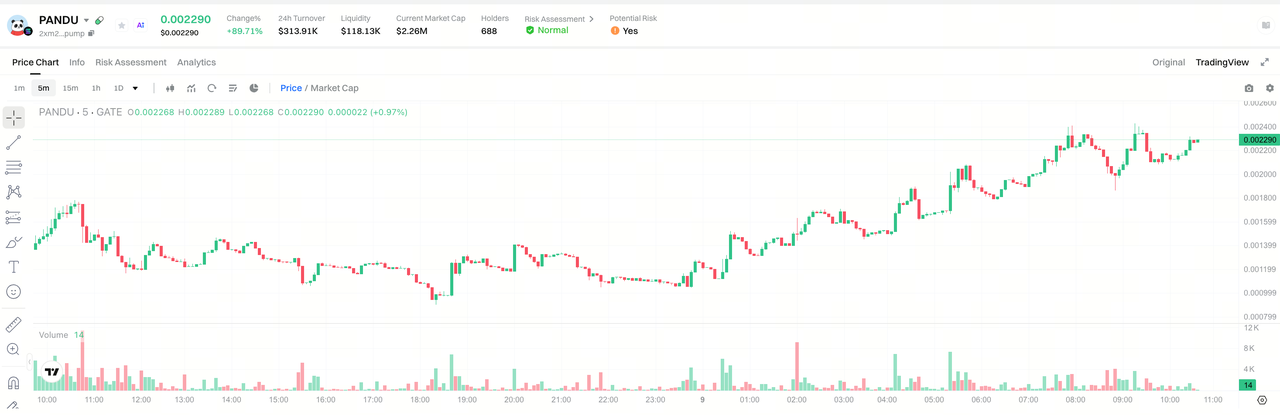
Pandu Pandas adopts a dual-layer economic structure combining tokens and NFTs. The PANDU Token is primarily used for incentives and circulation within the ecosystem, such as rewarding user participation, supporting community activities, or serving as a medium for accessing features.
NFTs function as identity and permission layers. The NFTs users hold may influence their AI Companion’s capabilities, interaction depth, or level of personalization. In some designs, NFTs can also be staked to earn additional rewards or ecosystem privileges.
The core idea behind this model is to link “usage behavior” with “asset ownership,” allowing users to become both participants and stakeholders, thereby strengthening ecosystem engagement and retention.
 Source: Gate
Use Cases: From Entertainment to Social AI
Pandu Pandas is primarily applied to AI interaction and social experience scenarios. Its most direct use case is as a digital companion, where users engage in everyday conversations with AI characters for emotional feedback or entertainment.
In addition, AI Companion can support content creation, including generating text, images, or personalized expressions. At the community level, the project enhances engagement through task systems, interaction mechanisms, and gamified design, gradually evolving into a social-oriented application.
This progression from entertainment to social interaction reflects a key direction for AI applications within Web3.
Pandu Pandas vs Dogecoin: Key Differences Between Meme Coins
Pandu Pandas and Dogecoin are both meme-driven crypto projects, making them natural points of comparison. However, their underlying logic differs significantly.
Dogecoin relies primarily on community culture and viral spread, with value largely driven by consensus and sentiment. In contrast, Pandu Pandas introduces AI functionality, enabling users to actively use the product, forming a dual structure of “functionality plus meme.”
In terms of usage, Dogecoin functions more like a payment or value storage tool, whereas Pandu Pandas emphasizes interactive experiences and long-term relationships. This distinction reflects the broader evolution of meme coins from purely cultural assets to application-driven products.
Advantages and Potential Limitations
Pandu Pandas’ main strength lies in its ability to merge narratives, combining AI, NFTs, and meme culture into a new product form. AI Companion enables continuous interaction, resulting in stronger user retention compared to traditional meme projects, while NFTs and token mechanisms provide structured incentives.

However, this model also comes with limitations. The quality of the AI experience directly impacts user retention; if interactions fall short, users may not stay engaged long term. Additionally, memory systems raise concerns around data privacy and management, requiring a careful balance between decentralization and user experience. Finally, the inherent volatility of meme projects remains, meaning long-term success depends on ongoing product iteration and active community participation.
Conclusion
Pandu Pandas is a Web3 application that integrates AI Companion, NFTs, and meme culture, with its core focus on building user relationships through interactive experiences. Unlike traditional crypto projects centered on trading, it emphasizes the “process of use” and emotional connection, reflecting Web3’s evolution from financial infrastructure toward user-focused products.
Within the AI + Crypto space, Pandu Pandas represents an application-layer approach driven by user experience. Whether this model can sustain long-term growth will depend on continuous improvements in AI capabilities, alignment with user needs, and the optimization of ecosystem incentives.
FAQs
Is Pandu Pandas (PANDU) a meme coin or an AI project
Pandu Pandas combines both meme attributes and AI functionality, making it a hybrid project distinguished by real-world use cases.
What is the difference between AI Companion and traditional chatbots?
AI Companion focuses on long-term memory and personalized interaction, while traditional chatbots typically provide one-time responses.
What is the primary function of the PANDU Token?
The PANDU Token is used for ecosystem incentives, feature access, and community participation, serving as the medium of value exchange within the system.
What role do NFTs play in Pandu Pandas?
NFTs act as identity markers and permission controls, and may also be linked to feature unlocks or incentive mechanisms.
What are the main use cases of Pandu Pandas?
Its applications include AI companionship, content creation, and social interaction.
Why are AI + Crypto projects gaining attention?
Because they combine intelligent generation capabilities with decentralized systems, potentially expanding the boundaries of blockchain applications.