As the DeFi market continues to mature, fixed income products are emerging as a key direction for on-chain finance. In traditional DeFi models, most returns come from variable-rate lending, staking rewards, or liquidity mining. While these offer profit opportunities, their yields are often volatile, making it difficult to meet the growing demand for stable returns and effective rate management. As a result, protocols that provide fixed income or interest rate control are becoming an essential part of DeFi infrastructure.
Pendle and Notional are two representative protocols in this space. Pendle uses yield tokenization to allow users to lock in returns or trade future yield streams, while Notional enables users to fix borrowing and lending rates in advance through its fixed-rate lending model. Although both address fixed income needs in DeFi, they differ significantly in core mechanisms and use cases. Comparing them helps clarify the broader direction of DeFi fixed income innovation.
Overview and Positioning Differences Between Pendle and Notional
Pendle is a DeFi protocol focused on yield tokenization. It splits yield-bearing assets into PT (Principal Tokens) and YT (Yield Tokens), allowing users to trade principal and future yield separately. Through this structure, Pendle creates an on-chain interest rate market where users can lock in fixed returns, speculate on yield movements, or hedge yield risk.
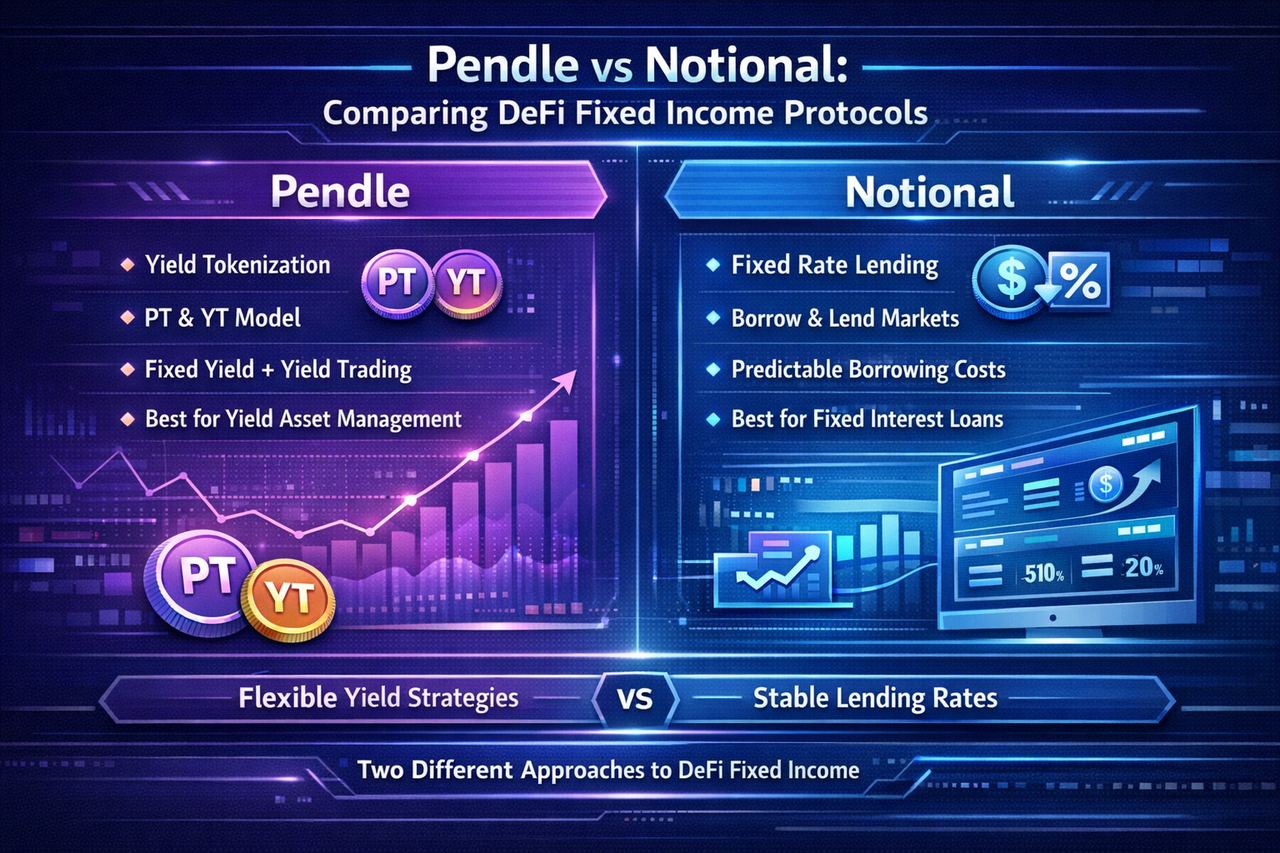
Notional, on the other hand, is a fixed-rate lending protocol. It allows users to lock in borrowing or lending rates for a set period, reducing uncertainty caused by fluctuating rates. Its core mechanism is a fixed-term lending market that provides predictable rates for both borrowers and lenders, making DeFi lending more similar to traditional finance products.
In terms of positioning, Pendle functions more as a yield asset trading market, while Notional operates as a fixed-rate lending platform.
Key Differences Between Pendle and Notional
Overall, while both protocols serve fixed income needs, Pendle focuses on yield asset management, whereas Notional centers on managing fixed borrowing and lending rates. They represent different directions within the same sector.
| Comparison Dimension |
Pendle |
Notional |
| Core Mechanism |
Splits yield assets into PT and YT |
Fixed-rate lending |
| Primary Functions |
Fixed yield, yield trading, yield hedging |
Fixed-rate borrowing and lending |
| Source of Returns |
PT discount yield and YT yield trading |
Lending spread |
| Supported Assets |
Yield-bearing assets (e.g., LSD, restaking assets) |
Lending assets (e.g., USDC, ETH) |
| Rate Formation |
Market-driven PT/YT pricing |
Determined by lending markets |
| Main Use Cases |
Yield management and speculation |
Fixed borrowing and lending needs |
| Risk Profile |
Yield volatility and liquidity risk |
Default risk and interest rate risk |
What Are Pendle’s Advantages?
Pendle’s biggest strength lies in its yield-splitting mechanism, which brings greater flexibility to yield-bearing assets. By separating PT and YT, users can choose between fixed returns or exposure to future yield, rather than passively accepting variable rates.
This design allows Pendle not only to offer fixed income, but also to support yield speculation and risk management. It effectively expands the financial utility of yield-bearing assets. With the rapid growth of LSD and restaking assets, Pendle’s ability to enable yield trading gives it a strong competitive edge in this market.
In addition, Pendle uses a specialized AMM to provide liquidity for yield assets, allowing yields to be priced by the market. This market-based pricing mechanism is a key distinction from traditional fixed income protocols.
What Are Notional’s Advantages?
Notional’s primary advantage lies in its fixed-rate lending mechanism. For borrowers, fixed rates reduce exposure to future rate fluctuations. For lenders, they provide predictable returns, improving income certainty.
Compared to yield tokenization, fixed-rate lending is easier to understand. Users simply select a loan term to lock in a rate, making the product more straightforward and accessible, especially for those with clear borrowing or lending needs.
By bringing traditional fixed-term lending models on-chain, Notional provides a more stable structure for returns and costs in DeFi lending, making it a key player in the fixed-rate lending space.
How Do Pendle and Notional Differ in Use Cases?
Pendle is better suited for users who already hold yield-bearing assets and want to optimize their returns. For example, users seeking stable income can purchase PT, while those expecting higher future yields can buy YT. Pendle functions more like a yield asset management platform, making it ideal for advanced yield strategies and risk management.
Notional, by contrast, is better suited for users with fixed borrowing or lending needs. If a user wants to borrow assets while locking in financing costs, or lend assets for stable returns, Notional offers a more direct and simple solution.
As a result, the two are not in direct competition, but instead serve different segments: yield management versus fixed-rate lending.
Which Has Greater Competitive Advantage: Pendle or Notional?
From a yield asset trading perspective, Pendle has a stronger advantage. Its yield-splitting model and interest rate market design offer greater flexibility and align well with the financialization of yield-bearing assets. As LSD and restaking assets continue to grow, Pendle’s potential use cases are likely to expand further.
From a fixed lending perspective, however, Notional offers a more straightforward product structure. Its fixed-rate lending mechanism is highly effective for users with clear borrowing or lending needs, though its scope for expansion is relatively limited.
Overall, Pendle shows greater long-term potential in yield asset management, while Notional maintains a strong position in fixed-rate lending.
Conclusion
Pendle and Notional are both key protocols in the DeFi fixed income sector, but they follow different development paths. Pendle uses PT and YT to provide fixed returns, yield speculation, and risk management tools, making it well suited for yield asset markets. Notional, through fixed-rate lending markets, offers rate certainty for borrowers and lenders, making it ideal for fixed lending scenarios.
As the DeFi fixed income space continues to evolve, both models will play important roles in different contexts. From a long-term perspective, Pendle’s yield market design offers greater scalability and may take on a more prominent role in the on-chain interest rate ecosystem.
FAQs
What is the main difference between Pendle and Notional?
Pendle enables fixed returns and yield trading through yield splitting, while Notional provides fixed returns through fixed-rate lending.
Who is Pendle best suited for?
Pendle is ideal for users who want to lock in yields, trade future returns, or manage yield-related risks.
Who is Notional best suited for?
Notional is best for users with fixed borrowing or lending needs who want to lock in interest rates in advance.
Which has greater growth potential, Pendle or Notional?
Pendle has greater scalability in yield asset markets, while Notional holds a strong position in fixed-rate lending.
Are Pendle and Notional competitors?
They operate within the same fixed income sector but serve different needs, making them more complementary than directly competitive.