Solana is a decentralized blockchain network designed with high throughput and low latency as its core objectives, aiming to provide high-performance infrastructure for smart contracts and decentralized applications. As blockchain technology continues to expand into decentralized finance, digital asset issuance, and on-chain interactive applications, network performance and scalability have become critical constraints. Solana was therefore designed to improve execution efficiency through innovations at the base architecture level.
This article analyzes Solana from multiple dimensions, including its definition, technical principles, network structure, token model, sources of performance, and ecosystem, helping readers build a complete and structured understanding.
What Is Solana? Definition and Core Positioning of a High-Performance Public Blockchain
Solana is a Layer 1 public blockchain that supports smart contracts. Its design focuses on improving transaction processing capacity through base-layer technical optimization rather than relying on external scaling layers or sharding structures. Unlike approaches that emphasize modular scaling or off-chain computation, Solana completes time ordering, transaction execution, and state updates directly on the main chain, achieving a higher level of system integration.
Within blockchain systems, public chains typically serve both asset recording and contract execution functions. Solana is positioned not only as a value transfer network, but also as a distributed computing environment designed for high-frequency applications. This means its design goals include not only security and decentralization, but also high performance and real-time responsiveness.
Founder Anatoly Yakovenko, a former Qualcomm engineer, introduced the concept of Proof of History in 2017 to address the trust problem around time in distributed systems. This enables Solana to approach the responsiveness of traditional centralized systems.
As a result, Solana is often regarded as a representative of performance-first public blockchain architecture. Its core logic lies in reducing communication overhead between nodes and improving parallel execution capabilities to overcome traditional blockchain throughput limitations. As of 2026, Solana mainnet throughput has stabilized at approximately 3,000 to 5,000 TPS, with higher peak capacity possible. Firedancer testing has demonstrated a theoretical upper limit reaching millions of TPS, making Solana particularly suitable for high-frequency trading, real-time gaming, and large-scale DeFi applications.
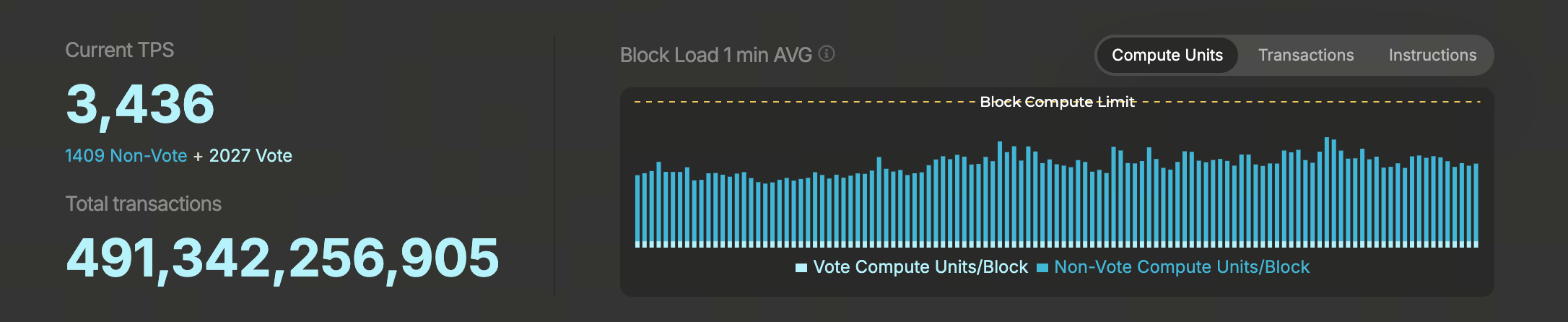
Image source: Solana Beach official website
The Origins of Solana: Blockchain Scalability Challenges and Performance Constraints
Early blockchain designs emphasized decentralization and security, but exposed performance bottlenecks in real-world operation. Long confirmation times, limited throughput, and network congestion leading to volatile fees all negatively affected application usability. Bitcoin processes roughly 7 TPS, while early Ethereum handled approximately 15 to 30 TPS, making high-frequency on-chain interactions such as in-game microtransactions or real-time order books impractical.
Scalability challenges are often summarized as the blockchain trilemma, where security, decentralization, and scalability must be balanced. Some networks address scalability through Layer 2 solutions such as optimistic rollups and zero-knowledge rollups, or through sharding as seen in Ethereum’s roadmap. Solana instead optimizes the underlying time structure and execution architecture.
This vertically integrated approach avoids the complexity introduced by Layer 2 solutions, such as bridge risks and data availability issues, but requires the main chain itself to achieve extremely high hardware and network efficiency.
Solana emerged as a direct response to debates during 2017 to 2018 around the blockchain trilemma. Yakovenko argued that traditional blockchain bottlenecks stem from repeated negotiation over event ordering. By introducing a verifiable time mechanism, Solana fundamentally restructured the pre-consensus process.
This design treats performance as an architectural issue rather than an auxiliary layer problem. By changing time synchronization and execution logic, Solana aims to achieve high throughput at the main-chain level while maintaining single-chain state consistency.
Solana’s Core Technical Principles: Proof of History and Consensus Design
Solana’s core innovation is Proof of History. Proof of History is not an independent consensus algorithm, but a verifiable time-ordering mechanism. Its role is to establish an objective record of event ordering in a distributed environment, reducing the need for repeated timestamp negotiation among nodes.
In traditional blockchains, nodes repeatedly broadcast and confirm messages to agree on block time and transaction order, increasing network latency. Proof of History generates a time sequence through continuous hash computation, embedding verifiable timestamps into transactions and reducing synchronization overhead.
Technically, Proof of History uses the SHA-256 hash function to construct a Verifiable Delay Function chain. Starting from a random seed, hashes are computed sequentially, with each output serving as the next input while recording the number of iterations. This process is single-threaded and sequential, but the passage of time can be independently verified because the hash function is irreversible and computationally intensive.
On top of this time structure, Solana integrates Proof of Stake for block confirmation and security. Proof of Stake selects validators and mitigates malicious behavior, while Proof of History provides the temporal framework. Together, they form Solana’s consensus model. A leader packages transactions based on the Proof of History sequence, while other validators use Tower BFT, a Proof of History-optimized variant of PBFT, to vote and confirm blocks, achieving sub-second finality.
This design separates time ordering from state confirmation, structurally improving efficiency. By 2026, with the ongoing development of the Alpenglow upgrade that replaces Proof of History and Tower BFT with Votor and Rotor components, finality has been further optimized to approximately 100 to 150 milliseconds, approaching Web2-level responsiveness.
Solana’s Network Architecture and Node Role Distribution
The Solana network is maintained by validators, leaders, and standard nodes. Validators execute transactions and maintain the ledger, while leaders rotate under a deterministic, stake-weighted schedule to produce blocks. Leader rotation is recalculated every epoch, which lasts approximately two days.
Solana introduces multiple performance-oriented components that collectively form its high-performance architecture:
- Turbine: A hierarchical data propagation protocol inspired by BitTorrent. It splits block data into small packets and distributes them through a tree-like structure, significantly reducing bandwidth requirements and accelerating network-wide synchronization.
- Gulf Stream: A mempool-less transaction forwarding mechanism. Transactions are forwarded directly to the current and upcoming leaders instead of entering a global waiting pool, reducing congestion and processing delays.
- Sealevel: A parallel execution engine that forms the core of the Solana Virtual Machine. As long as smart contracts do not access conflicting accounts, thousands of instructions can be executed in parallel, far exceeding the sequential execution model of EVM-based chains.
- Tower BFT: A Proof of History-optimized Byzantine Fault Tolerance mechanism that reduces voting rounds and enables fast finality.
Sealevel is the key driver of Solana’s performance gains. Traditional blockchains rely on sequential execution, while Solana allows parallel execution when account access does not conflict. This architecture more closely resembles high-performance distributed computing systems rather than simple ledger structures. Nodes require high-specification hardware, which represents a decentralization tradeoff.
The Role and Economic Model of the SOL Token
SOL is the native token of the Solana network and serves several functions:
- Paying transaction fees, which are typically extremely low and often below $0.001
- Participating in staking to secure the network, with current annualized yields of approximately 6% to 7%
- Acting as a medium of value exchange within the ecosystem, including DeFi and NFTs
Solana issues SOL under an inflationary model. Newly issued tokens are distributed to validators and stakers as block rewards, providing incentives for network participation and security. The initial inflation rate was set at 8% and decreased by 15% annually, gradually approaching a long-term floor of around 1.5%. As of February 2026, the inflation rate is approximately 3.985 to 4.39%, depending on network conditions. The total supply is around 590 million SOL, with a circulating supply of roughly 520 million SOL and a staking rate of approximately 67%.
A portion of transaction fees may be burned or redistributed through mechanisms such as priority fees, introducing deflationary pressure. Together, these elements form an incentive loop in which users pay fees, validators maintain the network, and the ecosystem continues to operate sustainably. The core objective of SOL’s economic model is to support network security and long-term operation, rather than to function solely as a store-of-value asset.
Where Does Solana’s Performance Advantage Come From?
Solana’s performance results from multiple architectural innovations. The following table summarizes key comparative dimensions:
| Dimension |
Traditional Blockchains |
Solana |
| Time Management |
Relies on block propagation |
Proof of History time sequencing |
| Execution Model |
Sequential execution |
Parallel execution (Sealevel) |
| Data Propagation |
Network-wide broadcasting |
Layered propagation (Turbine) |
| Transaction Forwarding |
Global mempool |
Mempool-less forwarding (Gulf Stream) |
| Scaling Path |
Layer 2 or sharding |
Base-layer performance optimization |
| Finality Time |
Several seconds to several minutes |
~12 seconds currently, ~150 ms after Alpenglow |
| Theoretical TPS |
Tens to thousands |
65,000+, up to 1M+ in Firedancer tests |
Structurally, Solana’s advantages do not stem from a single technology, but from the combined effects of its time mechanism, execution engine, and data propagation protocol. It is important to note that this high-performance architecture requires relatively high hardware specifications for nodes, representing a deliberate design tradeoff.
Solana’s Ecosystem and Application Structure
The Solana ecosystem consists of the protocol layer, infrastructure layer, and application layer.
The protocol layer handles consensus and state updates. The infrastructure layer includes wallets such as Phantom and Backpack, node service providers such as Helius and QuickNode, and development tools including the Anchor framework and Solana Program Library. The application layer covers decentralized finance, NFTs, and on-chain gaming.
In DeFi, Solana supports decentralized trading through tools such as the Jupiter aggregator and Raydium, lending protocols like Kamino and Drift, and perpetual contracts. Its total value locked consistently ranks among leading public blockchains. In NFTs, low fees support high-frequency minting and trading through platforms such as Magic Eden and Tensor. In gaming, high throughput enables real-time interaction in projects like Star Atlas, Honeyland, and Aurory.
The ecosystem follows a layered organizational structure, with each layer interdependent and collectively forming a complete network environment.
Advantages and Potential Limitations of Solana
Key advantages include:
- High throughput with thousands of TPS in practice and much higher capacity after upgrades
- Low latency with near real-time finality
- Parallel execution capabilities
- Main-chain scaling design without reliance on Layer 2 solutions
Potential limitations include:
- High hardware requirements, which may increase validator concentration risk
- Architectural complexity, with early network outages caused by software issues
- Tradeoffs between performance and decentralization due to high entry barriers for validators
- Historical stability concerns, though mitigated through multi-client development such as Firedancer
Understanding Solana requires balancing performance metrics with structural considerations.
Differences Between Solana and Other Major Public Blockchains
Solana emphasizes main-chain performance optimization, while other public blockchains such as Ethereum rely on Layer 2 solutions or modular architectures, including data availability layers like Celestia.
In terms of time structure, Proof of History provides a unique ordering mechanism. In execution, Solana uses parallel processing, while many traditional networks continue to rely on sequential execution models such as EVM. These differences reflect divergent architectural philosophies rather than simple performance comparisons. Solana pursues single-chain optimization, while Ethereum focuses on modular scalability.
Summary
Solana is a performance-focused public blockchain that improves throughput and responsiveness through time-ordering mechanisms and parallel execution architecture. Its network structure, token economics, and ecosystem together form a complete blockchain infrastructure. The Firedancer and Alpenglow upgrades in 2026 further reinforce its leading position.
Understanding Solana requires a holistic analysis across technical principles, system architecture, and incentive mechanisms rather than relying on a single performance metric.
FAQ
Is Solana a Layer 1 blockchain?
Yes. Solana is an independent Layer 1 blockchain with its own mainnet, consensus mechanisms based on Proof of History and Proof of Stake, and state machine, without relying on other chains or Layer 2 solutions.
What is the primary role of the SOL token?
SOL is Solana’s native token and is used to pay very low transaction fees, participate in staking to secure the network and earn approximately 6% to 7% annual yield, and serve as a medium of value exchange within the ecosystem including DeFi, NFTs, and games.
Is Proof of History an independent consensus algorithm?
No. Proof of History is a verifiable time-ordering mechanism used to objectively record event order in a distributed environment. It works in combination with Proof of Stake, where Proof of History handles timestamping and ordering, while Proof of Stake governs validator selection and final confirmation.
Does Solana support smart contracts, and how is execution different?
Yes. Solana supports smart contracts through the Sealevel parallel execution engine, allowing multiple non-conflicting contracts to run simultaneously. This parallel execution model significantly exceeds the throughput of traditional sequential EVM-based execution.







