The heart of this debate isn't about "whether quantum resistance is necessary," but about "who has the authority to define ownership"
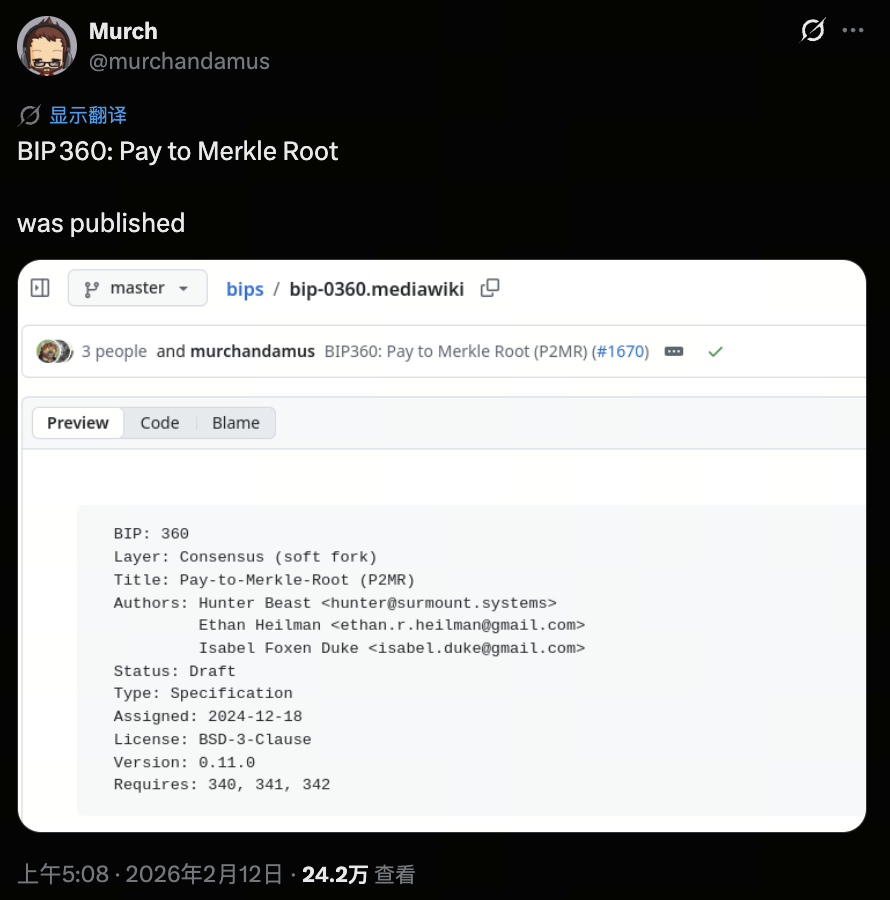
Image source: https://x.com/murchandamus/status/2021692852925857918
BIP-361 has sparked intense discussion within the community—not because quantum risk is a new topic, but because it raises a deeper question: can the protocol dictate that certain historically valid spending paths become invalid after a specific future date?
This strikes at the core of Bitcoin’s value proposition:
- Does “Not your keys, not your coins” remain an absolute principle?
- Is the boundary of protocol upgrades limited to “enhancing capabilities,” or can it also “revoke legacy capabilities”?
- When security and property rights conflict, which principle takes precedence?
In essence, this is not a typical technical proposal dispute—it’s a constitutional-level stress test for Bitcoin.
What BIP-361 Proposes: Migration, Sunset, Freezing, and Recovery
Based on the original documentation, BIP-361 is structured as a phased framework, not an immediate directive. Its outline is as follows:
- Phase A: Gradually restrict the ability to send new funds to quantum-vulnerable addresses, incentivizing migration.
- Phase B: At a later post-activation stage, sunset and invalidate legacy signature spending paths, effectively freezing assets that haven’t migrated.
- Phase C: Attempt to provide recovery mechanisms (such as proof-based remedies), though these remain incomplete.
This means the proposal goes beyond “how to create quantum-resistant addresses”—it’s about whether to impose systemic consequences on those who do not migrate.
Technically, BIP-361 is closely linked with BIP-360. BIP-360’s P2MR serves as the foundational layer, while BIP-361 acts as an accelerator for governance and migration mechanisms.
Why the Proposers Chose Such an Aggressive Approach
From the logic of the proposal and public statements, the motivation for this aggressive design is “preemptive risk management”:
- Once quantum threats cross a critical threshold, the impact could be systemic, not isolated.
- Waiting to migrate until the threat is explicit could lead to greater costs and chaos.
- Relying solely on voluntary migration may result in slow progress due to user inertia.
- By sunsetting legacy paths, strong incentives are created to accelerate migration.
In this context, BIP-361’s freezing mechanism is a game-theoretic tool—a means to an end, not the end itself. The goal is global, proactive migration; freezing is the punitive fallback.
The Real Concern Among Opponents Goes Beyond Freezing Satoshi’s Addresses
While public discourse often centers on “whether Satoshi’s addresses will be frozen,” the community’s deeper concerns are broader:
- Conditional property rights: If control of private keys requires completing upgrades by a set deadline, the definition of ownership fundamentally changes.
- Governance precedent: If legacy paths can be invalidated today due to quantum risk, could rules be further expanded for other reasons in the future?
- Asymmetry of enforcement and remedy: Freezing can be codified, but designing robust recovery mechanisms is extremely challenging. As long as remedies are incomplete, the risk of unintended losses remains systemic.
- Lack of social consensus: Bitcoin’s consensus relies not just on code correctness but on broad acceptance by economic nodes, users, and the broader culture.
Thus, the core opposition is not “no quantum resistance,” but “no default confiscatory pathways.”
The Biggest Weakness of BIP-361: Technical Path Exists, Social Consensus Does Not
The main challenge for BIP-361 isn’t technical feasibility—it’s the lack of a complete consensus chain.
Bitcoin upgrades require three layers to align:
- Technical: Solutions must be secure, implementable, and verifiable.
- Economic: Exchanges, miners, custodians, and wallets must support migration.
- Social: Users must accept new boundaries of property rights.
Technical and economic layers can progress with time and engineering, but social consensus is the hardest to achieve.
The intensity of the BIP-361 debate highlights how sensitive property boundaries remain within the Bitcoin narrative.
A More Practical Path: Achieve “Migratability” Before Discussing “Freezability”
If the goal is to strengthen post-quantum resilience without fracturing consensus, a gradual approach is more feasible:
- First, complete the toolchain for quantum-resistant addresses and improve wallet usability.
- Use fees, default settings, and exchange support to increase voluntary migration rates.
- Establish open, transparent risk thresholds, rather than relying on abstract fears.
- Ensure recovery mechanisms are fully developed before introducing any punitive measures.
- Define each phase’s objective as “reducing exposure,” not “expanding the scope of freezing.”
This approach is slower, but aligns with Bitcoin’s historical governance style: conservative, incremental, and focused on social acceptability.
Conclusion: A Rehearsal of Bitcoin’s Governance Boundaries
The true value of BIP-361 may not be in whether it passes as written, but in forcing the community to confront an inevitable question:
When future security conflicts with current property rights, how will Bitcoin prioritize its principles?
- In the short term, BIP-361 serves as a framework for intense debate, not an imminent upgrade.
- It will institutionalize and prolong the post-quantum migration conversation.
- Ultimately, it may lead to a more moderate migration consensus, rather than a direct freezing approach.
In short, BIP-361 is a mirror. It reflects not only the quantum threat but also the price Bitcoin is willing to pay for immutability.







