As the blockchain ecosystem gradually shifts from a single-chain model to a multichain landscape, demand for interoperability between assets and applications on different chains is growing rapidly. Bitcoin, Ethereum, and other public chains each have their own asset systems and user ecosystems, but assets usually cannot move freely and directly between chains. This makes cross-chain infrastructure an important bridge connecting the broader multichain ecosystem.
Whether users are transferring assets or making cross-chain trades, they need cross-chain protocols to move value between different blockchains. Without efficient cross-chain infrastructure, liquidity across the multichain ecosystem would remain fragmented, reducing the efficiency of asset use. For this reason, cross-chain bridges and cross-chain liquidity protocols are becoming important parts of DeFi infrastructure, while THORChain offers a new cross-chain liquidity solution in this context.
THORChain’s Unique Position in Cross-Chain Liquidity
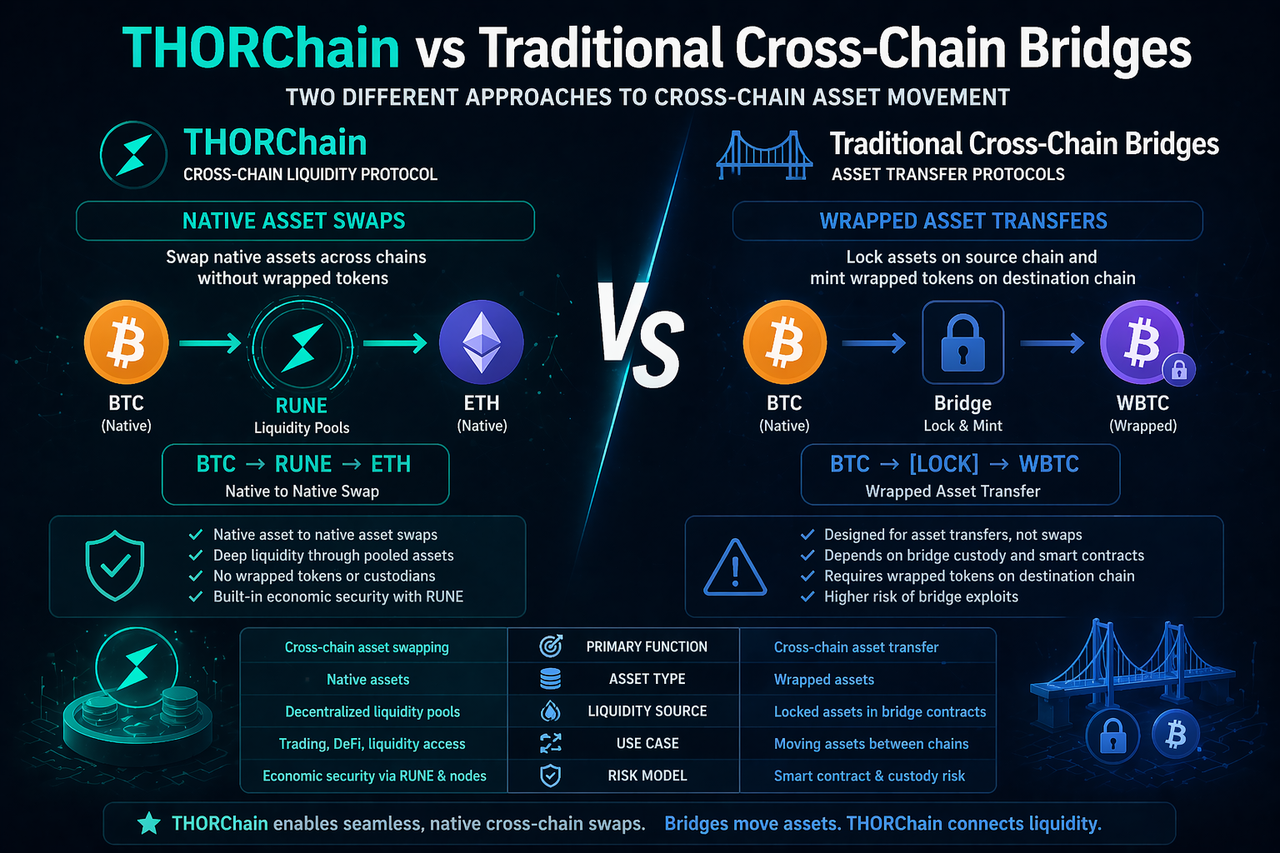
Within cross-chain infrastructure, traditional cross-chain bridges mainly solve the problem of “asset transfer,” while THORChain focuses on solving the problem of “native asset swaps.” The main goal of traditional bridge protocols is to map an asset from one chain onto another chain. THORChain’s goal, by contrast, is to let users exchange native assets directly across different blockchains.
This difference gives THORChain a distinct position in the cross-chain liquidity sector. It not only addresses cross-chain asset movement, but also enables cross-chain asset swaps through liquidity pools, creating a link between decentralized trading and cross-chain infrastructure. This model offers a more efficient way for assets to move in multichain DeFi and makes THORChain an important representative among cross-chain liquidity protocols.
How Do Traditional Cross-Chain Bridges Work?
Traditional cross-chain bridges usually work by “locking native assets and minting mapped assets.” For example, when a user transfers BTC to the Ethereum network, the cross-chain bridge first locks BTC in a custody address on the Bitcoin chain, then mints an equivalent amount of WBTC on Ethereum. The user can then use that asset within the Ethereum ecosystem.
This model enables cross-chain asset transfers, but what the user holds is actually a wrapped asset rather than the native asset itself. Although this approach improves the usability of assets across different chains, it also introduces custody risk and bridge contract risk, because the value of the wrapped asset depends on the security of the assets locked by the bridge protocol.
How Does THORChain Enable Native Cross-Chain Asset Swaps?
THORChain uses a mechanism that differs from traditional cross-chain bridges. It enables cross-chain swaps between native assets through liquidity pools and RUNE as an intermediary settlement asset. When a user wants to swap BTC for ETH, the protocol completes the swap through two liquidity pools, BTC/RUNE and ETH/RUNE, following the path BTC → RUNE → ETH.
This model means users can swap native BTC directly for native ETH without first converting BTC into a wrapped asset. THORChain completes asset settlement through decentralized liquidity pools and a node network, making cross-chain asset movement more direct and reducing reliance on bridged wrapped assets.
What Are the Core Differences Between THORChain and Traditional Cross-Chain Bridges?
The biggest difference between THORChain and traditional cross-chain bridges lies in how they handle assets and what each protocol is designed to do. Traditional cross-chain bridges mainly move assets from one chain to another, while THORChain uses liquidity pools to enable direct swaps between native assets on different chains.
| Comparison Dimension |
THORChain |
Traditional Cross-Chain Bridges |
| Core Function |
Cross-chain swaps of native assets |
Cross-chain asset transfers |
| Asset Form |
Native assets |
Wrapped assets |
| Swap Method |
Liquidity pool swaps |
Locking + minting mapped assets |
| Wrapped Assets Required |
No |
Yes |
| Liquidity Source |
Decentralized liquidity pools |
Bridged asset reserves |
| Main Use |
Cross-chain trading |
Cross-chain transfers |
| User Experience |
Direct asset swaps |
Bridge first, then trade |
| Main Risks |
Liquidity and protocol risks |
Contract and custody risks |
From an asset format perspective, traditional cross-chain bridges rely on wrapped assets, so users hold mapped assets on the target chain. THORChain, on the other hand, supports native asset swaps and avoids the complexity that comes with wrapped assets. From a liquidity perspective, traditional cross-chain bridges rely on bridged reserves, while THORChain relies on decentralized liquidity pools to provide asset depth. As a result, the two differ fundamentally in their functional positioning and liquidity logic.
What Advantages Does THORChain Have Over Traditional Cross-Chain Bridges?
THORChain’s core advantage is that it enables direct swaps between native assets while reducing the number of steps users need to take. A traditional bridging process usually requires users to first bridge assets to the target chain and then trade them. THORChain can complete the cross-chain swap in a single process, improving transaction efficiency.
In addition, THORChain integrates cross-chain liquidity through liquidity pools, allowing assets on different chains to be exchanged directly. This design improves the efficiency of cross-chain asset use and reduces reliance on wrapped assets, giving it clear advantages in multichain DeFi scenarios.
Conclusion: Which Is Better for Cross-Chain Trading, THORChain or Traditional Cross-Chain Bridges?
THORChain and traditional cross-chain bridges provide solutions for different cross-chain needs. Traditional cross-chain bridges are mainly used for asset transfers, allowing assets to enter other chain ecosystems through locking and mapping mechanisms. THORChain, by contrast, enables direct swaps between native assets through liquidity pools, making it better suited for cross-chain trading scenarios.
As the multichain ecosystem continues to develop, demand for cross-chain liquidity is rising, and THORChain’s native asset swap model is showing stronger advantages in liquidity efficiency. For users who need to trade assets across chains, THORChain offers a more efficient solution than traditional cross-chain bridges, while traditional bridges still play an important role in asset migration scenarios.
FAQs
What Is the Difference Between THORChain and Traditional Cross-Chain Bridges?
THORChain supports direct swaps between native assets, while traditional cross-chain bridges mainly use locking and wrapped asset minting to enable cross-chain transfers.
Why Does THORChain Not Need Wrapped Assets?
THORChain uses RUNE liquidity pools as an intermediary settlement layer, allowing direct swaps between native assets.
What Are Traditional Cross-Chain Bridges Best Suited For?
Traditional cross-chain bridges are suited for moving assets from one chain to another so they can be used within the target chain’s ecosystem.
What Is THORChain Best Suited For?
THORChain is better suited for cross-chain asset trading, such as swapping BTC directly for ETH without using wrapped assets.







