USDD Introduces WBTC Vaults to Unlock Bitcoin Liquidity in DeFi

Last Updated 2026-04-15 09:01:37
Reading Time: 4m
Amidst ongoing volatility and decreasing returns in the crypto marketplace, USDD has launched the WBTC Vault, enabling users to use WBTC as collateral to lend USDD stablecoin while maintaining their Bitcoin exposure. By utilizing over-collateralization and a tiered risk structure, this mechanism improves capital efficiency—allowing holders to pursue both return and holding strategies concurrently, rather than having to choose between them.

The Dilemma Between Holding Bitcoin and Pursuing Returns

In today’s market, crypto asset prices remain highly volatile, while DeFi yields continue to decline. This puts users in a classic bind: holding Bitcoin preserves its long-term growth potential, but without selling, it’s tough to access yield strategies. Switching to yield products can mean losing exposure to core assets. The WBTC Vault from USDD was created to solve this, letting users put their BTC to work without selling it.

WBTC: The Core Asset in the USDD Collateral System
(Source: usddio)

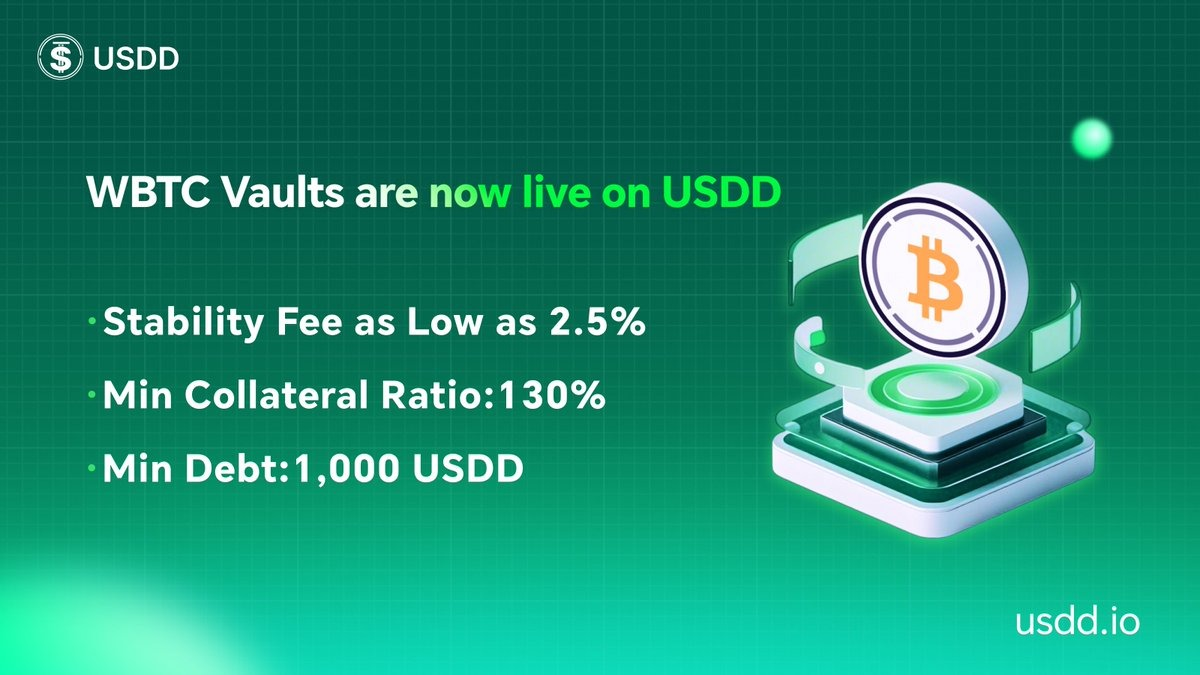
WBTC (Wrapped Bitcoin) is the on-chain representation of Bitcoin and has long served as a liquidity bridge in DeFi. By integrating WBTC, the USDD collateral system—originally focused on TRON native assets—now expands to include globally liquid Bitcoin assets.

This shift delivers several key advantages:

  • More diversified collateral assets

  • Stronger system risk resistance

  • Broader sources of available liquidity

  • Closer alignment with mainstream crypto markets

From a design standpoint, this isn’t just about adding assets—it’s a step toward greater overall stability.

How the WBTC Vault Works: Collateral and Minting in a Capital Cycle

The WBTC Vault operates on a straightforward mechanism:

  1. Users deposit WBTC as collateral

  2. The system mints USDD based on the collateral ratio

  3. Users deploy USDD in various yield strategies

  4. When ready, users repay and retrieve their WBTC

Common uses include liquidity strategies, yield farming, or cross-platform yield deployment.

The core benefits of this model:

  • No need to sell BTC

  • Simultaneous access to liquidity and yield opportunities

  • Significantly improved capital efficiency

Dual Vault Structure: Choices for Different Risk Preferences

To meet diverse user needs, USDD offers two types of WBTC Vaults:

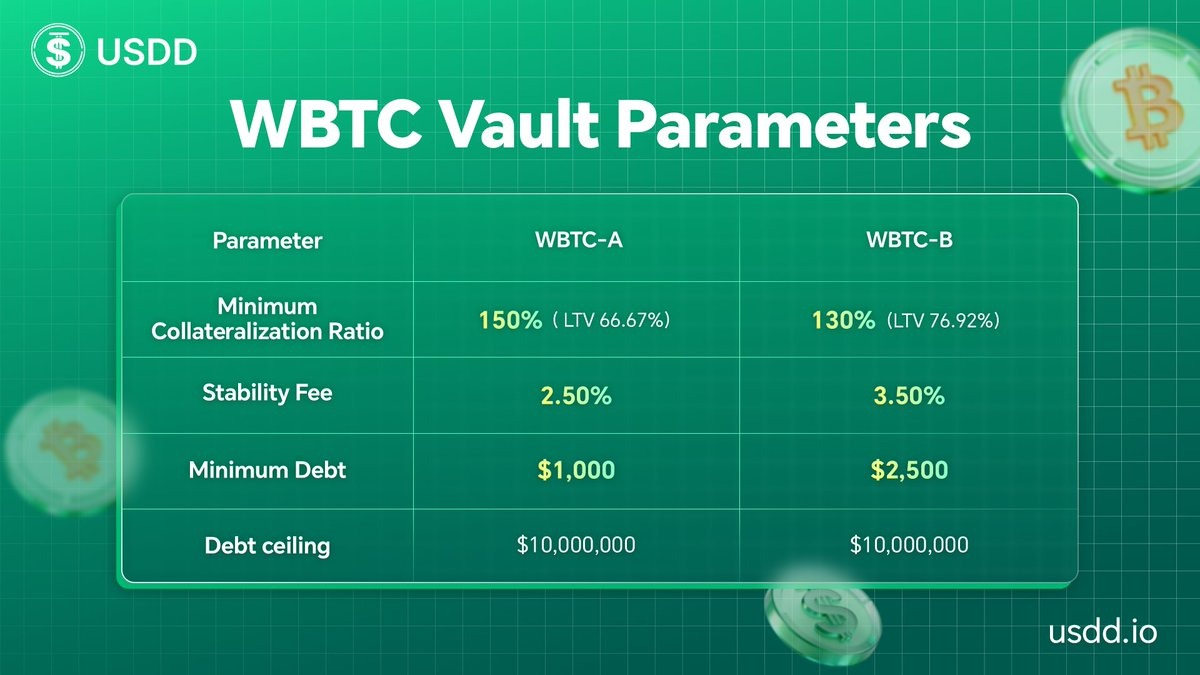
WBTC-A (Conservative)

  • Collateral ratio: approximately 150%

  • Lower interest rate (about 2.5%)

  • Prioritizes stability and minimal liquidation risk

Best for: long-term holders and risk-averse users

WBTC-B (Efficient)

  • Collateral ratio: approximately 130%

  • Interest rate around 3.5%

  • Allows higher leverage

Best for: users seeking aggressive strategies and capital amplification
(Source: usddio)

This tiered approach means the system goes beyond a single risk model, catering to a range of investment strategies.

Boosting Capital Efficiency: Lower Borrowing Costs by Design

Compared to traditional DeFi lending, the WBTC Vault stands out for its lower borrowing costs, starting at about 2.5%.

By comparison:

  • Traditional CDP systems typically have higher costs

  • Lending market rates are more volatile

  • Costs can spike during liquidity crunches

USDD is engineered to offer stable, predictable capital costs, enabling more controlled strategy execution.

Strategy Applications: From Lending Tool to Capital Efficiency Engine

The WBTC Vault isn’t just a collateralized lending tool—it supports advanced strategies:

  1. Leverage accumulation (Long Loop)

By repeating the cycle of collateralizing, borrowing, and buying more WBTC, users can amplify their BTC exposure.

  1. Yield arbitrage

Borrow USDD at low rates, deploy it in higher-yield DeFi opportunities, and profit from the rate differential.

These strategies turn the Vault into a true engine for capital efficiency.

Impact on the USDD Ecosystem

Adding WBTC brings three core benefits to the USDD protocol:

  1. Asset diversification: reduces reliance on a single ecosystem

  2. Lower correlation risk: BTC and TRON assets behave differently in volatile markets

  3. Greater stability in extreme conditions: Bitcoin’s high liquidity acts as a safety buffer

Overall, this evolution brings the USDD collateral model closer to a robust, multi-asset financial architecture.

Conclusion

The launch of the WBTC Vault marks a major upgrade in USDD’s approach to DeFi capital efficiency. By incorporating Bitcoin into its collateral system, users no longer have to choose between holding their assets and earning returns—they can do both. As the market’s demand for liquidity efficiency rises, structures that balance safety and flexibility are likely to become the blueprint for next-generation DeFi.

Disclaimer
* The information is not intended to be and does not constitute financial advice or any other recommendation of any sort offered or endorsed by Gate.
* This article may not be reproduced, transmitted or copied without referencing Gate. Contravention is an infringement of Copyright Act and may be subject to legal action.

Related Articles

In-depth Explanation of Yala: Building a Modular DeFi Yield Aggregator with $YU Stablecoin as a Medium
Beginner

In-depth Explanation of Yala: Building a Modular DeFi Yield Aggregator with $YU Stablecoin as a Medium

Yala inherits the security and decentralization of Bitcoin while using a modular protocol framework with the $YU stablecoin as a medium of exchange and store of value. It seamlessly connects Bitcoin with major ecosystems, allowing Bitcoin holders to earn yield from various DeFi protocols.
2026-03-24 11:55:44
The Future of Cross-Chain Bridges: Full-Chain Interoperability Becomes Inevitable, Liquidity Bridges Will Decline
Beginner

The Future of Cross-Chain Bridges: Full-Chain Interoperability Becomes Inevitable, Liquidity Bridges Will Decline

This article explores the development trends, applications, and prospects of cross-chain bridges.
2026-04-08 17:11:27
Solana Need L2s And Appchains?
Advanced

Solana Need L2s And Appchains?

Solana faces both opportunities and challenges in its development. Recently, severe network congestion has led to a high transaction failure rate and increased fees. Consequently, some have suggested using Layer 2 and appchain technologies to address this issue. This article explores the feasibility of this strategy.
2026-04-06 23:31:03
Sui: How are users leveraging its speed, security, & scalability?
Intermediate

Sui: How are users leveraging its speed, security, & scalability?

Sui is a PoS L1 blockchain with a novel architecture whose object-centric model enables parallelization of transactions through verifier level scaling. In this research paper the unique features of the Sui blockchain will be introduced, the economic prospects of SUI tokens will be presented, and it will be explained how investors can learn about which dApps are driving the use of the chain through the Sui application campaign.
2026-04-07 01:11:45
Navigating the Zero Knowledge Landscape
Advanced

Navigating the Zero Knowledge Landscape

This article introduces the technical principles, framework, and applications of Zero-Knowledge (ZK) technology, covering aspects from privacy, identity (ID), decentralized exchanges (DEX), to oracles.
2026-04-08 15:08:18
What is Tronscan and How Can You Use it in 2025?
Beginner

What is Tronscan and How Can You Use it in 2025?

Tronscan is a blockchain explorer that goes beyond the basics, offering wallet management, token tracking, smart contract insights, and governance participation. By 2025, it has evolved with enhanced security features, expanded analytics, cross-chain integration, and improved mobile experience. The platform now includes advanced biometric authentication, real-time transaction monitoring, and a comprehensive DeFi dashboard. Developers benefit from AI-powered smart contract analysis and improved testing environments, while users enjoy a unified multi-chain portfolio view and gesture-based navigation on mobile devices.
2026-03-24 11:52:42





