Not Claiming the Role of Savior
Vitalik Buterin recently made it clear that he doesn't see Ethereum as a cure-all for the world's problems. Still, amid growing concerns about unchecked power by governments and major corporations, he believes blockchain technology has real potential to shift the balance of power in the digital realm. In his view, reducing cryptocurrency to just an industry—or treating Ethereum as merely a business project—grossly undervalues its true potential.
Ethereum’s Role: Creating Digital Spaces
(Source: VitalikButerin)
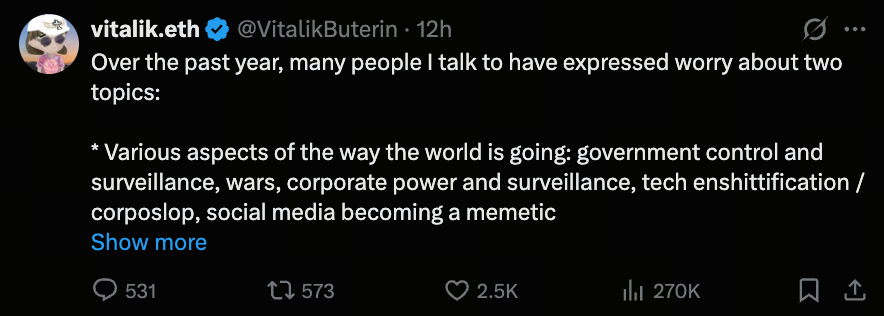
Buterin wrote on social media that Ethereum’s core mission is to build an open "digital space" where diverse communities can collaborate and interact.
He stressed:
-
The crypto industry shouldn't be defined solely by efficiency or flashy technology
-
There's no need to emulate the growth strategies of tech giants like Apple or Google
-
The industry should refocus on decentralization and the public good
He believes now is a pivotal moment for clearly defining these principles.
Addressing Social Criticism: Is Ethereum Driving Real Change?
Buterin acknowledged he's heard plenty of criticism that Ethereum hasn't made a tangible impact on real-world issues. Whether it's surveillance capitalism, armed conflict, or social media polarization, some question whether Ethereum is truly advancing core values like freedom, privacy, and community autonomy. In response, he says Ethereum needs to redefine its role.
Building Sanctuary Technologies
Buterin introduced the idea that Ethereum should be part of a "sanctuary technologies" ecosystem.
Such technologies are characterized by:
-
Being open-source and free
-
Supporting individuals’ daily lives and work
-
Enhancing digital privacy and asset security
-
Enabling community self-organization
-
Remaining resilient under external pressures
In other words, these technologies should prioritize resilience and autonomy over sheer efficiency.
De-Totalization: Reducing Power Concentration
Buterin introduced "de-totalization"—the goal of limiting the chance that any single government, corporation, or dominant entity can take total control.
He compared this to lowering the stakes in a battle for paradise: preventing winners from seizing overwhelming power and losers from being entirely excluded. In this framework, the digital world moves away from zero-sum competition toward coexistence among many stakeholders.
Echoing the Cypherpunk Ethos of the 1990s
Buterin’s perspective echoes the cypherpunk movement of the 1990s, whose advocates championed cryptographic tools to resist centralized surveillance and abuses of power, framing privacy and autonomy as digital age essentials. Now, he calls on developers to organize around shared values, making Ethereum more than a technology platform—it should be the backbone for resisting excessive centralization.
Summary
For Buterin, Ethereum isn’t about saving the world—it's about reshaping digital power structures. As governments and corporations amass increasing digital control, he believes blockchain offers a real alternative: open, decentralized systems that make absolute dominance by any single party nearly impossible.







