What Is Monad? A Comprehensive Guide to the High-Performance EVM Layer 1 Blockchain
Most mainstream EVM chains rely on a sequential execution model, which naturally limits TPS and confirmation speed. Even when Layer 2 solutions alleviate part of the scaling pressure, the underlying architectural bottlenecks remain. Monad addresses these constraints through parallel execution, a separation of consensus and execution, and optimized state storage design. All of this is achieved while maintaining full EVM compatibility.
This approach, often described as a “natively high performance EVM Layer 1,” gives Monad strategic relevance in use cases such as high frequency DeFi trading, onchain central limit order books, gaming, and real time interactive applications.
This article begins with the project’s background and vision, then examines Monad’s core technical architecture, performance advantages, and differences from Ethereum and other Layer 1 networks. It continues with an analysis of the MON token model, ecosystem development, and developer tooling. Finally, it outlines key risks and evaluates Monad’s potential position in the evolving blockchain landscape. The goal is to provide a structured and comprehensive understanding of Monad’s technical value and long term outlook.
What Is Monad? Project Background and Vision
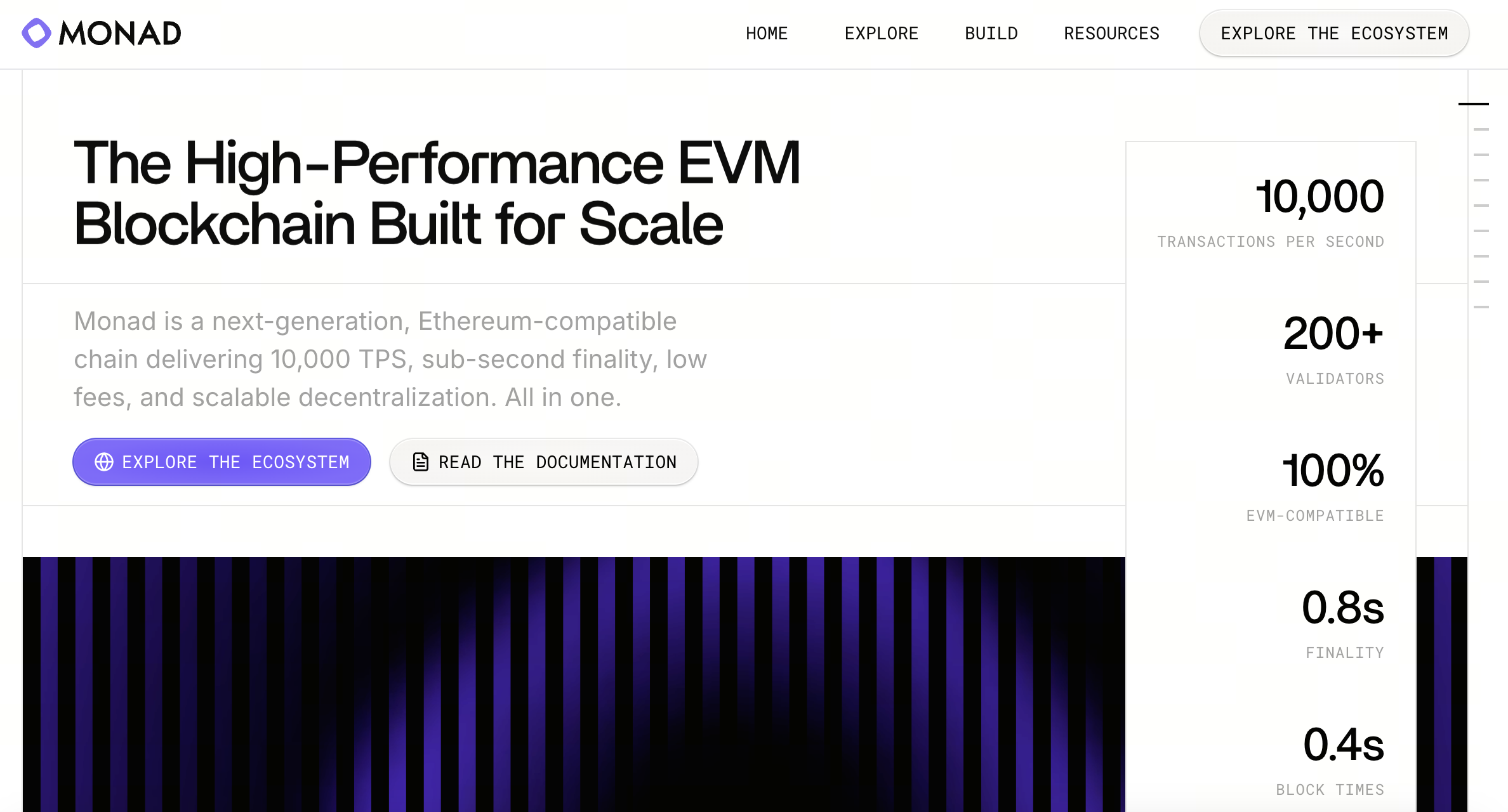
Image source: Monad official website
Monad is a next generation, EVM compatible Layer 1 blockchain protocol. It supports the Ethereum Virtual Machine (EVM) and its associated development tools while delivering performance far beyond traditional EVM based chains through a series of architectural innovations. Unlike conventional blockchains that rely on strictly sequential transaction execution, Monad enables large scale parallel processing, significantly increasing network throughput.
The core team behind Monad brings experience in both blockchain engineering and high performance systems. The project has received backing from prominent investment firms including Paradigm and Dragonfly. Its long term vision is to provide foundational infrastructure for high frequency, interactive applications such as DeFi platforms, decentralized exchanges, real time games, and prediction markets, while pushing the EVM ecosystem toward a new level of scalability.
How Does Monad Work? Core Technical Architecture
Monad’s performance gains stem from a combination of foundational technical innovations: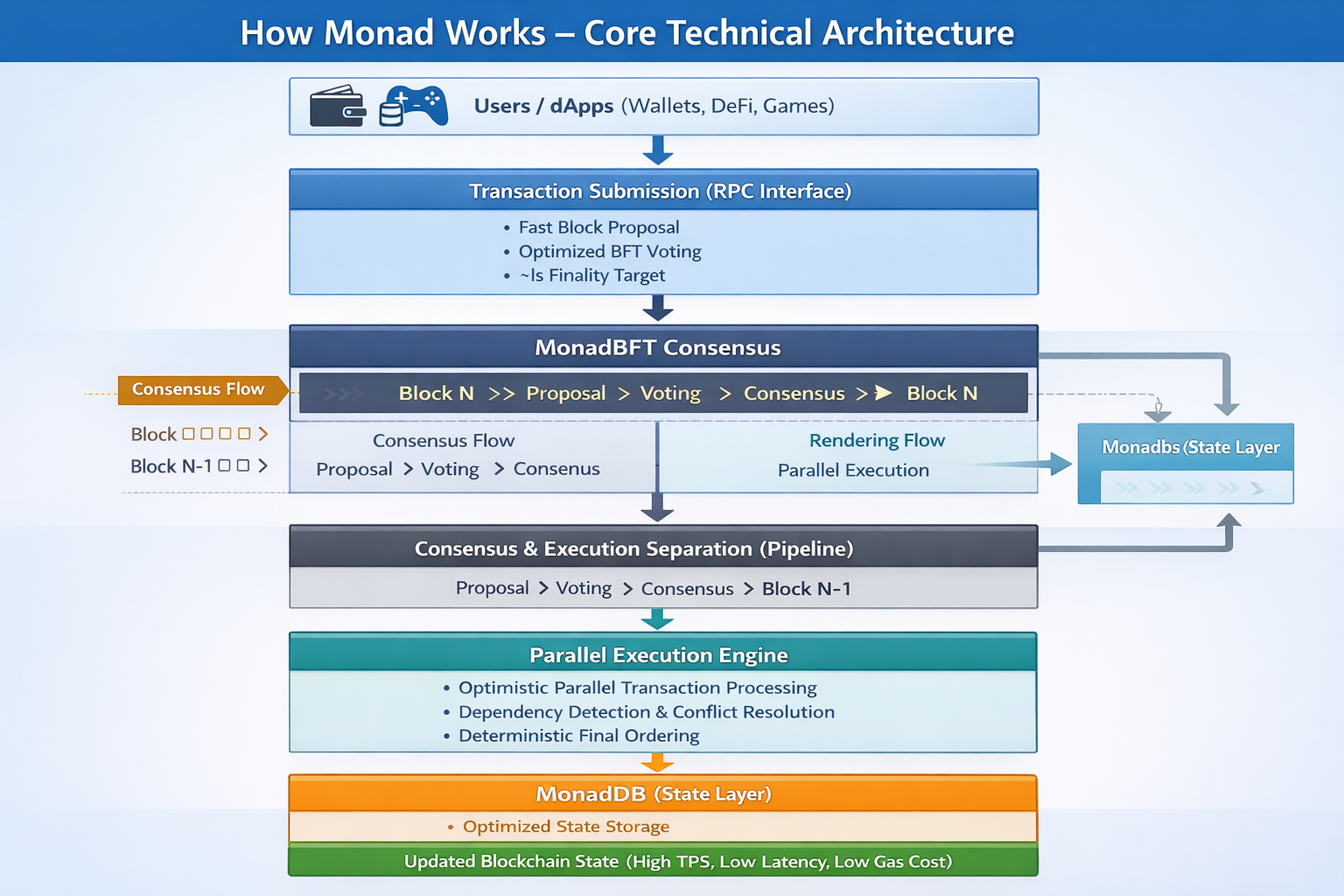
Parallel Execution
Traditional blockchains typically process transactions one by one. Monad introduces optimistic parallel execution, predicting dependencies between transactions and executing multiple transactions simultaneously. After execution, results are merged in the correct order to preserve deterministic state consistency, dramatically increasing TPS.
Delayed Execution and Consensus Separation
Monad separates block consensus from transaction execution. While consensus is being reached for the current block, transactions from the previous block can already be executed in parallel. This pipeline design reduces overall latency and improves efficiency.
Custom State Storage with MonadDB
To address EVM state access bottlenecks, Monad developed a specialized state database called MonadDB. It significantly optimizes storage and access performance for the Merkle Patricia Trie data structure, enabling efficient parallel state reads and writes.
MonadBFT Consensus Mechanism
Monad uses a Byzantine Fault Tolerant consensus protocol optimized for high performance. By reducing communication rounds and introducing responsive adjustments, MonadBFT strikes a balance between fast block production and strong security guarantees.
How Is Monad Different from Ethereum and Other Layer 1 Networks?
| Comparison Dimension | Monad | Ethereum (Ethereum) | Other High Performance L1s such as Solana and Aptos |
|---|---|---|---|
| Network Type | Natively high performance EVM Layer 1 | Traditional EVM Layer 1 | Mostly non EVM native architectures |
| Execution Model | Optimistic Parallel Execution | Sequential Execution | Typically parallel or concurrent execution models |
| Relationship Between Consensus and Execution | Consensus and execution separated, pipeline design | High coupling between execution and consensus | Varies by chain, often highly customized architectures |
| EVM Compatibility | Fully EVM compatible, no modifications required for Solidity contracts | Native EVM | Generally not fully compatible, requires dedicated languages |
| Theoretical TPS | Target of 10,000+ TPS | Approximately 15 to 30 TPS on mainnet | Typically thousands to tens of thousands TPS |
| Finality | Target of approximately 1 second | Several minutes for economic finality | Usually 1 to 2 seconds |
| Gas Costs | Designed for low fees | Highly variable, can be expensive during congestion | Generally low, but dependent on network structure |
| State Storage | Custom MonadDB optimized for state access | Traditional Merkle Patricia Trie | Each chain adopts its own optimized database design |
| Developer Migration Cost | Extremely low, existing EVM toolchain can be used directly | No migration cost | Requires learning new languages or tools |
| Ecosystem Maturity | In growth stage | Most mature, largest ecosystem | Some chains have relatively active ecosystems |
The core difference between Monad and Ethereum, as well as other major Layer 1 blockchains, lies in execution models and scaling strategy. Although Ethereum has the largest developer ecosystem, its single chain sequential execution architecture limits maximum throughput. Monad breaks through this ceiling by leveraging parallel execution and pipelined processing.
Compared with other high performance chains such as Solana, Monad’s defining advantage is full EVM compatibility. Ethereum tools, smart contracts, and wallets can work out of the box on Monad. Developers do not need to rewrite code in a new programming language to migrate or deploy applications.
Monad’s Performance Advantages: TPS, Finality, and Cost
In terms of performance metrics, Monad presents ambitious targets:
- Support for 10,000+ TPS throughput
- Block time of approximately 0.4 to 0.5 seconds
- Near 1 second single slot finality
- Extremely low transaction costs
This level of performance makes Monad particularly competitive for high frequency trading, central limit order book based decentralized exchanges, and real time gaming applications. It not only significantly outperforms Ethereum mainnet but also competes directly with other performance focused non EVM chains.
Monad’s Ecosystem Foundation and Developer Appeal
Monad attracts developers for several key reasons:
- Full EVM compatibility
- Familiar development toolchains such as Solidity, Hardhat, and MetaMask
- Extremely low gas fees
- Scalability designed specifically for high performance decentralized applications
In addition, community initiatives such as hackathons, accelerator programs, and ecosystem incentive campaigns help attract projects and foster a diverse and growing ecosystem.
MON Token Utility and Economic Model Overview
MON is Monad’s native token and serves as the core asset of the network at both the technical and economic levels.
- MON is used to pay onchain gas fees. Whether for simple transfers, DeFi interactions, or smart contract calls, MON is required. As network throughput and application activity increase, demand for MON is directly tied to onchain usage.
- MON functions as the staking asset in a Proof of Stake (PoS) mechanism. Validators must stake MON to participate in block production and earn rewards. Malicious behavior can result in slashing (penalties). This economic design secures the network while encouraging long term participation.
- MON also supports governance. Token holders can vote on protocol upgrades, parameter adjustments, and ecosystem fund allocations, helping decentralize network decision making.
From a tokenomics perspective, MON’s supply and demand dynamics are influenced by:
- Growth in transactions and application usage
- The proportion of tokens staked, which affects circulating supply
- Inflation rates and token release schedules
- Unlock schedules for the team and investors
Ultimately, MON’s value capture depends on the actual scale of ecosystem adoption and network activity, rather than market sentiment alone.
What Applications Are Emerging in the Monad Ecosystem?
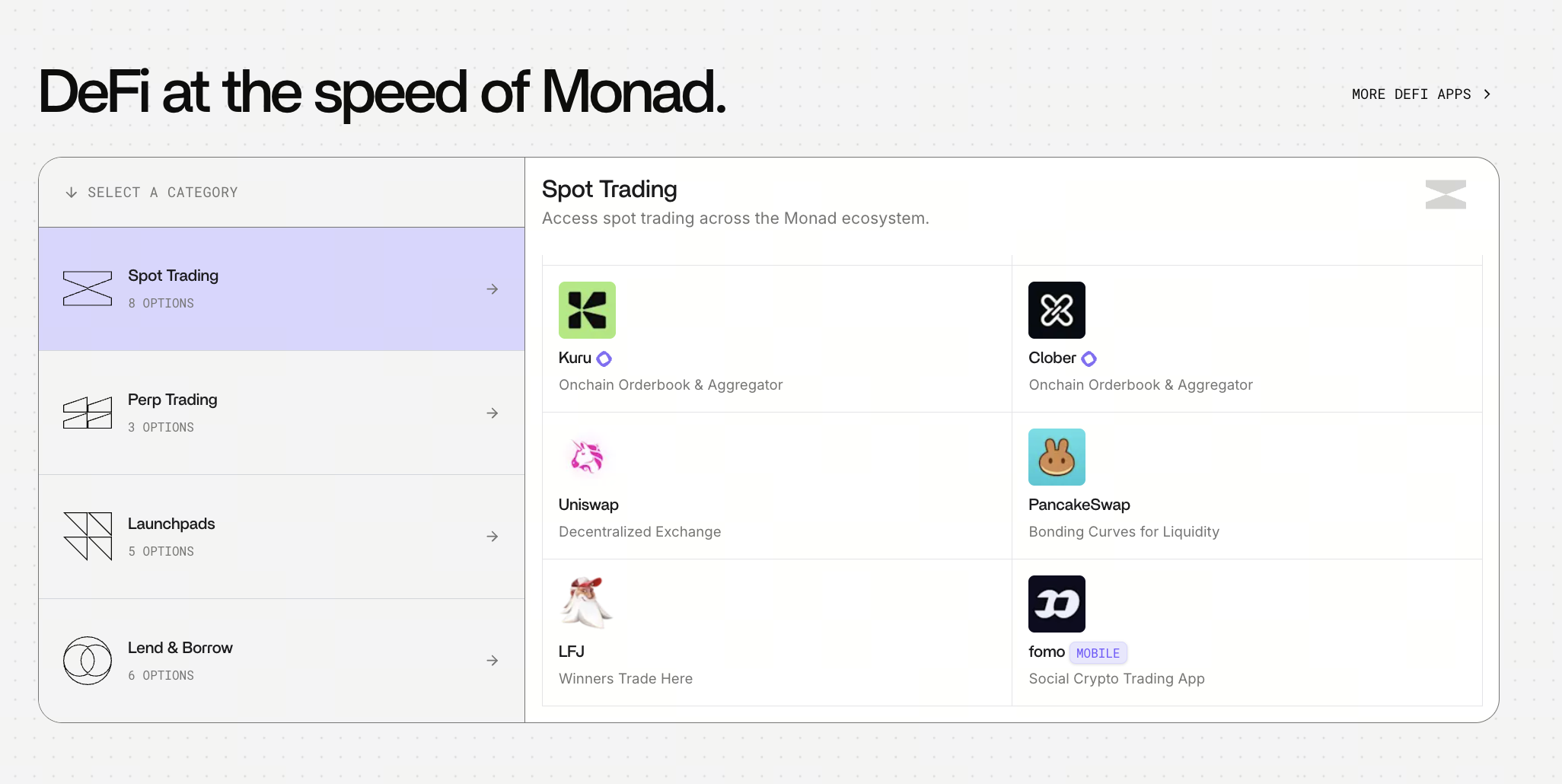
Image source: Monad official website
As testnet activity grows, the ecosystem has begun to see decentralized exchanges, lending protocols, NFT marketplaces, cross chain bridge protocols, and infrastructure services emerge. Infrastructure providers such as oracle services and wallet integrations are also actively integrating with Monad.
How Can Developers Get Started with Monad? Tools and Workflow
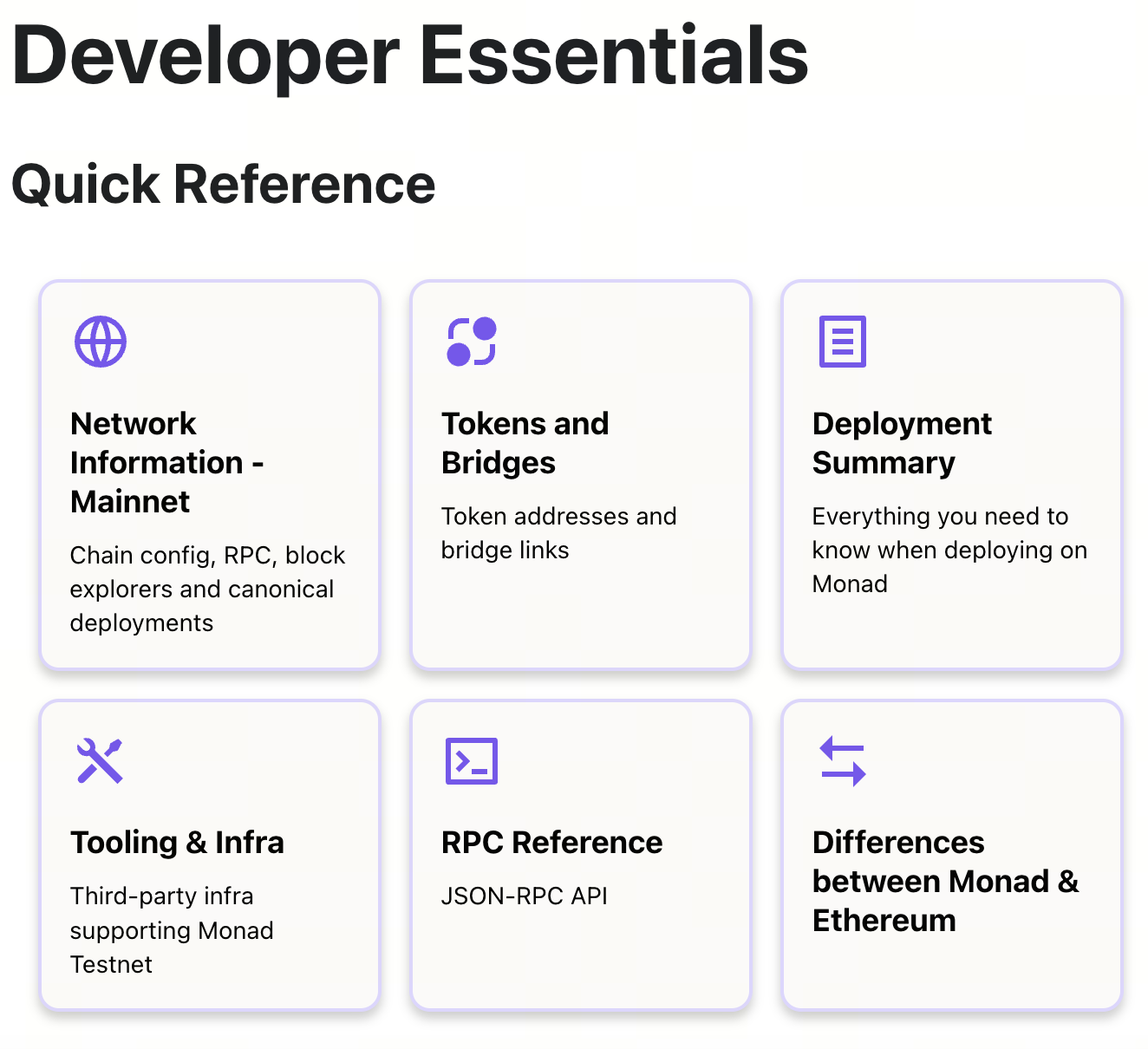
Image source: Monad official documentation
Developers can use familiar EVM tools such as Solidity, Hardhat, and Truffle to deploy and test contracts by connecting to Monad’s testnet RPC endpoints. Once the mainnet is live, the deployment workflow is expected to closely mirror the Ethereum deployment process, lowering the barrier to entry.
Risk Disclosure: What Should Participants Be Aware Of?
Despite its technical strengths, Monad carries certain risks:
- Mainnet data and real world performance still require long term validation
- Market competition is intense, and ecosystem activity must be monitored closely
- Token economics may involve dilution risks
- Engineering implementation and security audits remain critical factors
Investors and developers should conduct careful evaluations before participating.
Conclusion: Monad’s Potential and Future Direction
Overall, Monad represents a significant architectural step forward in blockchain performance. By expanding scalability without requiring migration away from the EVM ecosystem, it opens new possibilities for developers and users alike. As the mainnet matures and the ecosystem expands, Monad has the potential to become foundational infrastructure for high performance DeFi and real time applications.
FAQs
Can applications on Monad and Ethereum interoperate directly?
Monad maintains full EVM compatibility, and smart contracts can migrate seamlessly. However, asset interoperability still requires bridges or cross chain protocols.
Is Monad’s 10,000+ TPS target realistically achievable?
Testnet data shows strong performance, but final mainnet results will require real time validation.
What are the primary uses of the MON token?
It is used for transaction fees, governance participation, and staking in consensus, serving as the core economic driver of the ecosystem.
Is Monad suitable for beginner developers?
Because it is compatible with existing EVM tools, newcomers can get started easily with Solidity and standard testing workflows.
How fast is Monad’s ecosystem developing?
The testnet is active and multiple projects are participating. Ecosystem expansion is progressing positively, though it remains in a growth phase.
Share
Content
What Is Monad? Project Background and Vision
How Does Monad Work? Core Technical Architecture
How Is Monad Different from Ethereum and Other Layer 1 Networks?
Monad’s Performance Advantages: TPS, Finality, and Cost
Monad’s Ecosystem Foundation and Developer Appeal
MON Token Utility and Economic Model Overview
What Applications Are Emerging in the Monad Ecosystem?
How Can Developers Get Started with Monad? Tools and Workflow
Risk Disclosure: What Should Participants Be Aware Of?
Conclusion: Monad’s Potential and Future Direction
FAQs


Related Articles
What Are Altcoins?

What is Blum? All You Need to Know About BLUM in 2025

What Is Dogecoin?

What is GateToken (GT)?

What is Neiro? All You Need to Know About NEIROETH in 2025