Volatility Is the New Normal: Investment Tools Must Keep Pace
In today’s crypto market, waiting is no longer an edge. Price action is swift and reversals are frequent—sentiment can shift dramatically in a matter of moments. Instead of focusing on long holding periods, what matters most now is the ability to adjust positions instantly and respond before risk escalates.
This new market dynamic demands a reevaluation of investment tools. ETFs, once seen as long-term allocation instruments, are increasingly redefined as vehicles for short-term strategy execution. Leveraged ETFs, in particular, are attracting renewed interest among traders.
A Middle Ground for Those Avoiding Futures but Seeking Greater Efficiency
For most users, there’s a clear distinction between spot and futures trading: spot is intuitive and straightforward but offers limited capital efficiency; futures provide leverage and flexibility, but introduce margin requirements and liquidation risk.
Leveraged ETFs bridge this gap. They retain the simplicity of spot trading, while their structure amplifies the effect of price movements on capital. This allows traders to implement leveraged strategies without directly entering the futures market.
Gate Leveraged ETF Tokens: Let the System Handle the Complexity
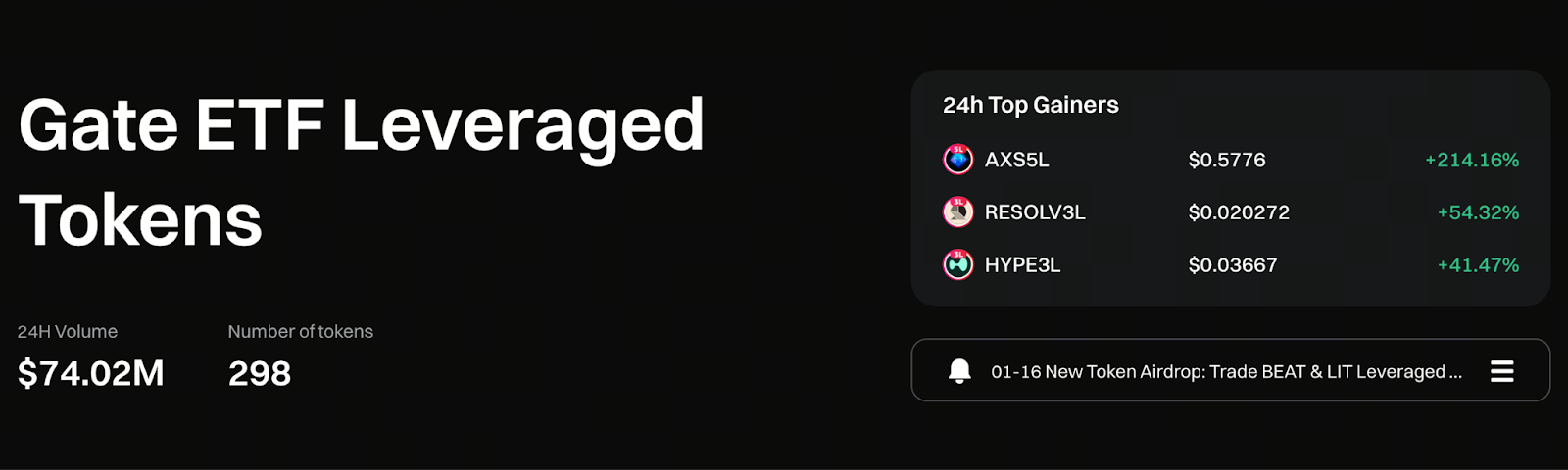
On Gate, leveraged ETF tokens are backed by perpetual contracts that provide the stated leverage. All contract management and technical details are handled automatically by the system.
For users, this means a dramatically simplified trading experience:
- No margin or maintenance calculations
- No risk of immediate forced liquidation
- No need to monitor funding rate changes
- No manual leverage adjustments required
Trading is reduced to basic buying and selling, while leverage is seamlessly embedded in the product structure.
Start trading Gate leveraged ETF tokens now: https://www.gate.com/leveraged-etf
Rebalancing Keeps Leverage on Target
Leveraged ETFs do not simply multiply gains and losses. To prevent extreme volatility from causing uncontrolled exposure, the system periodically rebalances the underlying contracts, maintaining positions within the target leverage range. While this process is nearly invisible to users, it’s crucial for the product’s long-term viability. Because of rebalancing, actual returns depend on the market’s path, not just the magnitude of price moves.
Turning Risk into Price, Not Forced Liquidation
For many, the main deterrent in futures trading isn’t necessarily a bad call, but the system design—where even a brief adverse move can end a strategy. Leveraged ETFs don’t remove market risk; instead, they translate it into changes in net asset value. With this structure, even temporary adverse moves won’t trigger forced liquidation, allowing for smoother trading and more manageable psychological pressure.
Boosting Capital Efficiency in Clear Trends
When market direction is clear, leveraged ETFs can magnify the impact of price moves on capital—without adding operational complexity. With rebalancing, this can create a compounding effect in trending markets. Many traders use leveraged ETFs as a stepping stone to full leverage strategies, a hands-on tool for stress-testing strategies, and a flexible allocation between spot and futures trading.
Structural Constraints in Range-Bound Markets
Leveraged ETFs are not suited for every scenario. In prolonged sideways or choppy markets, rebalancing can gradually erode net asset value, leading to outcomes that may differ from intuition.
Key factors affecting performance include:
- Trading costs during rebalancing
- The frequency and magnitude of volatility
- The overall price trajectory
This is why leveraged ETFs are generally not recommended as long-term passive holdings.
Management Fees: An Operational Requirement, Not an Extra Cost
Gate leveraged ETFs charge a daily management fee of about 0.1%, which covers the ongoing operation of the structure—including contract execution, funding rate payments, position adjustments, and losses during rebalancing. These fees are not an added burden, but a necessary condition for maintaining target leverage.
Who Should Use Leveraged ETFs?
Leveraged ETFs are strategy execution tools—not products for indiscriminate leverage. They’re best suited for traders who can clearly assess market direction, plan entries and exits, and tolerate short-term net asset value swings. Only with a full understanding of their structure and limitations can leveraged ETFs truly enhance capital efficiency.
Conclusion
The value of Gate leveraged ETFs isn’t in making trading easy, but in enabling more direct strategy execution. They shorten the gap between market judgment and leveraged action, amplifying the impact of every decision. For traders who actively manage risk and understand market rhythm, leveraged ETFs are a vital bridge between spot trading and leveraged strategies. However, ignoring their structure and cost implications can lead to unexpected risks.