The Origin of Bitcoin
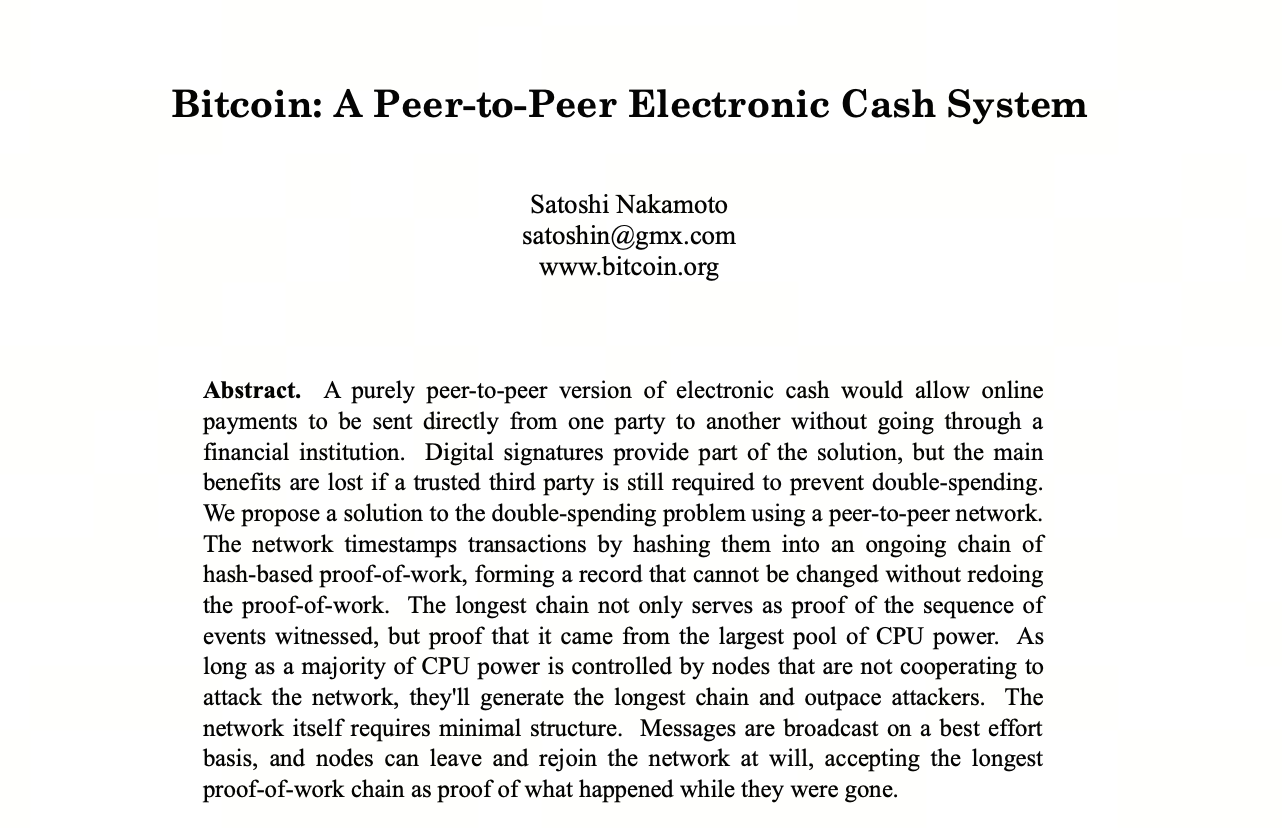
Image: https://bitcoin.org/bitcoin.pdf
Bitcoin emerged in 2008, when Satoshi Nakamoto published the white paper “Bitcoin: A Peer-to-Peer Electronic Cash System” on a cryptography mailing list. This document introduced the concept of a peer-to-peer electronic cash system that operates without any centralized authority. In 2009, the genesis block of Bitcoin was mined, officially launching the first blockchain network.
Bitcoin’s core architecture incorporates proof-of-work, cryptographic signatures, and a distributed node consensus model—mechanisms that established the foundation for the broader blockchain ecosystem.
Who Is Satoshi Nakamoto?
Satoshi Nakamoto is recognized as Bitcoin’s creator, though the name is clearly an alias and not a publicly confirmed identity. After limited interactions with developers between 2009 and 2010, Nakamoto vanished and has not reappeared in any form. Due to this anonymity, the true identity remains unconfirmed to this day.
Satoshi left very few clues—such as coding style, email habits, and possible timezone inferences—but none offer conclusive proof.
Recent Updates on the Identity
Over the past year, renewed discussion about Bitcoin’s founder has been sparked by several factors:
- Anonymous transfers of large BTC amounts from early addresses have led to speculation about whether Satoshi Nakamoto remains active in the community.
- New documentaries and media reports have introduced additional theories, seeking to identify the original Bitcoin development team.
- Blockchain analytics teams have tracked old addresses, but still cannot reach definitive conclusions.
Despite the growing volume of information, none of these developments directly verify Satoshi Nakamoto’s identity—they simply fuel further debate.
Craig Wright Ruling
Australian entrepreneur Craig Wright has repeatedly claimed to be Satoshi Nakamoto, the inventor of Bitcoin, attempting to prove his claim through copyright filings, interviews, and supporting documents.
However, a series of British court rulings have categorically rejected his assertions. Judges found he failed to present cryptographically valid evidence or demonstrate real contributions to the white paper or early Bitcoin code. These judgments provided overwhelming evidence, erasing his credibility within the crypto community.
Potential Candidates
Several individuals are frequently mentioned within the community:
- Adam Back: Creator of Hashcash. His technical background aligns with Bitcoin’s philosophy, leading to some speculation, though he has denied involvement.
- Nick Szabo: Originator of the smart contract concept. His writing style has been compared to the Bitcoin white paper, but there is no public evidence linking him to Bitcoin’s creation.
- Peter Todd: An early developer cited in some documentaries, but he has explicitly denied being Satoshi Nakamoto.
- Dorian Nakamoto: Was mistakenly identified by the media due to the similarity of his name, but was quickly ruled out.
All candidates are based on speculation or behavioral analysis, lacking scientific or legal substantiation.
The Significance of the Founder’s Identity for the Market
Although Bitcoin’s architecture is fundamentally decentralized, the founder’s identity continues to influence market sentiment and price:
- If the more than one million BTC held in early Satoshi Nakamoto wallets were moved, it could trigger significant market volatility.
- Confirmation that the founder is a particular country, institution, or notable individual could shift regulatory approaches and industry sentiment.
- Revealing the true identity could reshape academic perspectives on Bitcoin’s early technological development.
As a result, the question of Bitcoin’s creator is not only a matter of technological history but also deeply connected to market psychology.
Conclusion
To date, the identity of Bitcoin’s creator remains unresolved. “Satoshi Nakamoto” is likely an anonymous cryptography expert or a collective pseudonym for a team. Regardless of the true identity, Bitcoin has become the world’s most successful decentralized asset, with its value and influence far exceeding that of its founder.







