In traditional payment systems, value transfer and incentive mechanisms are often separated. Users act as executors of transactions rather than contributors to network growth. ZBCN integrates payment behavior, governance rights, and incentives into a single framework, aligning the interests of users, developers, and the protocol to support network expansion.
From a blockchain and DeFi perspective, ZBCN represents a model where payment itself becomes a source of incentives. By combining real-time settlement, programmable cash flows, and token economics, Zebec transforms payments into a composable economic layer where tokens support not only value exchange but also governance, resource allocation, and ecosystem growth.
How ZBCN Connects Payment Activity and Network Value
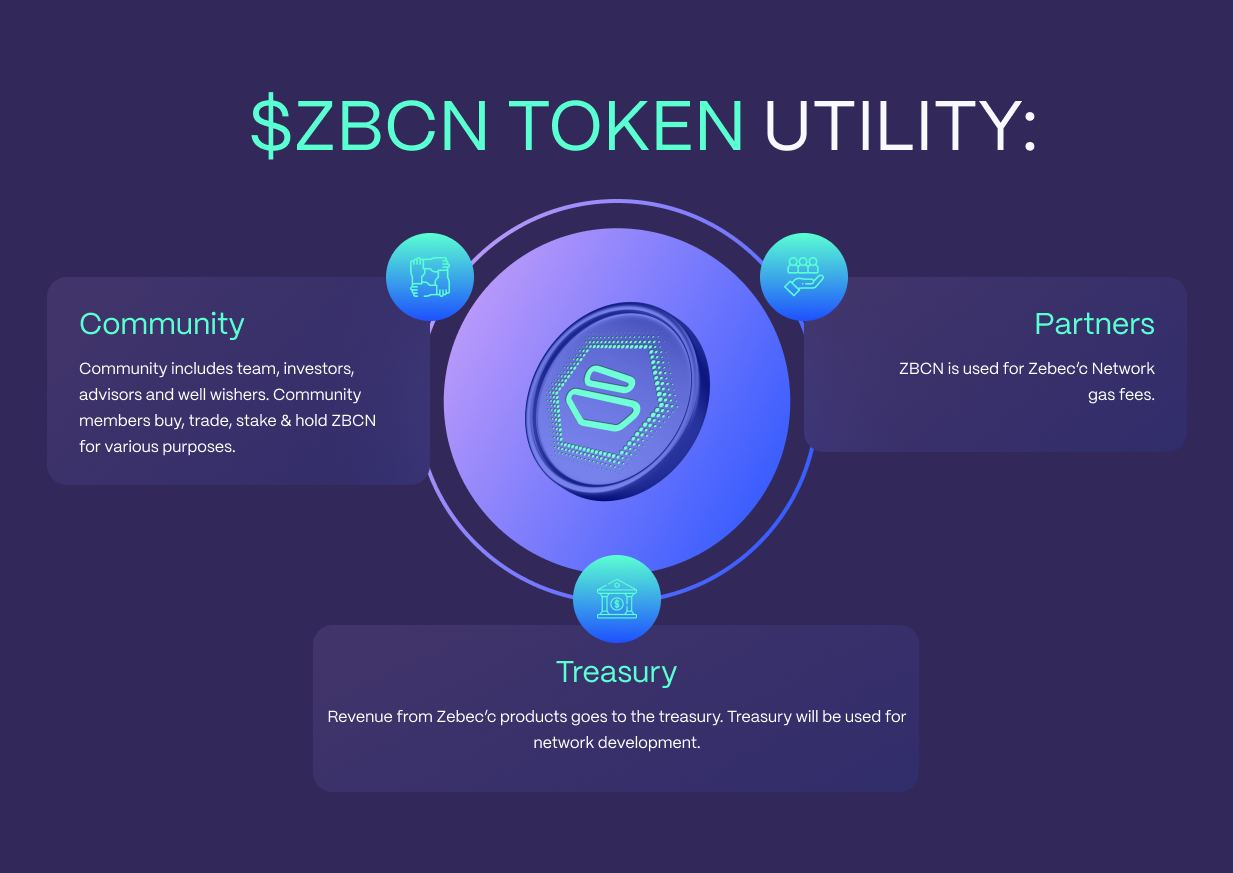
ZBCN performs multiple roles within the Zebec ecosystem, with its core logic centered on linking payment activity to network value.
-
Functional role: ZBCN serves as a medium for accessing Zebec network services. Users can use it for streaming payments, cash flow management, and related transaction fees, creating a direct link between the token and real usage scenarios.
-
Governance role: ZBCN allows holders to participate in protocol decision-making. This includes voting on network parameters, feature upgrades, and ecosystem resource allocation, turning users into active participants.
-
Incentive role: ZBCN is used to reward ecosystem contributions such as developer integrations, liquidity support, and user growth, helping expand the network and attract participants.
Overall, ZBCN forms a closed-loop system that connects usage, governance, and incentives within a unified token model.
Token Distribution and Incentive Mechanism
ZBCN has a total supply of 100 billion tokens and uses lock-up and linear release mechanisms to balance market liquidity with long-term development.
According to official disclosures, the core distribution structure is as follows:
| Allocation Category |
Share |
Unlock Mechanism |
| Seed Round |
9.28% |
6-month lock-up + 3-year linear release |
| Private Round |
10.97% |
6-month lock-up + 3-year linear release |
| Public Sale |
5.74% |
Released in stages |
| Market Making |
4.00% |
Gradual release over 3 years |
From a design perspective, ZBCN reduces early selling pressure through long-term vesting while maintaining liquidity through market-making allocation, forming a relatively stable market structure.
At the incentive level, ZBCN emphasizes a usage-driven model. Token demand is generated through payment activity, ecosystem participation, and governance involvement rather than relying solely on subsidies or mining rewards. This mechanism creates a positive feedback loop between network growth and token usage, although its long-term effectiveness depends on the scale of real adoption.
The Role of ZBCN in Decentralized Payments
Within the Zebec system, ZBCN is not an isolated asset but is embedded directly into the payment infrastructure.
Its core functions can be understood as follows:
-
Value medium for payments: ZBCN functions as a value layer within the payment ecosystem, enabling fee settlement and access to services. This creates a direct link between payment activity and token usage.
-
Participation in streaming payments: In streaming payment scenarios, ZBCN supports the management and interaction of continuous cash flows, including creating, adjusting, and terminating payment streams. This allows the token to participate not only in payment outcomes but also in the payment process itself.
-
Connector across application layers: ZBCN serves as a unified interaction medium across different use cases, including enterprise payments, DAO treasury allocation, and Web3 integrations. This improves system composability and interoperability.
This structure positions ZBCN as a foundational asset within the payment network rather than a simple circulating token.
How to Participate in Governance and Decision-Making with ZBCN
ZBCN governance is based on an on-chain voting system, following the principle that token ownership represents participation rights.
Holders can participate in governance decisions such as:
-
Protocol parameter adjustments, including fee structures and reward mechanisms
-
Product roadmap and feature prioritization
-
Allocation and usage of ecosystem funds
-
Network upgrades and key strategic decisions
In practice, users may need to use or lock their tokens to participate in voting. Voting power is directly proportional to token holdings, which gives long-term holders greater influence over governance outcomes.
This model improves transparency and openness. However, it also introduces the risk of governance concentration, where large holders may exert disproportionate influence. As a result, community participation levels and token distribution play a key role in governance effectiveness.
Market Value and Long-Term Potential of ZBCN
The market value of ZBCN is derived primarily from its functional role within the network rather than purely from supply and demand dynamics.
On the demand side, its value depends on:
-
The scale of Zebec network usage
-
Growth of streaming payment use cases
-
Number of enterprise and application integrations
-
Overall user activity
On the supply side, token distribution and release schedules influence liquidity conditions and price behavior.
From a long-term perspective, ZBCN's potential is closely tied to:
-
Whether real-time payments become core Web3 infrastructure
-
The development of multi-chain and cross-chain capabilities
-
Adoption in enterprise-level payment scenarios
-
Integration with stablecoins and real-world assets (RWA)
If Zebec achieves progress in these areas, the demand foundation for ZBCN may strengthen.
Risk and Return Analysis of ZBCN
From an investment perspective, ZBCN presents both potential opportunities and risks.
On the return side, its growth is largely driven by network expansion. Increased adoption of the Zebec ecosystem may lead to higher token demand, supporting value growth.
However, several risks should be considered:
-
Technical risk: Smart contract vulnerabilities or system failures may affect asset security
-
Market risk: Token prices are influenced by overall cryptocurrency market volatility
-
Regulatory risk: Payment-focused projects may face stricter regulatory requirements
-
Ecosystem risk: If user growth does not meet expectations, token demand may remain limited
As a result, ZBCN is better viewed as a structural exposure to decentralized payment infrastructure rather than a short-term speculative asset.
Conclusion
ZBCN's tokenomics are built around three core elements: payment, governance, and incentives. By integrating streaming payment mechanisms with token-based systems, it enables participants to receive value while actively contributing to the network.
This design improves capital efficiency and addresses the lack of incentive alignment in traditional payment systems. From a long-term perspective, ZBCN's value depends on the real-world adoption and development of the Zebec ecosystem.
As decentralized payments continue to evolve, ZBCN represents a model that transforms payment systems into programmable, incentivized, and governable on-chain economic infrastructure.







