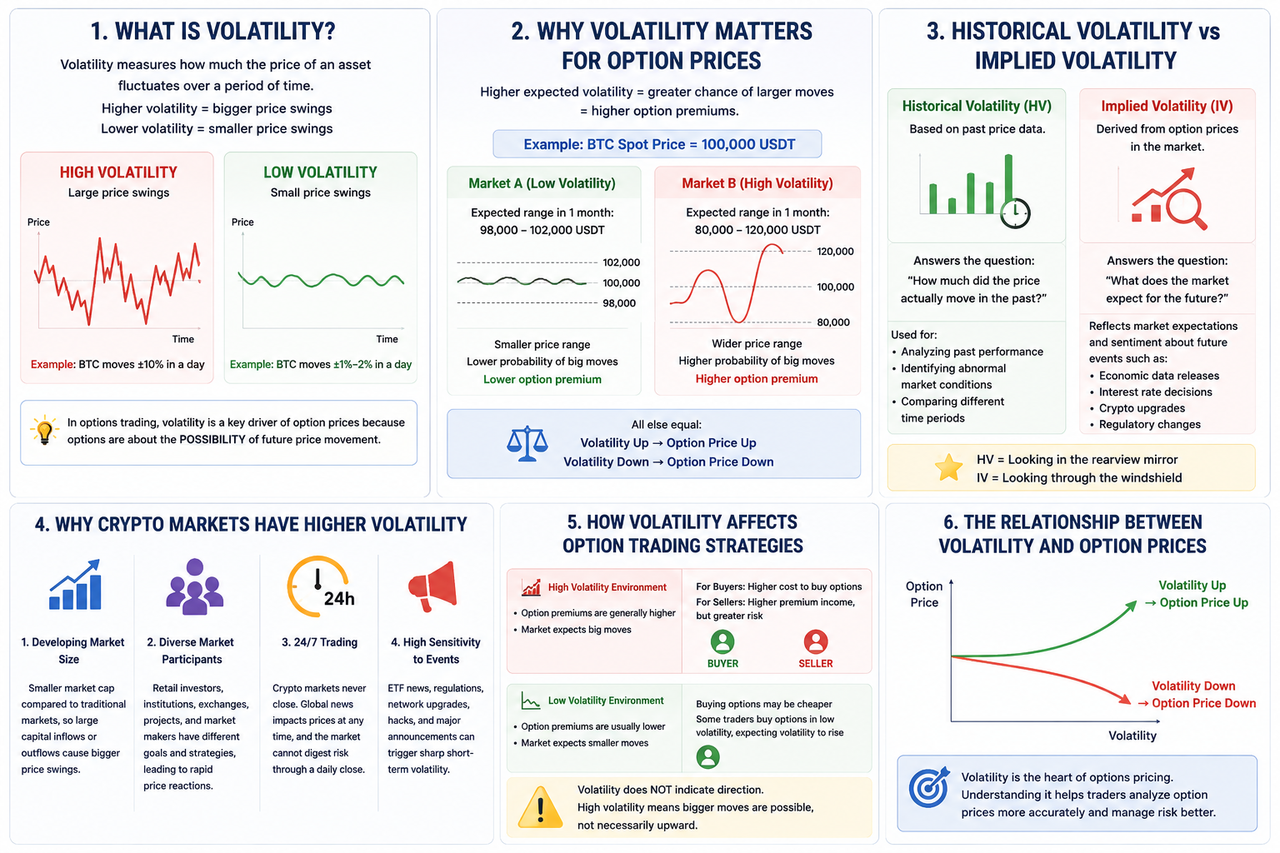
What is Volatility?
Volatility is a key metric for measuring the magnitude of asset price changes, reflecting how sharply market prices rise or fall within a given period.
Simply put, volatility represents the level of market "uncertainty." When asset prices frequently experience large swings, market volatility is high; when prices remain relatively stable for extended periods, volatility is low.
If BTC rises or falls by 10% in a single day, this indicates significant price movement and high volatility; if BTC fluctuates only within a 1%-2% range over a long period, market volatility is relatively low.
In spot trading, investors typically focus more on price direction, such as whether BTC will rise or fall. However, in the options market, volatility is one of the key factors influencing option value.
This is because options fundamentally trade on the potential for future price movements. When market volatility increases, the chances of asset prices breaking through the strike price also rise, making options generally more valuable.
For example, a BTC call option:
-
If the market expects BTC to make significant moves up or down in the future, the option value may increase;
-
If the market expects BTC's price to remain stable, the option value may decrease.
Therefore, options traders need to judge not only market direction but also the potential magnitude of future price changes.
Why is Volatility So Important to Option Prices?
Option prices are mainly influenced by several factors, including underlying asset price, strike price, time to expiration, and volatility. Among these, volatility is a crucial variable. The reason is: option buyers are purchasing the possibility of future price movement, and higher volatility means a greater range of potential price changes.
Suppose BTC's current price is 100,000 USDT.
-
Market A: BTC is expected to fluctuate only between 98,000-102,000 USDT over the next month.
-
Market B: BTC may rise to 120,000 USDT or fall to 80,000 USDT over the next month.
Compared to Market A, Market B has a wider price range, meaning there's a higher probability for options to become profitable. Investors are generally willing to pay higher premiums for options in such scenarios.
Therefore, all else being equal:
-
When volatility rises, option prices usually increase;
-
When volatility falls, option prices usually decrease.
This is why some options traders do not focus on whether the market will ultimately rise or fall but rather on whether future volatility will exceed market expectations. This type of trading is called Volatility Trading.
Historical Volatility vs. Implied Volatility
In the options market, volatility is usually divided into two types:
-
Historical Volatility
-
Implied Volatility
Both describe market fluctuations but represent different meanings.
Historical Volatility
Historical volatility is calculated based on past price data. It answers the question: "How much did the asset's price actually fluctuate during a past period?"
For example: By analyzing BTC's price changes over the past 30 days, you can calculate its historical volatility for that period.
Historical volatility is mainly used to:
-
Analyze past market performance;
-
Determine if current market movements are abnormal;
-
Compare market conditions across different timeframes.
However, historical volatility only reflects the past and cannot directly predict the future.
Implied Volatility
Implied volatility represents market expectations for future fluctuations. It answers: "How much does the market think prices might change in the future?" Implied volatility is usually inferred from option market prices. If market participants expect major upcoming events such as:
-
Macroeconomic data releases;
-
Federal Reserve interest rate decisions;
-
Major upgrades in the crypto industry;
-
Regulatory policy changes;
Investors may buy options in advance, driving up option demand and implied volatility. Therefore, implied volatility essentially reflects market sentiment and future expectations.
Why Does the Crypto Market Have Higher Volatility?
Compared to traditional financial markets, crypto assets generally exhibit higher volatility. This is related to several unique features of the crypto market.
Market Size Still Developing
Compared to mature markets like stocks and bonds, the overall crypto market is smaller. Large inflows or outflows of capital can trigger more significant price movements.
Diverse Market Participants
Crypto markets include:
-
Retail investors;
-
Institutional investors;
-
Trading platforms;
-
Project teams;
-
Market makers.
Different participants have different trading goals, which can lead to rapid price changes.
24/7 Continuous Trading
Traditional financial markets have trading hour restrictions, but crypto markets operate 24/7 all year round. This means:
-
Global news can impact prices at any time;
-
The market cannot pause to digest risks;
-
Sudden events can quickly be reflected in prices.
Industry Events Have Strong Impact
The crypto market is sensitive to events such as:
These events can all cause significant short-term market swings.
How Does Changing Volatility Affect Option Trading Strategies?
Understanding volatility not only helps traders judge option price movements but also influences strategy selection.
High Volatility Environment
When market volatility is high:
For option buyers, high volatility means higher purchase costs.
For option sellers, high volatility can mean higher premium income but also greater market risk.
Low Volatility Environment
When markets are calm:
Some traders may choose to buy options during low-volatility periods and wait for future increases in volatility.
It's important to note that volatility does not indicate price direction.
High volatility means larger potential price swings but does not necessarily mean an upward move.
For example:
A sudden spike in BTC volatility could be due to expectations of a major rally or concerns about a rapid decline.
Therefore, option traders need to consider:
-
Market direction;
-
Level of volatility;
-
Timeframe;
-
Event factors;
for comprehensive judgment.
Summary of the Relationship Between Volatility and the Options Market
Volatility is a fundamental concept for understanding crypto options. In the options market, traders are not just trading on asset price movements—they are also trading on future market uncertainty. Historical volatility helps investors understand past market performance, while implied volatility reflects expectations of future risk.
When volatility rises, option prices generally increase because the likelihood of large future price moves grows; when volatility falls, option values are usually pressured. Understanding volatility enables traders to analyze option price changes more accurately and lays the groundwork for further learning about option Greeks and event risk management.
Summary
This lesson introduced the basic concept of volatility and why it's such an important factor influencing crypto option prices. By learning about the differences between historical and implied volatility, you now understand how market expectations are reflected in option prices.