What Are Crypto Options?
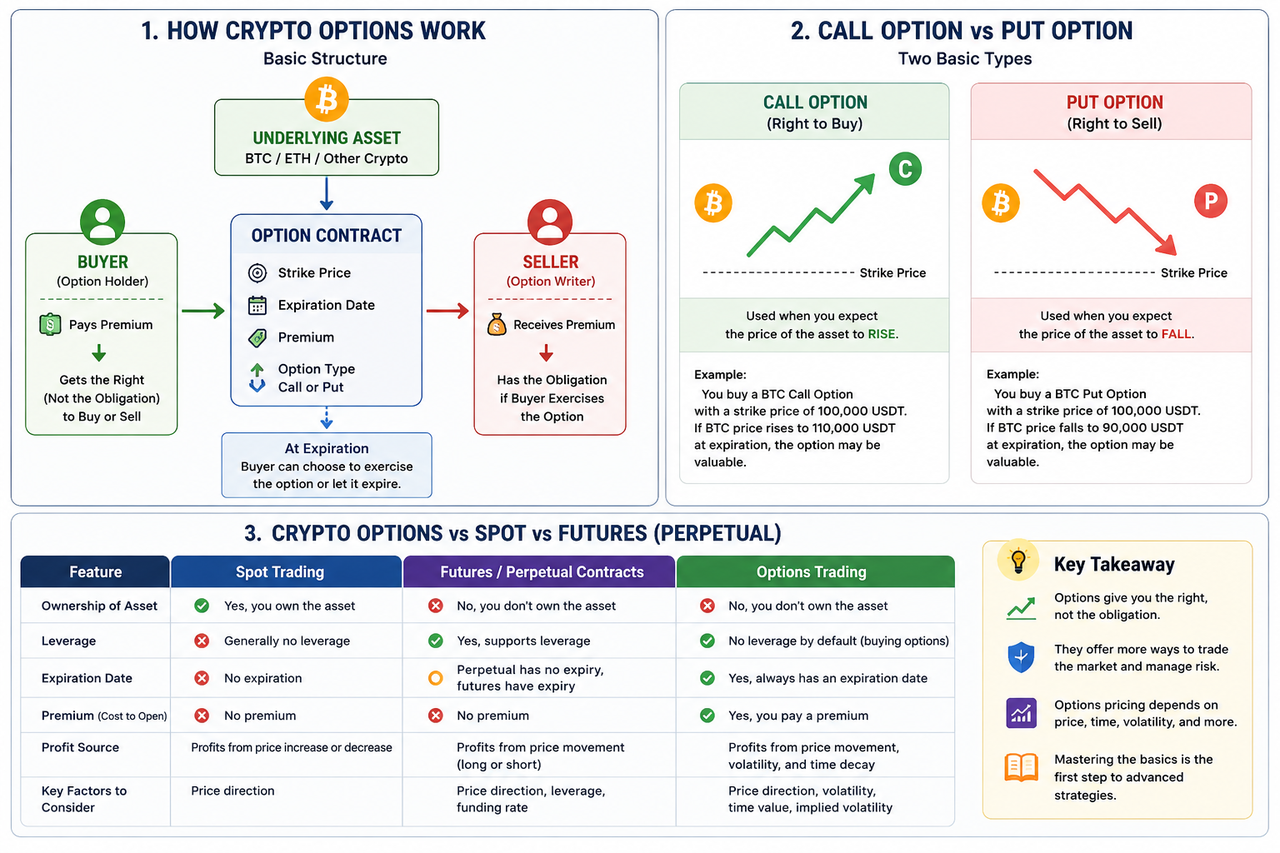
Crypto options are financial derivatives based on crypto assets that grant traders the right to buy or sell a certain asset at a predetermined price at a specific time in the future.
Unlike directly purchasing crypto assets such as Bitcoin (BTC) or Ethereum (ETH), the core of options trading is not to immediately own the asset, but to trade on the potential price movements in the future.
Simply put, an option is a "right to choose." The buyer of an option has the right to execute the trade, but is not obligated to do so. For example, if a trader believes BTC might rise in the future, they can buy a BTC call option. If BTC's price at expiration rises above the agreed price, the trader can choose to exercise the option or sell it for a profit. If the market does not perform as expected, the trader can forgo exercising the option, with their maximum loss usually limited to the premium paid for the option.
In the crypto market, options mainly revolve around major assets like BTC and ETH. As more participants enter the market, options have evolved from simple speculative tools into important components for risk management and strategic trading.
Compared with spot trading, options provide more ways to participate in the market. Traders can not only speculate on price increases or decreases, but also seek trading opportunities by analyzing market volatility, time value, and probability of price changes.
Call Options and Put Options
Crypto options are mainly divided into two basic types: call options and put options. A call option means the trader expects the price to rise in the future and wants the right to buy the asset at a fixed price.
For example, if a trader buys a BTC call option with a strike price of 100,000 USDT and an expiration date one month later, and BTC's price rises to 110,000 USDT at expiration, this option may have significant value because the trader has the right to buy BTC at 100,000 USDT.
A put option means the trader expects the price to fall in the future and wants the right to sell the asset at a fixed price.
For example, if an investor holds BTC but is worried about a major pullback in the market, they can purchase a BTC put option. If BTC's price drops, the put option may increase in value, helping the investor reduce losses from falling asset prices.
In practice, options are used not only for predicting market direction but also for risk management:
-
Investors can use put options to protect existing assets;
-
Traders can use call options to express bullish views;
-
Professional investors can combine different options to build trading strategies.
Core Components of an Options Contract
An options contract typically contains several key elements, including underlying asset, strike price, expiration date, and premium. These factors together determine an option's value.
Underlying Asset
The underlying asset is what the options contract is based on. In the crypto market, common underlying assets include Bitcoin (BTC), Ethereum (ETH), and other digital assets. The value of an option changes as the underlying asset's price changes, so understanding trends of the underlying asset is fundamental to analyzing options.
Strike Price
The strike price is the pre-agreed transaction price in an options contract. For example, if a BTC call option has a strike price of 100,000 USDT, it means that in the future, the buyer can purchase BTC at that price. The relationship between market price and strike price affects whether an option has real value.
Expiration Date
The expiration date is how long an options contract is valid. Unlike spot assets, options have time limits. As expiration approaches, the time value portion of an option gradually decreases—this is a key foundation for learning about Theta (time decay) later.
Premium
The premium is the cost paid to buy an option. The option buyer pays a premium for future rights, while the seller receives the premium and takes on corresponding obligations.
The premium is affected by several factors including asset price, strike price, remaining time, and market volatility.
Differences Between Crypto Options, Spot Trading, and Contract Trading
In the crypto market, spot trading and contract trading are the most common forms of trading for users. Options trading features more complex pricing logic and trading characteristics.
Differences from Spot Trading
Spot trading means directly buying or selling crypto assets. For example, if a user buys BTC and BTC's price rises, they can sell it for profit.
Features of spot trading:
Options trading does not involve direct ownership of assets but rather trading rights to buy or sell in the future.
Differences from Contract Trading
Contract trading allows investors to use leverage and go long or short to predict market direction. By contrast, options trading requires consideration of:
For example, even if BTC's price rises, a call option may not necessarily be profitable—if the increase isn't enough to cover the premium cost, traders may still incur losses. Therefore, options trading requires more comprehensive analysis of market factors.
Importance of Learning Crypto Options Basics
Understanding crypto options basics is a key step toward further study of derivatives trading. Compared with simply predicting price movements, options markets involve more variables including time, volatility, and market sentiment.
Mastering options fundamentals can help traders:
-
Understand how option prices change;
-
Learn how to use options for risk management;
-
Prepare for further study of volatility trading and advanced options strategies.
It's important to note that while options provide more trading opportunities, they are also more complex. Traders need to fully understand how options work and develop appropriate strategies based on their own risk tolerance.