What Are Option Greeks?
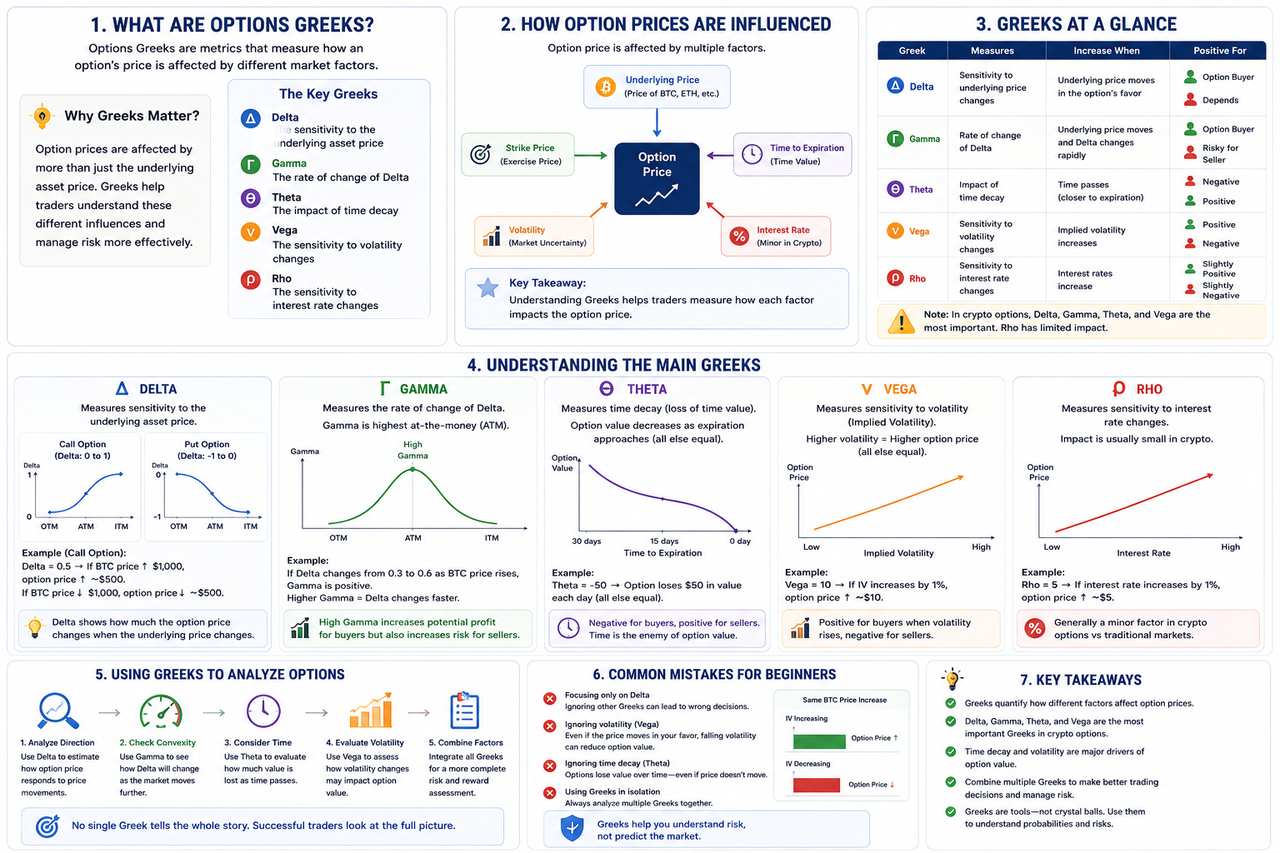
Option Greeks are a set of indicators used to measure the sensitivity of option prices to different market factors. Since option prices are influenced not only by the price of the underlying asset but also by time, market volatility, and other variables, traders rely on Greeks to analyze how changes in these variables impact option value.
In spot trading, users typically only need to focus on asset price changes. For example, if BTC rises, users holding BTC usually profit. However, options markets are more complex. A call option may appreciate if BTC rises, but its value may also decrease due to reduced time remaining or lower volatility. Therefore, simply predicting price direction is not enough to analyze options trading outcomes.
The purpose of Greeks is to help traders break down the different factors affecting option prices. The most common indicators include Delta, Gamma, Theta, Vega, and Rho.
-
Delta: Measures the impact of changes in the underlying asset price on the option price
-
Gamma: Measures the rate of change of Delta
-
Theta: Measures the effect of time decay on option value
-
Vega: Measures the impact of volatility changes on option price
-
Rho: Measures the effect of interest rate changes on option price
In the crypto options market, where assets like Bitcoin (BTC) and Ethereum (ETH) are highly volatile, traders usually focus more on Delta, Gamma, Theta, and Vega.
Delta: Measuring an Option's Sensitivity to Asset Price Changes
Delta is one of the most fundamental and widely used Greeks in options trading. It represents the theoretical change in an option's price as the underlying asset's price moves.
Simply put, Delta answers the question: "If BTC's price rises or falls, how much will the current option price be affected?"
For example, if a BTC call option has a Delta of 0.5, a $1,000 USDT increase in BTC price could theoretically raise the option's value by about $500 USDT. Conversely, a $1,000 USDT drop in BTC could reduce the option's value by about $500 USDT.
Note that Delta is not fixed. As market prices change and the option's distance from profitability shifts, Delta continually adjusts.
For call options, Delta usually ranges between 0 and 1. The closer an option is to being profitable, the higher its Delta—meaning its price more closely follows movements in the underlying asset.
Example: BTC is currently priced at 100,000 USDT.
-
A call option with a strike price of 100,000 USDT may have a higher Delta because it's close to the current market price.
-
A call option with a strike price of 120,000 USDT would have a lower Delta since BTC needs to rise significantly before it becomes profitable.
For put options, Delta is usually negative. For example: if a BTC put option has a Delta of -0.4, a $1,000 USDT drop in BTC could theoretically increase the option's price by about $400 USDT. Thus, Delta helps traders gauge an option's sensitivity to market direction changes and serves as a key reference when building trading strategies.
Gamma: Understanding the Rate of Change in Delta
Gamma measures how quickly Delta changes. If Delta represents the speed at which an option's price changes, Gamma shows how much that speed itself changes.
For example: if a BTC call option currently has a Delta of 0.3 and BTC rises rapidly, Delta might increase from 0.3 to 0.5 or even closer to 1. This shift in Delta is due to Gamma.
Gamma becomes especially important during periods of high market volatility. Since crypto assets often experience sharp moves within short periods, options with high Gamma may see more pronounced price swings.
For option buyers, high Gamma means that if the market moves rapidly in their favor, the option price can increase quickly. For instance, if a trader buys a BTC call and BTC surges suddenly, the rising Delta will further amplify gains.
For option sellers, high Gamma means greater risk. When markets move quickly, sellers face constantly changing Delta exposure; without proper risk management, this can lead to significant losses.
Thus, Gamma is a key metric for professional options traders managing risk.
Theta: Time Value Decay
Theta measures how the passage of time affects an option's value. Unlike spot trading, options have defined expiration dates. As expiry approaches, there is less time for the option to generate value—thus its time value steadily decreases.
This phenomenon is known as time decay.
For example, suppose a trader buys a BTC call that expires in 30 days. If over the next week:
Even if BTC's price doesn't move, the option's value may still decrease.
The reason is that with less time remaining, there are fewer chances for BTC to reach a profitable level.
Theta affects buyers and sellers differently.
For buyers:
The passage of time is typically unfavorable because holding an option incurs time value decay.
For sellers:
Time decay is usually beneficial since as time passes, the option's value may decline—allowing sellers more profit potential. However, sellers must still manage the risk of sudden large market moves. Therefore, traders need to consider not just direction but also timing.
Vega: The Impact of Volatility Changes on Option Prices
Vega is an important indicator measuring how changes in implied volatility affect option prices.
In crypto options markets, Vega is particularly important because assets like BTC and ETH frequently see rapid shifts in implied volatility due to market events.
For example:
The market anticipates major upcoming events:
Investors may buy options ahead of time, causing expectations for future volatility—and implied volatility—to rise.
Even if BTC's price remains stable for now, an increase in Vega can still push up option prices.
Example: BTC current price: 100,000 USDT. A certain call option price: 2,000 USDT.
If major news emerges and investors expect bigger moves ahead for BTC—if implied volatility jumps from 50% to 80%—the call's price may rise. In this scenario, profits aren't due to BTC having risen already but because the market sees higher chances for significant future price swings.
This is one of the key differences between options and spot trading.
How Do You Use Greeks Together to Analyze Options?
In practice, traders rarely look at just one Greek—they combine several indicators for comprehensive analysis.
For example, if a user plans to buy a BTC call:
-
Focus on Delta: How much will the option respond if BTC rises?
-
Watch Gamma: If BTC rises rapidly, will Delta increase further and amplify returns?
-
Consider Theta: How long until expiration? How much time value will be lost?
-
Analyze Vega: If market volatility increases ahead, will that boost option prices?
By combining these factors, traders can better understand options risk as a whole.
Example: An option with high Delta might appear very sensitive to BTC upside—but if little time remains until expiration (high Theta), its value could erode quickly; or if volatility drops suddenly (Vega), its price may fall as well.
Therefore, options trading isn't simply about predicting "up" or "down"—it's about analyzing how multiple variables interact.
What Should Beginners Watch Out For When Learning Greeks?
Greeks are vital tools for analyzing options—but they are not market prediction indicators.
Beginners should avoid common mistakes when learning Greeks:
First, focusing only on Delta.
Many traders believe that as long as BTC rises, call options are sure to profit. In reality, if gains don't offset time decay and premium costs, losses can still occur.
Second, ignoring volatility.
Option prices aren't determined solely by direction. If market volatility falls—even as BTC rises—option prices may be affected negatively.
Third, overlooking timing.
Options are not like spot assets that can be held indefinitely. As expiration nears, Theta continually erodes value.
Therefore, learning Greeks isn't about predicting every market move—it's about understanding sources of risk and making more informed trading decisions.
Summary
This lesson covered the core concepts of option Greeks—including Delta, Gamma, Theta, and Vega. By studying these indicators, you now understand why option prices don't simply follow movements in underlying assets and how time and volatility influence option values.