The Essence of Spot Stocks: Real Equity, Not Just Price Exposure
The core feature of spot stocks lies in their "ownership attribute." When an investor holds a spot stock, they essentially own a portion of a publicly listed company's equity, not just a price fluctuation tool.
This structure fundamentally differentiates spot stocks from derivatives. Spot holdings do not rely on leverage, nor do they amplify returns or risks through margin mechanisms; their value stems from the company's operating results and long-term growth capacity.
In the Gate stock trading system, spot stocks typically correspond to real stock asset structures, enabling investors to participate in global stock markets with actual holdings via the platform, rather than price contracts. This mechanism makes spot stocks closer to traditional long-term investment tools, with their core anchor still rooted in company fundamentals.
Therefore, during earnings season, while spot stock volatility can be significant, the underlying logic always revolves around the revaluation of company value.
Core Drivers of Spot Prices During Earnings Season: Fundamentals + Expectation Reassessment
Spot stock price changes during earnings season mainly stem from two aspects.
The first aspect is the update of fundamental company data, such as revenue growth, profit levels, changes in gross margin, and cash flow status. These figures determine the basic "current value range" of the company.
The second aspect is the market's reassessment of future growth. When earnings data diverges from market expectations, valuation models are recalibrated, impacting stock prices.
For example, even if a company achieves profit growth, if the growth rate falls short of market expectations, its valuation may still be downgraded; conversely, even with significant short-term profit fluctuations, if long-term growth prospects are reinforced, the market may assign a higher valuation.
This shows that spot stock prices do not simply reflect "profit outcomes," but rather represent a comprehensive judgment of "profit quality + growth expectations."
Volatility Characteristics of Spot Stocks During Earnings Season
During earnings season, spot stocks typically experience amplified volatility, but this volatility has structural features.
-
Jump Pricing: Around earnings announcements, the market rapidly adjusts valuation ranges based on new information, causing prices to gap or trend sharply within a short timeframe.
-
Disagreement Amplification Effect: Different investors may interpret the same earnings report completely differently. Some focus on short-term profits, while others prioritize long-term guidance; this divergence manifests in higher price volatility.
-
Short-Term Misalignment Between Sentiment and Fundamentals: Immediately after earnings releases, market sentiment may exaggerate reactions, causing prices to deviate from long-term fundamental trends. As information is gradually digested, prices typically return to fundamental logic.
These features mean that spot stocks during earnings season can offer both trending opportunities and short-term volatility risks.
Impact of Liquidity and Trade Structure on Spot Prices
Spot stock performance during earnings season is also significantly influenced by market liquidity structure.
Before and after earnings releases, rising uncertainty may prompt some market participants to reduce order depth or adjust quoting strategies, widening bid-ask spreads.
At the same time, concentrated inflows and outflows of short-term trading funds further amplify volume fluctuations, making prices more susceptible to rapid changes in a short period.
Such liquidity shifts are especially pronounced in large-cap tech stocks, which attract both institutional and retail investors and feature more concentrated capital flows.
Thus, even if company fundamentals remain stable, liquidity structure itself can become a major source of short-term price volatility.
Long-Term Perspective: Core Advantages of Spot Stocks
Spot stocks may see significant volatility during earnings season, but from a long-term investment perspective, their advantages remain clear.
-
Clear Structure: The value of spot stocks directly corresponds to company operating results without interference from complex derivative structures.
-
Defined Risk Boundaries: Without leverage mechanisms, investors are not exposed to forced liquidation risks from short-term volatility, making spot holdings more suitable for long-term investment.
-
Deeply Linked to Company Growth: Over the long run, stock returns mainly come from sustained growth in company profitability rather than short-term market sentiment.
For investors seeking long-term asset allocation, spot stocks remain the most fundamental and core asset class.
Relationship Between Spot Stocks and Gate Stock Trading
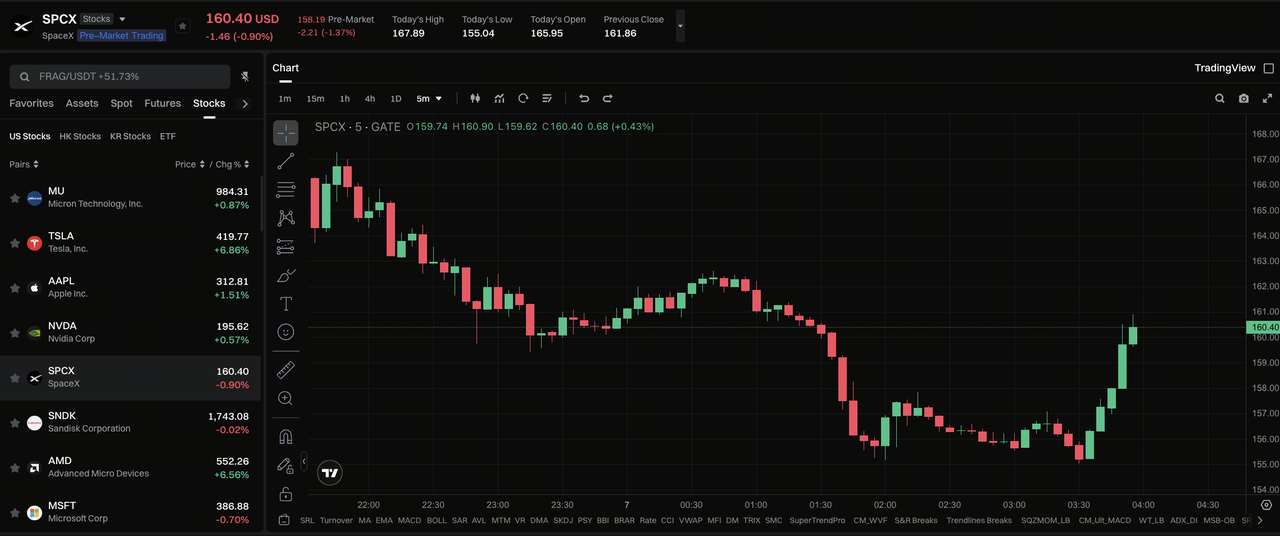
In Gate's stock trading system, spot stocks provide users with direct access to global stock markets.
The core feature is connecting digital asset users' trading habits with traditional stock market structures, allowing investors to manage both stock assets and other asset classes on a unified platform.
During earnings season, this structure reduces cross-market operational complexity and enables investors to make decisions more directly based on company fundamentals rather than being overly influenced by tool structures.
It's important to emphasize that the tool itself does not change the risk structure of the market; investment decisions must still be based on an understanding of companies and markets.
Summary
Spot stock performance during earnings season essentially results from the interplay between changes in company fundamentals and market expectation reassessment. Although prices may temporarily deviate due to liquidity and sentiment fluctuations in the short term, their long-term value remains centered on company profitability and growth trajectory. Understanding the structure of spot stocks helps investors more clearly distinguish between "short-term volatility" and "long-term value" during earnings season and avoid having their judgment affected by market noise.
In the next lesson, we will further analyze how ETFs operate during earnings season and explain how index structure changes the impact path of individual earnings reports on the overall market.