Nature of CFDs: No Stock Ownership, Only Trading Price Differences
The core mechanism of stock CFDs (Contract for Difference) is fundamentally different from spot stocks.
In the spot market, investors hold actual stock assets, corresponding to company ownership. In CFD trading, however, investors do not own the stock itself; instead, settlement is based on the difference between opening and closing prices.
In other words, the object of CFD trading is not "company shares," but "price movements."
This structure makes CFDs more akin to financial derivatives whose value derives not from company fundamentals but from the direction and magnitude of market price fluctuations.
Within Gate's stock system, CFDs typically serve as derivative trading tools that emphasize short-term trading efficiency and leverage usage rather than long-term asset holding.
Leverage Mechanism: Amplifying Both Returns and Risks
The most fundamental feature of CFDs is leverage.
Leverage allows investors to control larger nominal positions with a relatively small margin, thus amplifying both gains and losses resulting from price changes.
For example, with 5x leverage, a 1% price movement could translate to a 5% change in account profit or loss.
During earnings season, this amplification effect is especially pronounced since market price fluctuations often exceed those seen during regular trading cycles.
If earnings results deviate significantly from market expectations, CFD positions may experience substantial profit or loss changes in a short period—this is one of the key sources of CFD risk structure.
CFDs During Earnings Season: Volatility as the Core Risk Source
During earnings season, the core variable in CFD trading is not "company value," but "the magnitude of price volatility."
Earnings releases directly trigger market reassessment of future expectations, often causing prices to move rapidly in a short timeframe. Under leverage, these quick movements are further magnified.
Therefore, CFD risk during earnings season mainly comes from three areas:
-
Directional risk—market expectations differ from actual price movements
-
Volatility risk—rapid price changes cause swift account fluctuations
-
Liquidity risk—extreme conditions may widen spreads or reduce trading depth, affecting closing efficiency
The combination of these factors makes CFDs one of the riskiest trading tools during earnings season.
Margin and Forced Liquidation Mechanism
CFD trading typically uses a margin system. Investors only need to put up part of their funds as margin to open larger positions; however, if the market moves unfavorably, falling account equity may trigger margin calls or forced liquidation.
In the high-volatility environment of earnings season, prices can change rapidly in a short time, increasing the likelihood of risk control mechanisms being triggered.
Thus, CFD trading requires not only direction judgment but also position and risk exposure management—otherwise, short-term volatility may have a significant impact on the account.
Structural Differences Between CFDs, Spot Stocks, and ETFs
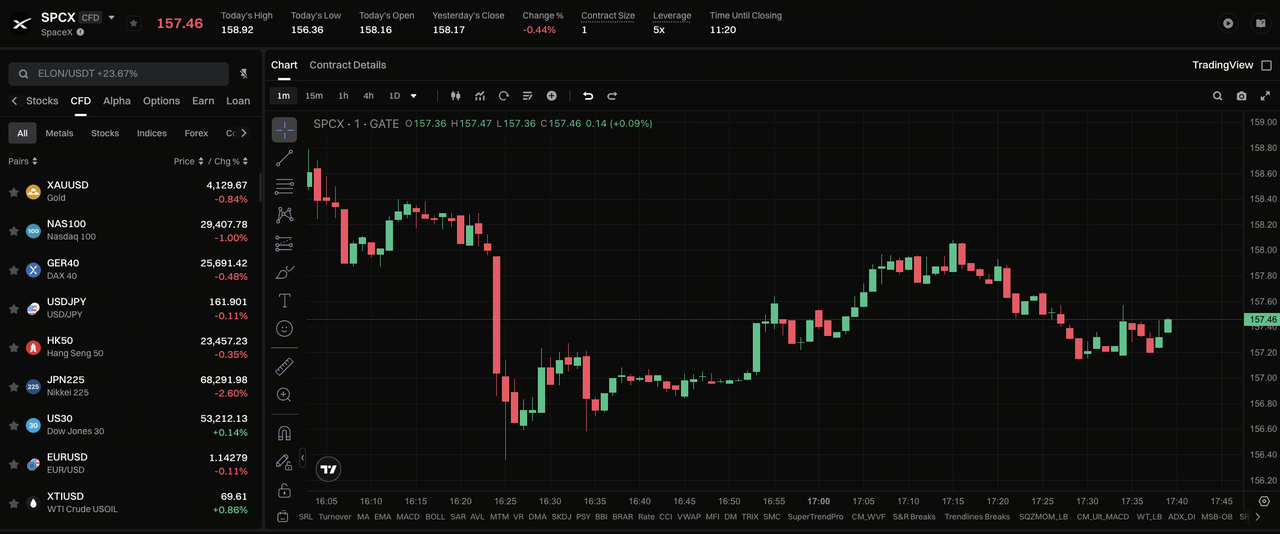 Gate CFD Market Page
Structurally, CFDs are distinctly layered compared to spot stocks and ETFs.
Spot stocks emphasize long-term ownership and fundamental-driven returns; ETFs focus on portfolio diversification and systematic allocation; CFDs stress price volatility and short-term trading efficiency.
During earnings season, these differences become especially apparent:
-
Spot stocks focus more on long-term changes in company value
-
ETFs focus more on overall index or sector trends
-
CFDs are directly exposed to price volatility itself and leverage amplifies this volatility
Thus, while all three trade the same market assets, their risk structures are entirely different.
Behavioral Differences in Trading During Earnings Season
During earnings season, users of different tools exhibit distinctly differentiated behavior.
Spot investors typically pay more attention to how earnings affect long-term fundamentals such as revenue growth trends and future guidance changes;
ETF investors focus more on overall sector performance and the impact of weighted stocks;
CFD traders are more concerned with short-term price movement opportunities, especially around rapid market conditions before and after earnings releases.
This behavioral segmentation causes the same earnings report to elicit completely different market responses across different tools.
Risk Awareness: CFDs Are Not Suitable for All Investors
Because of leverage, CFDs are not suitable for all types of investors.
During earnings season, if there is insufficient understanding of volatility or poor position management, investors may incur significant losses in a short period.
Therefore, understanding CFDs is not about "how to use leverage," but about "whether you can withstand the volatility structure brought by leverage."
For investors with low risk tolerance or those focused on long-term allocation, spot stocks or ETFs are usually more suitable.
Summary
Stock CFDs are derivative trading tools centered around price volatility, with leverage amplification as their main feature.
During earnings season, this mechanism significantly magnifies market volatility, simultaneously increasing both returns and risks.
Compared to spot stocks and ETFs, CFDs are more suited to short-term trading and their risk structure is highly dependent on position management and market volatility control.
Understanding the structure of CFDs helps investors better distinguish risk boundaries among different tools during earnings season and avoid misapplying short-term trading logic to long-term investment scenarios.
In the next lesson, we will systematically compare spot stocks, ETFs, and CFDs and summarize their core differences and applicable strategies during earnings season.