Global Capital Markets Are Entering a New Era of Openness
Over the past decades, global capital markets have gone through phases of electronic trading, internet finance, and mobile finance. Today, with digital finance infrastructure becoming increasingly mature, global capital markets are entering a new stage of development.
Future investment models will focus more on:
-
Global market connectivity
-
Digital asset management
-
Multi-asset collaborative allocation
-
Higher efficiency in capital flow
-
More convenient cross-market investment experience
For investors, participating in global stock markets will no longer be overly restricted by geography, account systems, or fund conversion processes. They will be able to flexibly allocate quality assets from different countries and regions. This change not only enhances market efficiency but also further drives global capital markets toward greater openness.
TradFi and Crypto Are Continuously Integrating
For a long time, traditional finance (TradFi) and digital asset markets (Crypto) operated as two relatively independent financial systems. TradFi features mature regulatory frameworks, robust trading systems, and a wide variety of asset classes. Digital finance leverages blockchain technology to innovate in globalization, digitization, and capital flow efficiency.
In recent years, the connection between the two has been strengthening. More digital asset platforms are beginning to offer stocks, ETFs, and other traditional financial products, while more financial institutions are exploring the application of digital assets and blockchain technology in financial services. This trend means that the future development focus of financial markets is not about replacement, but about how to fully combine the strengths of both sides. TradFi provides mature market systems and asset frameworks, while digital finance further improves investment efficiency and global connectivity, jointly driving the continuous upgrade of future financial markets.
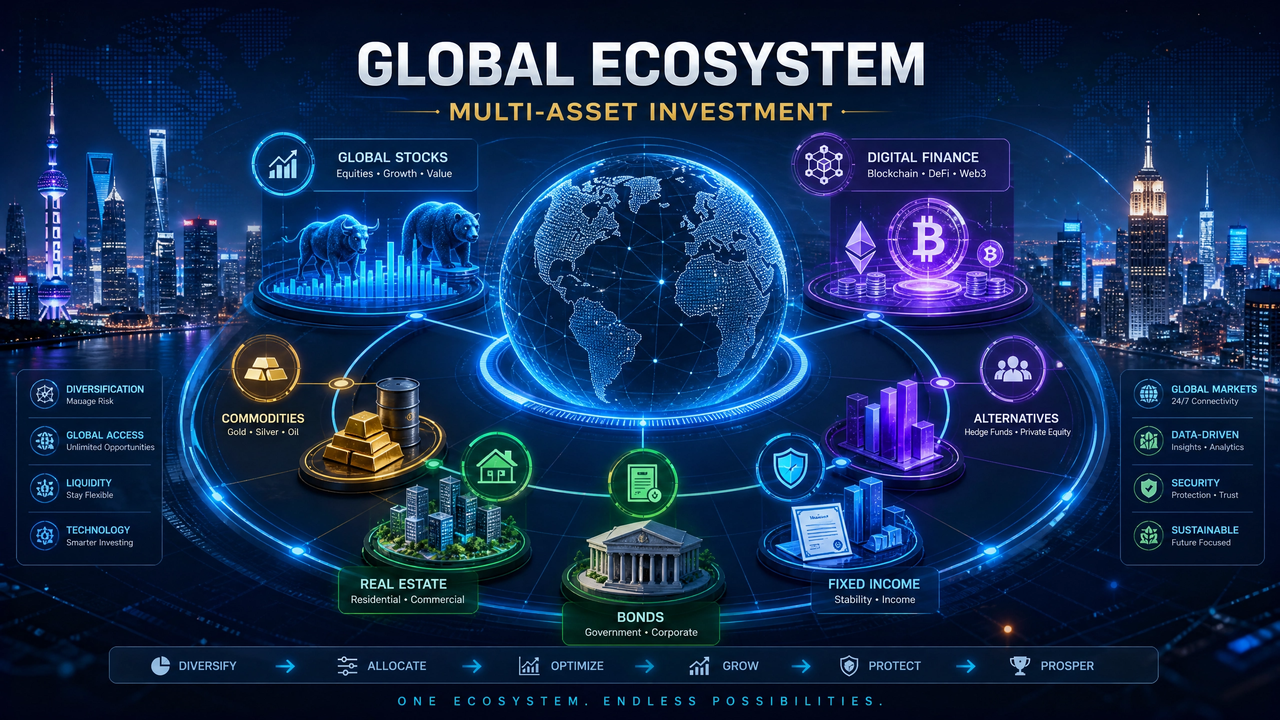
As investment demands continue to rise, modern investors are increasingly emphasizing cross-market and multi-asset allocation capabilities. In the future, a comprehensive investment portfolio may include:
-
US technology companies
-
Hong Kong-listed companies
-
Korean semiconductor and advanced manufacturing companies
-
ETF products
-
Digital assets
-
Other global financial assets
Each market has its own characteristics and represents different industry development opportunities.
The US market continues to lead global technological innovation; the Hong Kong market connects international capital with Asian economies; the Korean market brings together many world-leading companies in semiconductors, artificial intelligence, new energy, and advanced manufacturing. Going forward, these markets will be more closely connected, and investors will pay more attention to the development of global industrial chains rather than just single-country market performance.
With ongoing advancements in financial technology, investment processes are becoming simpler and more efficient. Previously, investing in overseas stocks typically required managing multiple brokerage accounts and dealing with currency conversion issues. Now, digital finance platforms are gradually integrating resources from different markets, enabling investors to invest in global stocks through a unified platform.
As financial technology evolves, global stock investing is moving toward greater digitization and intelligence. Unified account management, digital fund transfers, cross-market trading, and more efficient asset management models are becoming trends for global investment platforms. For investors, this not only means easier access to international markets but also enhanced collaborative management capabilities across stocks, ETFs, digital assets, and other asset classes—making global asset allocation more flexible and efficient.
Korean Stocks Will Play an Increasingly Important Role in Future Global Investment Systems
In recent years, artificial intelligence, high-performance computing, new energy vehicles, and advanced manufacturing have continuously driven global industry upgrades—and Korea is a key player in these sectors. From semiconductors to consumer electronics to new energy vehicles, batteries, biotech, and internet platforms, Korean listed companies consistently demonstrate strong international competitiveness. Thus, Korea's market importance extends beyond Asia—it is becoming a vital component of the global technology industry.
As international investors focus more on Asian market allocations and global capital pays increasing attention to technological innovation sectors, Korea's capital market is expected to attract more long-term capital. For investors looking to build a global investment perspective, Korean stocks are not just a national market—they offer an important window into global industry development.
Digital Finance Will Continue to Upgrade Global Investment Methods
The future development of financial markets is not just about increasing product variety—it's about continuously upgrading investment methods. The connection between digital asset platforms, financial technology, and global capital markets will keep growing. Multi-asset investing will gradually become mainstream.
Future investors will focus on:
-
How to quickly participate in global markets
-
How to manage different assets in a unified way
-
How to improve capital utilization efficiency
-
How to build long-term global asset allocation capabilities
As platforms continue to enhance their global stock product offerings and expand into more international markets, the integration between digital finance and traditional finance will deepen further. In the long run, global capital markets will keep developing toward greater digitization, globalization, and efficiency.
Conclusion
This course series systematically introduced the development background of Korea's stock market, the digital finance ecosystem, construction of global stock platforms, and the value of asset allocation—helping learners build a more complete understanding of global stock investing. Korea's capital market—with its strengths in semiconductors, artificial intelligence, new energy vehicles, advanced manufacturing, and internet industries—has become one of the key markets for global investors. Meanwhile, as digital finance rapidly evolves, methods for investing in global stocks are also being upgraded: unified accounts, USDT fund management, and access to global markets are gradually lowering cross-border investment barriers and improving overall investment efficiency.
As a key platform connecting digital assets with traditional finance, Gate Stocks continues to improve its global stock system covering US stocks, Hong Kong stocks, and Korean stocks—enabling users to manage global stock assets on one platform for a more convenient and diversified global investment experience. In the future, as global capital markets become more open, financial technology continues to innovate, and digital finance ecosystems mature further, global investing will become more digitalized, diversified, and international. Understanding these trends and building cross-market and cross-asset investment perspectives will help investors seize long-term opportunities in global economic development.
Through five courses starting from Korea's capital market development background, we explored the global stock market landscape, digital finance ecosystem, cross-market asset allocation strategies, and future directions in finance. We hope this course helps learners build a more comprehensive global investment perspective—enabling systematic understanding of connections between different markets and mastering long-term opportunities brought by the digital finance era amid ever-changing international capital markets.