Global Capital Markets Are Entering an Era of Cross-Market Investment
In the past, investors typically focused on their domestic stock markets, with cross-border investments mainly undertaken by institutional investors or professionals. However, as global economic ties strengthen and the development of the internet and digital finance accelerates, investment boundaries are gradually breaking down, and more investors are exploring opportunities across different markets worldwide.
In recent years, U.S. tech companies have continued to drive advancements in artificial intelligence, cloud computing, and high-performance computing; Asian markets have demonstrated strong competitiveness in semiconductors, advanced manufacturing, new energy, and consumer electronics. Each country and region has its own industrial strengths, creating a complementary relationship across global stock markets and making cross-market asset allocation an increasingly important investment concept. The development of ETF products, improved global capital flow efficiency, and the maturation of digital trading platforms have all further lowered the threshold for investors to participate in international markets.
Today, investing in global stocks is no longer just a strategy for large institutions—it is increasingly becoming a focus for individual investors. In the long term, global capital markets are moving toward greater openness and interconnectivity, and cross-market investment will remain a major trend in future financial markets.
Why Korea Is One of Asia's Leading Capital Markets
When discussing Asian capital markets, many first think of American companies' supply chains in Asia or major economies like China and Japan. However, Korea, with its longstanding industrial advantages, has also developed into one of Asia's most internationally influential capital markets.
Korea boasts a comprehensive and mature capital market system. The Korea Exchange (KRX) is the country's primary securities trading platform, overseeing both the KOSPI main board and the KOSDAQ growth board. The former gathers Korea's larger, well-established listed companies, while the latter is home to numerous technology innovators, biotech firms, and growth enterprises, providing diversified momentum for the market's development.
Compared to other markets, Korea's capital market stands out for its high industry concentration. In global consumer electronics, semiconductors, automobile manufacturing, new energy batteries, and internet platforms, Korea has internationally competitive representative companies. This means the Korean market not only reflects domestic economic progress but also maintains close ties with global industry chains. As a result, the Korean stock market has become an important window for observing developments in Asian tech industries, global manufacturing, and innovative enterprises—attracting growing international capital attention.
AI and Technology Industries Propel Korean Companies onto the Global Stage
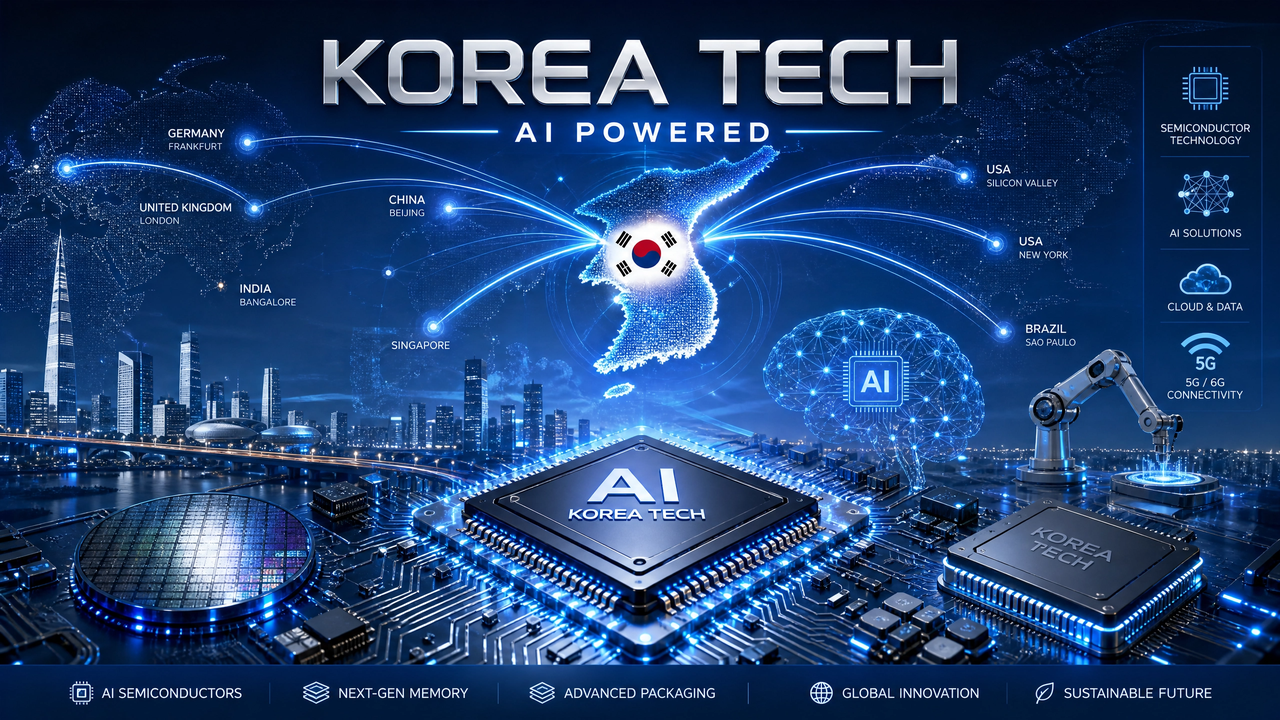
In recent years, advances in artificial intelligence have redefined the global tech industry and further elevated the importance of Korean companies. As AI models expand in scale, high-performance computing demands for storage chips, high-bandwidth memory (HBM), and advanced semiconductors are rapidly increasing—keeping Korea's semiconductor industry under global scrutiny. Meanwhile, developments in new energy vehicles, battery technology, consumer electronics, and advanced manufacturing have further strengthened Korean companies' competitiveness in international markets.
Korea is home not only to world-renowned semiconductor firms but also to leading companies in internet platforms, automotive manufacturing, biotech, and new energy sectors. These enterprises serve the local market while deeply participating in global supply chains—their performance is closely watched by international markets. For investors, the Korean stock market offers more than just access to Korean companies; it provides insight into global technological innovation trends and helps track how AI, advanced manufacturing, and digital economy developments are shaping global capital markets over the long term. As AI technology continues to proliferate in the future, Korea's tech industry is expected to gain even greater prominence globally—drawing more international investor attention to its capital market.
Beyond industrial development, changes in financial infrastructure are also driving continuous evolution in global investment models. Previously, participating in overseas stock markets typically required multiple steps—opening local brokerage accounts, processing cross-border remittances, currency exchange, and managing several investment accounts—making cross-market investing complex and cumbersome.
As the digital asset market matures, more platforms are bridging traditional finance with digital finance—allowing investors to access global capital markets more efficiently through unified methods. Digital assets not only change how funds move but also foster new approaches to cross-market asset management. Investors increasingly want to manage both digital and traditional financial assets on a single platform—reducing operational costs related to account switching, fund transfers, and multi-currency conversions. This trend shows that the future direction of financial markets isn't just about product innovation but about leveraging digital infrastructure to improve global asset allocation efficiency and create a more open and convenient investment experience.
Global Stock Investment Is Advancing Toward Greater Openness and Diversity
With ongoing development in global financial markets, investors are placing greater emphasis on cross-market and diversified asset allocation strategies. The Korean stock market's strengths in technology and advanced manufacturing are making it an increasingly important component of global investment portfolios—offering more options for investors seeking exposure to Asia's growth opportunities.
Against this backdrop, the Korean stock market is not only representative of Korea's economic development but is also a crucial part of global technology industries and manufacturing sectors. At the same time, digital finance enables investors to participate in international markets more flexibly—making cross-market investing a key trend in global asset allocation. For digital asset users, future investments will no longer be confined to a single market but will gradually expand to stocks, ETFs, digital assets, and other global financial products. In this process, integration between traditional finance and digital finance will deepen—bringing new opportunities for global capital markets.
In recent years, Korea's stock market has attracted increasing international investor attention—not just because it has many globally renowned companies but also due to its significant role in semiconductors, AI, advanced manufacturing, and new energy industries. As global capital markets open up further and digital finance evolves rapidly, cross-market investment is becoming a new market trend.