Why is global asset allocation becoming increasingly important?
With ongoing economic globalization, the industrial connections between different countries and regions are growing stronger, and the interconnectivity of capital markets continues to increase. In the past, investors might have focused mainly on their domestic stock markets; today, however, a breakthrough in artificial intelligence technology, an international corporate earnings report, or adjustments in global economic policy can all simultaneously impact capital markets across multiple countries. As a result, more investors are adopting a global asset allocation mindset, aiming to diversify investment risks and improve portfolio stability by combining assets across different regions, industries, and categories. Global asset allocation is not just about investing in more markets—it's about seeking long-term growth opportunities from the perspective of global industrial development, with the Korean market being an important part of this strategy.
What makes the Korean capital market valuable for long-term investment?
Although Korea is part of the Asian market, it holds a significant position in the global technology industry chain. As a major player in manufacturing and technology, Korea maintains international competitiveness in several key sectors, including:
-
Semiconductors
-
AI-related hardware
-
Consumer electronics
-
New energy vehicles
-
Power batteries
-
Biotechnology
-
Internet platforms
These industries not only impact Korea's economy but also deeply influence the development of global supply chains.
For example, rapid growth in artificial intelligence has driven demand for high-performance computing, data centers, and advanced chips, further elevating the importance of Korean semiconductor companies. The widespread adoption of new energy vehicles has fueled continuous growth for battery and automotive manufacturers. The development of internet platforms and digital services has also strengthened the international competitiveness of Korean tech companies. Therefore, the Korean stock market reflects not only Korea's economic progress but also global technology industry trends.
Technological innovation drives continuous growth in the Korean market
In recent years, artificial intelligence has become one of the most closely watched trends in global capital markets. From AI chips and cloud computing to smart manufacturing and robotics, industries worldwide are experiencing a new wave of technological upgrades. Korean companies, with their deep roots in semiconductors and advanced manufacturing, continue to attract international attention. Beyond AI, Korea boasts complete industry chains in consumer electronics, new energy vehicles, battery technology, and biomedicine. This diversified industrial structure means that Korea's capital market does not rely on a single sector but instead features multiple engines with international competitiveness. For investors, focusing on the Korean market means not just investing in individual companies but participating in the ongoing upgrade of global technology industries. As AI, high-performance computing, and new energy sectors expand, the market influence of Korean listed companies is expected to grow further.
Korean stocks: A key allocation choice in the Asian market
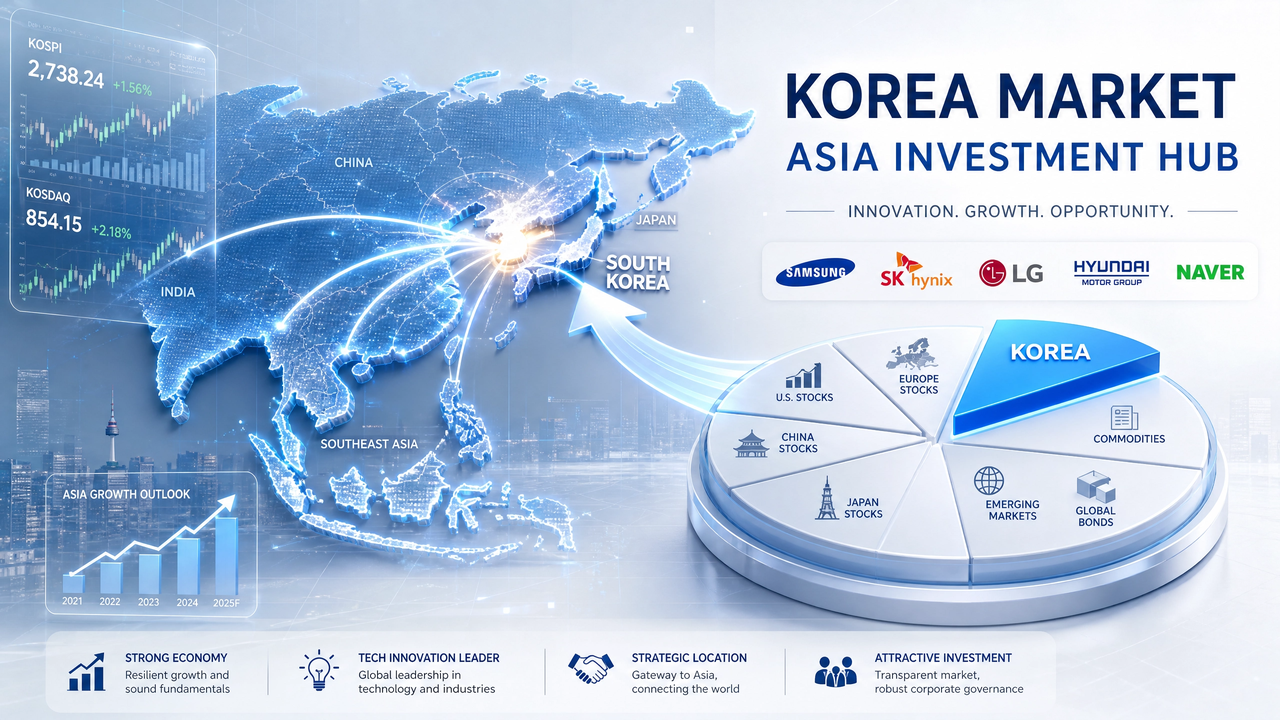
In global equity markets, the US offers the largest capital scale, Hong Kong connects Asian and Chinese economies, while Korea gathers many internationally competitive tech and manufacturing firms. As a result, more international investors are including Korean stocks in their long-term asset allocations.
The Korean market has several notable features:
-
High concentration of technology industries that reflect global tech trends
-
Internationally competitive semiconductor and advanced manufacturing sectors
-
Continuous growth in new energy vehicle and battery industries
-
Mature market system with highly internationalized listed companies
-
An important part of Asia's regional economy
For investors seeking exposure to both US tech innovation and Asian growth opportunities, the Korean market further diversifies portfolios and enhances regional allocation.
Digital finance makes global asset allocation more convenient
In the past, participating in multiple international stock markets meant managing separate brokerage accounts, different trading currencies, and varying market rules. With rapid advances in digital finance, this is changing. Through unified account structures and digital fund management, investors can now access various global capital markets more easily, making global asset allocation more efficient.
Take Gate Stock as an example: investors can trade US stocks, Hong Kong stocks, and Korean stocks through a single brokerage account using USDT for fund management—no need to prepare different currencies for each market. The platform also supports fractional share trading starting from as little as 0.01 shares, allowing investors to build flexible global equity portfolios based on their available capital. This digital investment model not only lowers barriers to cross-market investing but also promotes integration between digital assets and traditional financial markets, making global asset allocation accessible to more investors.
Multi-asset allocation is becoming a key trend for future investment
As financial markets evolve, investment strategies are also changing. Modern investors look beyond stock markets to digital assets, ETFs, commodities, and other financial products—aiming to boost overall investment efficiency through diversified asset combinations. For global investors, US stocks, Hong Kong stocks, and Korean stocks each represent different industry and regional opportunities; digital finance platforms further connect these markets, enabling more flexible asset management and ongoing portfolio adjustments in response to changes in the global economy. Over the long term, multi-asset, multi-market, and globalized allocation will become an important trend in modern investing—and the Korean market will play an increasingly vital role in the global investment system.
With ongoing advances in technology innovation and continued development in AI, new energy vehicles, and advanced manufacturing sectors worldwide, Korea's capital market is becoming even more significant. As a major center for technology and manufacturing in Asia, Korea not only brings together many internationally competitive companies but also offers global investors a wider range of long-term opportunities. The growth of digital finance is transforming how assets are allocated globally—through unified accounts, USDT fund management, and cross-market trading capabilities—enabling investors to participate more efficiently in global equity markets while further integrating traditional and digital finance.