What Is Ethereum?
Ethereum is a public blockchain platform that enables anyone to deploy and operate smart contracts—self-executing code that runs on-chain. Its native asset, Ether (ETH), is used to pay transaction fees and smart contract execution costs (commonly referred to as gas fees) and functions as a settlement asset across the network. Unlike blockchains limited to simple value transfers, Ethereum supports decentralized applications (DApps) such as lending platforms, digital marketplaces, and NFTs.
At its core, Ethereum is designed as a programmable blockchain. Smart contracts can hold and move assets, enforce rules, and trigger actions automatically based on predefined conditions. This capability underpins decentralized finance, digital ownership systems, and many forms of on-chain automation without reliance on centralized intermediaries.
Current Ethereum (ETH) Price, Market Cap, and Circulating Supply
Indicative ETH price in NZD can be estimated by converting a USD snapshot using an FX rate. For real-time ETH/NZD, use Gate’s live market interface.
Important notice: This section is provided for informational purposes only and does not constitute financial, investment, or trading advice. Cryptocurrency prices and foreign-exchange rates change rapidly.
ETH/NZD Quick View (Indicative, Not Real-Time)
- ETH spot reference: USD-denominated market snapshot
- NZD value: Derived using an indicative USD→NZD exchange rate
- Purpose: Currency interpretation only, not a live quote
- Note: Prices and FX rates vary continuously by venue and time
Indicative market snapshot (reference only):
- As of: 2026-01-27 (spot market snapshot; not real-time)
- ETH price (USD): approximately $2,942.70
- Market capitalization: approximately $355.17 billion USD
- Reported circulating supply: approximately 120.69 million ETH
- 24-hour trading volume: approximately $806.67 million USD
- Execution prices: can differ across venues due to spreads, fees, and liquidity; snapshots are for reference only
ETH price in NZD (illustrative conversion): The table below shows an indicative ETH value in New Zealand Dollars derived from the USD spot reference above. This is not a live ETH/NZD quote and should not be used as an execution price.
| Metric |
Value |
Methodology (As of) |
| ETH price (USD) |
$2,942.70 |
Spot market snapshot (2026-01-27) |
| USD → NZD exchange rate |
1 USD ≈ 1.68 NZD (indicative; varies by provider and time) |
Indicative same-day FX reference (provider/time can vary) |
| ETH price (NZD, indicative) |
≈ NZ$4,930 (rounded; indicative only) |
USD price × FX rate (rounded) |
FX rates vary by provider, methodology, and time of day. NZD values shown are illustrative only and may differ from live market pricing on trading platforms.
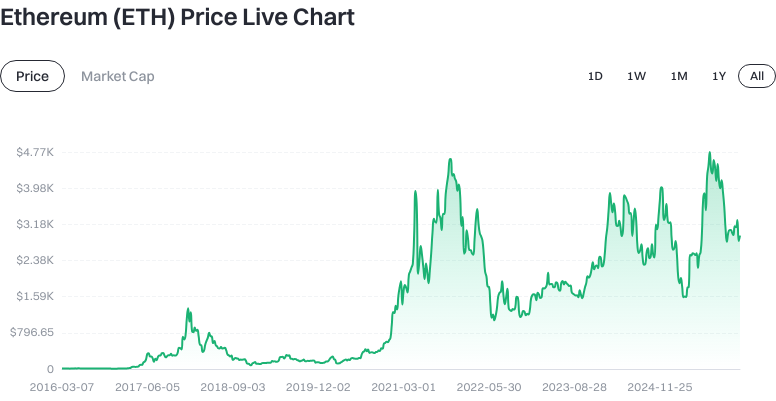
Click to view Latest ETH Price Data
Supply and FDV clarification (accuracy note): Ethereum does not have a fixed maximum supply. ETH supply changes over time based on issuance under Proof of Stake, validator rewards, and fee burning introduced by EIP-1559. Because there is no capped maximum supply, fully diluted valuation (FDV) is not a consistent or universally meaningful metric for Ethereum. Market capitalization is typically reported using circulating supply at a given point in time.
If you want to check Ethereum’s price in New Zealand Dollars (NZD), switch the display currency to NZD on Gate’s market interface where available.
How to view live ETH/NZD pricing on Gate
- Step 1: Open the ETH market page on Gate
- Step 2: Switch the fiat display currency to NZD (if available)
- Step 3: Use the live ticker and order book for execution decisions
- Reminder: This article does not display live prices
Who Created Ethereum (ETH) and When?
Ethereum was proposed in 2013 by Vitalik Buterin. Early contributors and co-founders included Gavin Wood, Joseph Lubin, and other developers who helped define Ethereum’s technical architecture and early governance.
The Ethereum mainnet officially launched on July 30, 2015. Since launch, the network has undergone multiple major upgrades, most notably the transition from Proof of Work to Proof of Stake in September 2022, followed by ongoing improvements focused on scalability, efficiency, and security.
How Does Ethereum (ETH) Work?
Ethereum operates under a Proof of Stake (PoS) consensus mechanism. Validators stake ETH to participate in block production and transaction validation. Honest participation earns rewards, while downtime or malicious behavior can result in penalties.
Transactions and smart contract executions consume computational resources measured in gas units. Gas fees are paid in ETH and typically quoted in Gwei, where one Gwei equals one-billionth of an ETH.
The introduction of EIP-1559 restructured Ethereum’s fee market. Each transaction includes a base fee that adjusts automatically based on network congestion, and that base fee is burned. Depending on network activity, the burn can partially or fully offset issuance, affecting net supply change over time. Users may optionally include a priority fee to incentivize faster inclusion by validators.
To improve scalability, Ethereum relies on Layer 2 solutions. Layer 2 networks process transactions off the main chain and periodically settle compressed results back to Ethereum, increasing throughput while preserving base-layer security guarantees.
What Can You Do With Ethereum (ETH)?
Ethereum supports a wide range of on-chain activities:
- DeFi: ETH is commonly used as collateral for lending, borrowing, decentralized trading, and derivatives within the DeFi ecosystem.
- NFTs: Creators mint and trade non-fungible tokens, with ETH used for minting and settlement.
- Payments and settlement: ETH enables global, permissionless transfers without banking intermediaries.
- Token issuance: Stablecoins, governance tokens, and gaming assets are frequently issued on Ethereum.
- Automation: Smart contracts automate processes such as escrow, subscriptions, and on-chain governance.
What Wallets and Scaling Solutions Exist in the Ethereum (ETH) Ecosystem?
Ethereum supports a broad range of self-custodial wallets, including browser-based extensions and hardware wallets. Self-custody means users are responsible for securing private keys or seed phrases. Loss or exposure of these credentials can result in permanent asset loss.
Blockchain explorers such as Etherscan allow users to verify addresses, transactions, and smart contract data independently.
Major Layer 2 scaling solutions include Arbitrum, Optimism, Base, and zkRollup-based networks. When using Layer 2 systems, users should understand bridge mechanics, withdrawal delays, and fee structures before transferring assets.
What Are the Main Risks and Regulatory Considerations for Ethereum (ETH)?
Market volatility: ETH prices can fluctuate significantly over short periods. Viewing prices in NZD reflects both ETH market volatility and changes in the USD/NZD exchange rate.
Smart contract risk: Bugs or exploits in decentralized applications or bridges can lead to irreversible losses.
Network fees: Periods of congestion can increase gas costs and slow transaction confirmation.
Staking risk: Validators and delegated staking participants may face penalties for downtime or protocol violations.
Regulatory and tax considerations: Legal treatment of crypto assets varies by jurisdiction and may change over time.
Security: Phishing, malware, and private-key exposure remain primary causes of user losses.
How Can I Buy and Securely Store Ethereum (ETH) on Gate?
Step 1: Create a Gate account and complete identity verification, subject to regional requirements.
Step 2: Fund your account using supported assets or available fiat on-ramps.
Step 3: Locate ETH trading pairs such as ETH/USDT and place market or limit orders.
Step 4: Enable security features including two-factor authentication and withdrawal protections.
Step 5: Withdraw ETH to a self-custodial wallet if you plan to interact on-chain or hold long term.
Step 6: Back up seed phrases offline and never store them digitally or share them with others.
How Is Ethereum (ETH) Different From Bitcoin?
Ethereum and Bitcoin are both public blockchains but are designed for different primary use cases.
| Category |
Ethereum (ETH) |
Bitcoin (BTC) |
| Primary purpose |
Programmable smart contract platform |
Store of value and peer-to-peer money |
| Supply model |
No fixed maximum supply; fee burning via EIP-1559 |
Maximum supply capped at 21 million BTC |
| Consensus |
Proof of Stake |
Proof of Work |
Click to view Top Crypto Market Cap Dominance
Summary of Ethereum (ETH)
Ethereum is the leading smart contract blockchain, with ETH serving as the fuel for transactions and on-chain computation. Proof of Stake and EIP-1559 have reshaped Ethereum’s issuance dynamics, though ETH does not have a fixed supply cap. The network supports major use cases across DeFi, NFTs, and tokenized applications, while Layer 2 adoption continues to improve scalability and cost efficiency. Given price volatility, technical risks, and evolving regulation, users should prioritize security, understand fee mechanics, and distinguish between indicative price references and live market data.
FAQ
What Are the Benefits of Viewing Ethereum’s Price in New Zealand Dollars?
Viewing ETH prices in NZD helps users interpret value in their local currency for budgeting, reporting, and tracking. NZD pricing reflects both ETH market movements and changes in the USD/NZD exchange rate.
How Can I Quickly Check Real-Time Ethereum Prices in NZD?
On Gate’s ETH market page, switch the display currency to NZD where available and refer to the live ticker and order book.
Does Quoting Ethereum in NZD Impact Investment Risk?
Changing the display currency does not alter ETH’s underlying market risk, but NZD values also move with foreign-exchange fluctuations.
Is It Safe for New Zealand Users to Buy Ethereum with NZD on Gate?
Gate provides security features that vary by product and jurisdiction. Users should enable two-factor authentication, verify URLs, and follow anti-phishing best practices.
Are There Big Differences Between ETH Priced in NZD Versus Other Fiat Currencies?
Differences are mainly due to exchange rates, liquidity, spreads, and fees rather than intrinsic differences in ETH value.
Glossary of Key Ethereum (ETH) Terms
- Smart Contract: A self-executing program that runs on the Ethereum blockchain.
- Gas: The unit of computation required to execute transactions and contracts.
- Ethereum Virtual Machine (EVM): The runtime environment for smart contracts.
- Staking: Locking ETH to participate in network validation.
- DeFi: Decentralized financial applications built on blockchains.
- Layer 2: Scalability solutions that operate on top of Ethereum.
Further Reading on Ethereum (ETH)