What is Numeraire?
Numeraire (NMR) is the native token of the Numerai ecosystem, designed to incentivize data scientists to participate in machine learning competitions and stake their predictions. Participants stake NMR tokens to back the accuracy of their models: high-performing predictions earn rewards, while poor results can lead to staked tokens being burned. The core aim is to aggregate decentralized modeling talent, generating superior signals for real-world quantitative trading strategies.
Current Price, Market Cap, and Circulation of Numeraire (NMR)
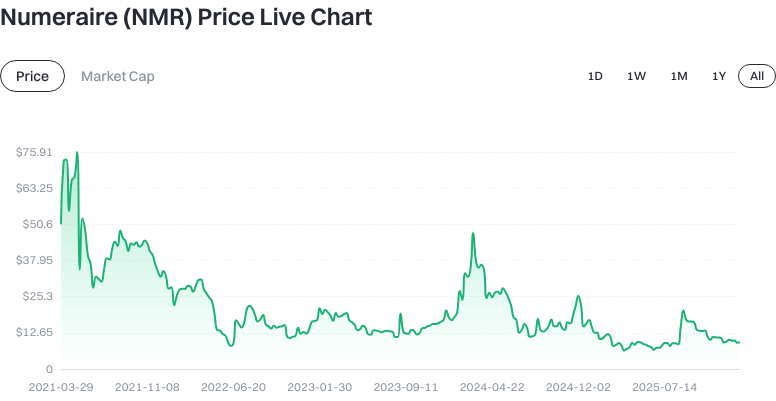
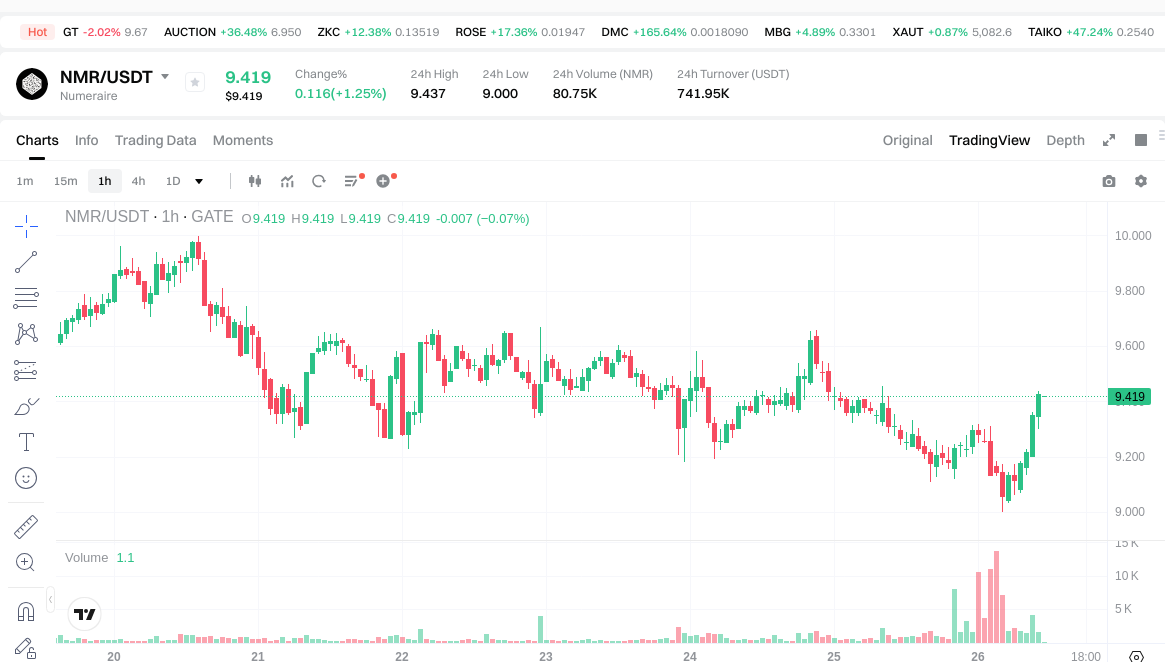
As of 2026-01-26 (source: provided data), the latest price of Numeraire is approximately $9.387 USD. Circulating supply stands at about 8,007,701.310704 NMR, with a market capitalization of $99,953,377.185695 USD, representing around 0.003200% of the total crypto market cap. The total supply is roughly 10,648,064.044497 NMR, with a maximum supply capped at 11,000,000 NMR, leading to a fully diluted market cap of $99,953,377.185695 USD.
Short-term price changes:
- 1-hour change: +0.630%
- 24-hour change: +0.960%
- 7-day change: -1.300%
- 30-day change: +0.590%
View Latest NMR Price
The 24-hour trading volume is about $738,764.188610 USD. Market cap is calculated by multiplying price by circulating supply and reflects the current market valuation of the project; fully diluted market cap uses the maximum supply to estimate potential future valuation.
Who Created Numeraire (NMR) and When?
Numeraire was launched on February 20, 2017. According to public information (as of October 2024), Numerai was founded by a quantitative hedge fund team aiming to enable global data scientists to build models on encrypted and anonymized datasets without revealing proprietary trading strategies. The best-performing models are integrated into the fund’s actual trading activity. Early token distribution targeted competition participants and was allocated based on scores and performance.
How Does Numeraire (NMR) Work?
The core process involves three stages: data, modeling, and staking. Numerai encrypts and anonymizes trading data; participants download these datasets, train their models, and submit predictions. They then stake NMR tokens to back their predictions—staking involves locking a specific amount of NMR on-chain, signaling confidence in their model.
If the model performs well in subsequent real-market evaluation, stakers earn token rewards and bonuses. If performance is poor, some or all of the staked NMR is burned—permanently removed from circulation.
View NMR USDT Price
By rewarding high-quality models and penalizing poor ones, Numerai aligns token economics with model quality and reduces noise from random submissions.
NMR is issued on the Ethereum network as an ERC-20 token. ERC-20 is the standard for fungible tokens on Ethereum; withdrawals and transfers require payment of gas fees—network transaction costs—priced in ETH according to network congestion.
What Can You Do With Numeraire (NMR)?
The main use cases for NMR are staking on prediction results and participating in competitions. Staking allows model authors to “back” their predictions with tokens, helping maintain submission quality by discouraging low-effort entries. Regular holders can use NMR as an entry ticket to the ecosystem—supporting or joining competitions, monitoring model leaderboards and historical performance, and engaging in staking under controlled risk.
For example, if you have confidence in a particular market signal model, you can stake a certain amount of NMR for potentially greater rewards. However, if your model underperforms, any burned tokens are irrecoverable.
Wallets and Extensions in the Numeraire (NMR) Ecosystem
As an ERC-20 token, NMR can be managed using mainstream Ethereum wallets. Software wallets are suitable for everyday use and offer browser extensions or mobile apps for convenient on-chain interaction; hardware wallets store private keys offline and are better suited for long-term holdings or larger amounts.
When staking or withdrawing NMR, ensure you select the Ethereum network (ERC-20), and keep sufficient ETH available to cover gas fees. Backing up your mnemonic phrase and private key is essential for security—a mnemonic phrase is the sole recovery credential for your wallet and should be stored offline (never via screenshot or cloud storage).
Major Risks and Regulatory Considerations for Numeraire (NMR)
First is model performance risk: staking directly links rewards to model quality as evaluated by real market outcomes; poor results may lead to token burns.
Second are smart contract and network fee risks: on-chain interactions rely on contract security and Ethereum network stability; gas fees can rise sharply during congestion, impacting participation costs.
Third are liquidity and price volatility risks: with limited market cap and trading volume, NMR can experience significant short-term price swings that affect buying and selling execution.
Finally, regulatory compliance: legal frameworks differ by jurisdiction regarding token trading and income recognition; users must understand and comply with local laws—especially identity verification (KYC) and tax reporting requirements.
How Can I Buy and Safely Store Numeraire (NMR) on Gate?
Step 1: Register & Complete KYC. Go to Gate’s official site to create an account and complete identity verification (KYC) for improved account security and higher withdrawal limits.
Step 2: Fund Your Account. Deposit fiat currency or transfer stablecoins such as USDT from another wallet to ensure sufficient balance for your intended purchase and any gas fees.
Step 3: Spot Trading Order. Search for “NMR”, choose a spot trading pair, and place a limit order (custom price) or market order (current market price) as needed.
Step 4: Withdraw to Personal Wallet. On the “Assets” page, select withdraw, choose Ethereum (ERC-20), paste your Ethereum address, confirm withdrawal amount and fee, then submit after security checks. To minimize errors, start with a small test transfer before moving larger amounts.
Step 5: Backup & Security. Write down your wallet mnemonic phrase and private key offline and store securely; enable two-factor authentication (2FA) and withdrawal whitelist features to reduce account and fund risks.
Step 6: Ongoing Management. Monitor gas fees and network status; assess model risks and reward expectations before staking; keep liquid funds available to handle market volatility and transaction costs.
How Does Numeraire (NMR) Compare to Fetch.ai (FET)?
Purpose: Numeraire focuses on harnessing global data scientists’ modeling abilities for hedge fund trading strategies; Fetch.ai aims to build a decentralized AI agent network for automated tasks and data services.
Token utility: NMR is used for staking predictions—poor results may result in burned tokens; FET is primarily used for paying computational resources, governance, or network participation with an emphasis on agent/service ecosystem.
Economics & User Base: NMR has a defined maximum supply and burn mechanism tied to model performance; FET’s supply and mechanisms support its agent network operations. NMR’s core participants are data scientists and quant enthusiasts, while FET targets AI app developers and service providers.
Summary of Numeraire (NMR)
Numeraire (NMR) is an incentive and staking token built around data science competitions and quantitative trading, linking economic rewards with model quality via reward-and-burn mechanisms. Its current market cap and supply structure are transparent; as an ERC-20 token, participation and custody processes are mature. For beginners, start by preparing your Gate account and funding; practice with small transactions; prioritize wallet and key security; then gradually learn about staking mechanisms and fee structures. Long-term value depends on whether the ecosystem continues attracting high-quality models that reliably convert into verifiable trading returns—keep track of competition outcomes, on-chain data, and fee dynamics.
FAQ
Is NMR the Same as Monero (XMR)?
No. NMR is the Numeraire token used for incentivizing participation and governance on Numerai’s data science competition platform; XMR is Monero—a privacy-focused standalone coin. They are entirely different projects with separate purposes—do not confuse them.
What Is the Main Use of NMR?
NMR serves as Numerai’s platform token, primarily rewarding data scientists who participate in competitions by submitting models. Holders can also participate in platform governance decisions, while staking is available in certain seasons to support prediction models.
How Do I Buy NMR?
You can buy NMR on major cryptocurrency exchanges such as Gate. Search for NMR trading pairs on Gate, choose your preferred trade method (spot trading is simplest), enter your desired amount, and place your order. Beginners should start small to get familiar with the process.
Is NMR Safe? What Risks Should I Be Aware Of?
NMR runs on the Ethereum blockchain and inherits its security properties. Key risks include market volatility, relatively limited liquidity, and dependence on Numerai’s platform development. Never invest more than you can afford to lose.
How Should I Safely Store My NMR?
Small amounts can be kept in your Gate account for convenience; larger holdings should be transferred to self-custody wallets such as MetaMask or hardware wallets. Always verify recipient addresses carefully when transferring funds—and never share your private key or mnemonic phrase with anyone.
- Data Science Competition: Machine learning prediction contests organized by Numerai where participants earn NMR rewards for accurate models.
- Staking Mechanism: Users lock up NMR tokens to participate in competitions—rewards or losses depend on prediction performance.
- Oracle: Bridges off-chain data and competition results onto the blockchain, ensuring smart contracts execute automatically.
- Token Incentives: The platform rewards outstanding data scientists and machine learning contributors with NMR.
- Decentralized Financial Forecasting: Utilizes crowdsourced models from data scientists worldwide to predict financial markets and facilitate hedging.
- Model Fusion: Numerai combines multiple participant models into robust ensemble predictions.
Numerai (NMR) Reference & Further Reading