What Is RLC Token?
RLC is the native utility token of iExec, a decentralized cloud computing marketplace. It serves as the medium of exchange for renting computing resources, datasets, and application services, as well as for staking and incentivizing both providers and task executors. Decentralized cloud computing refers to leveraging globally distributed compute and data providers instead of relying on a single cloud vendor, enabling on-demand transactions and on-chain settlement.
RLC is issued on Ethereum as an ERC-20 token, adhering to Ethereum’s widely adopted token standard for seamless compatibility with wallets and applications. iExec is designed for decentralized applications (DApps) operating on the blockchain, using smart contracts to coordinate task allocation and results verification, thereby enhancing scalable compute and data availability.
RLC Token (RLC): Current Price, Market Cap, and Circulating Supply
As of 2026-01-27, RLC is priced at approximately $0.5940, with a circulating market capitalization of around $51,677,872.28 and a 24-hour trading volume of about $21,017.89. The price has changed by 0.63% in the last hour, 2.09% over 24 hours, -7.39% over the past week, and -10.07% over the past 30 days (all figures based on provided data).
Regarding supply: the circulating amount is roughly 72,382,548.07 RLC, with a total and maximum supply both set at approximately 86,999,784.99 RLC. With most tokens already circulating, the fully diluted market cap closely matches the circulating market cap. This high float aids price discovery by reflecting actual market circulation but does not guarantee reduced volatility.
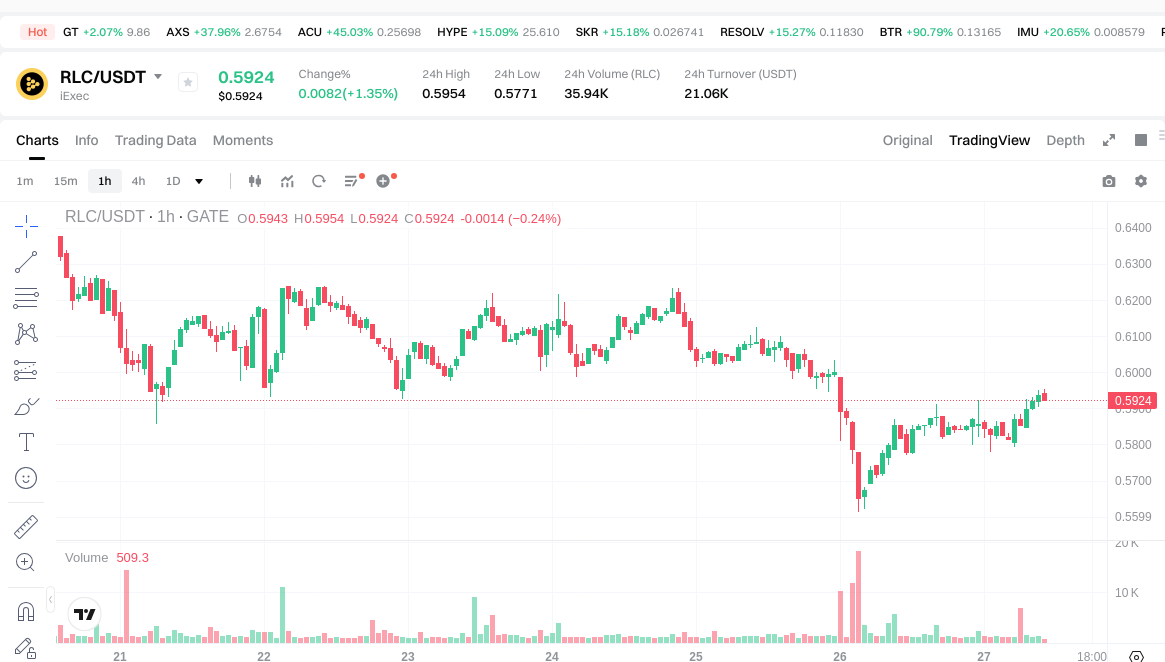
Click to view RLC USDT Price
Who Created RLC Token (RLC) and When?
iExec launched in 2017, with the RLC token debuting on April 18, 2017. The team comes from a background in distributed computing and academic research; public records indicate that the founders and core researchers have contributed to distributed computing frameworks and grid computing projects, aiming to integrate "on-demand computing" with blockchain-based settlement (source: iExec whitepaper and official website, accessed 2026-01-27).
iExec’s model centers on outsourcing compute tasks to independent providers grouped into "worker pools," using on-chain rules and cryptographic techniques to ensure result verifiability and data protection. Over time, iExec has expanded into data marketplaces and oracle capabilities.
How Does RLC Token (RLC) Work?
At its core, iExec operates as a matching marketplace: requesters submit computational tasks, while providers supply compute power or data. On-chain smart contracts escrow funds and determine task delivery outcomes. RLC is used for service payments and staking to reduce default risk.
To ensure trust in results, iExec implements PoCo (Proof-of-Contribution) to validate task execution against agreements. It also leverages Trusted Execution Environments (TEEs), such as Intel SGX, allowing code to run securely in hardware-isolated enclaves to maintain data confidentiality. TEEs create secure zones that protect code and data from external access.
On the settlement layer, ERC-20 RLC interacts with smart contracts for payment escrow, release, and penalties. On the execution layer, worker pools accept tasks, perform off-chain computation, and return proofs for on-chain settlement. This architecture boosts throughput while maintaining blockchain transparency and traceability.
What Can You Do with RLC Token (RLC)?
- Pay for computation tasks: Use RLC for high-throughput, short-term workloads like AI model inference, video transcoding, rendering, or Monte Carlo simulations.
- Purchase data and app services: Acquire datasets or API access rights in the data marketplace and pay per usage.
- Participate in incentives and staking: Providers can stake RLC to boost their credibility for job selection and earn rewards from completed tasks.
- Integrate with oracles: iExec offers tools for bringing off-chain trusted data on-chain—ideal for DeFi, insurance, and other use cases requiring external information.
For example, a small team can outsource a one-off AI inference job to an iExec worker pool and settle with RLC—eliminating the need to build their own GPU cluster while protecting confidential data or model weights within a TEE.
Wallets and Extensions in the RLC (RLC) Ecosystem
- Wallets & Custody: Compatible with mainstream Ethereum wallets—including both software and hardware wallets—for managing ERC-20 assets and DApp authorization. Hardware wallets provide enhanced private key security via offline signing.
- Developer Tools: The iExec SDK, data marketplace tools, and oracle utilities enable developers to integrate off-chain computation, data access, and trusted execution into DApp workflows.
- Operations & Monitoring: Worker pool operators can deploy and monitor tasks using official tools; developers can track task status through contract events and logs.
These are common ecosystem components; users should balance security, compatibility, and cost when choosing solutions.
Main Risks and Regulatory Considerations for RLC Token (RLC)
- Technical reliance: TEEs (like SGX) are vulnerable if hardware flaws are discovered—prompt patching and upgrades are required to maintain confidential computing guarantees.
- Supply & demand uncertainty: Compute/data supply is fragmented; actual availability and service quality depend on worker pool operation standards.
- Fees & network congestion: As an Ethereum ERC-20 token, gas fees may spike during busy periods, reducing economic viability for small tasks.
- Token price & liquidity: Volatility can be high; order book depth and trading volume may fluctuate by market phase, increasing slippage risk.
- Compliance & data regulation: Cross-border or sensitive data usage must comply with local privacy laws and regulatory requirements.
- Custody & operations: Exchange accounts face platform/account security risks; self-custody requires careful management of private keys and seed phrases—lost credentials cannot be recovered.
How to Buy and Safely Store RLC (RLC) on Gate
Step 1: Register a Gate account and complete identity verification. Enable Google Authenticator or SMS verification for two-factor authentication to enhance account security.
Step 2: Fund your account. Purchase USDT via fiat channels under “Buy Crypto” or deposit USDT from your personal wallet into Gate—follow platform prompts and regional policies.
Step 3: Spot trading. Search for “RLC/USDT” in the spot market; select either a limit order (set your own price) or a market order (execute instantly at current market prices).
Step 4: Order completion & asset check. After trade execution, view your RLC balance under “Funds” or “Wallet” to confirm quantity and transaction records.
Step 5: Withdraw to a self-custody wallet (optional). For long-term holding or on-chain activity, transfer to an Ethereum-compatible self-custody wallet. Double-check that you select the ERC-20 network; test with a small amount before transferring larger sums to the same address/network.
Step 6: Security & backup. Enable withdrawal whitelist and anti-phishing codes; if self-custodying, write down your seed phrase offline for safekeeping—hardware wallets offer added protection against theft.
How Is RLC Token (RLC) Different from Golem?
- Market focus: Both are decentralized computing marketplaces. iExec emphasizes data/app service markets and confidential computing; Golem has long focused on general-purpose compute rental and task distribution.
- Privacy & trust: iExec highlights TEE-based confidential computing for sensitive data; Golem is more open but relies less on privacy-preserving hardware.
- Ecosystem components: iExec provides data marketplace and oracle tools for bringing external data on-chain; Golem focuses more on developer tools and task frameworks.
- Token utility: RLC is used for payments, staking, incentives, and is tightly linked with data/app services; GLM mainly facilitates payment and settlement for compute tasks.
These platforms are not mutually exclusive—the right choice depends on needs for confidential computing, data authorization, or ecosystem tooling.
Summary of RLC Token (RLC)
RLC powers iExec’s decentralized cloud resource marketplace by enabling payments and incentives while combining PoCo and TEEs to bring "trusted results" and "data privacy" into on-chain settlement. With most supply circulating, price discovery reflects real market conditions—though volatility remains possible. On the application side, RLC shows strong potential in AI inference, data authorization, and oracle services. Beginners should first familiarize themselves with Ethereum/ERC-20 fee dynamics before purchasing on Gate—and prioritize account/private key security. Looking ahead, RLC’s long-term value will depend on real demand for compute/data resources, worker pool quality of service, compliance adherence, and ongoing cost optimization.
FAQ
What Is RLC Token?
RLC is the native token of the iExec platform used for transactions and incentives within its decentralized computing network. Holders can stake RLC to earn network rewards or trade it on platforms like Gate. The token represents ownership rights and access to distributed computing resources.
What Are the Practical Uses of RLC Token?
RLC plays a central role in the iExec ecosystem—it enables users to purchase compute resources or pay task fees and allows providers to earn rewards by offering computational power. Additionally, holders can participate in platform governance decisions by voting.
How Do I Buy and Hold RLC Token?
You can purchase RLC on major exchanges like Gate using fiat or other cryptocurrencies. After buying, you may transfer it to a self-custody wallet (such as MetaMask) for safekeeping or keep it in your exchange account. Beginners are advised to start small while learning operational procedures.
Is RLC Token Volatile?
As a low market cap utility token, RLC can experience significant price swings influenced by market sentiment, platform development progress, and broader crypto trends. Always assess your risk tolerance before investing—never commit more than you can afford to lose or chase prices at their peaks.
Quick Reference Glossary for iExec RLC (RLC)
- Decentralized cloud computing: Aggregates distributed compute resources via blockchain to deliver secure and trustworthy cloud services.
- Smart contract: Self-executing program code on blockchain that enforces agreement terms without third-party intervention.
- Proof-of-Work (PoW): A consensus mechanism where computational work validates transactions/blocks to secure the network.
- Gas fee: The transaction fee required for executing blockchain operations or contracts—used to incentivize network validators.
- Token staking: Users lock tokens to participate in network operations in exchange for rewards or voting rights.
- Decentralized application (DApp): Apps running on blockchain networks featuring decentralization, transparency, and resistance to censorship.
Further Reading & Resources