What Is Worldcoin?
Worldcoin (WLD) is a cryptocurrency project and its native token, designed with the core goal of “proof of human uniqueness.” The protocol enables individuals to create a reusable digital identity called “World ID,” leveraging zero-knowledge proof technology. This allows users to verify they are unique, real humans without exposing their biometric details. The WLD token powers network incentives, potential governance, and settlement within applications.
For beginners: Decentralization means no single entity maintains long-term control; important rules transition through community-driven decision processes. ERC-20 refers to a standard for tokens on Ethereum, ensuring compatibility across wallets and exchanges.
What Are Worldcoin (WLD)'s Current Price, Market Cap, and Circulating Supply?
As of 2026-01-26 (according to available data): Latest price is approximately $0.4515; circulating supply is about 2,757,802,859.146073 WLD; both total and maximum supply are set at 10,000,000,000 WLD; circulating market cap stands at roughly $4,515,000,000; fully diluted market cap is also around $4,515,000,000; market share is approximately 0.14%; 24-hour trading volume is about $1,982,225; price changes are +0.27% over 1 hour, -3.8% over 24 hours, -7.1% over 7 days, and -8.54% over 30 days.
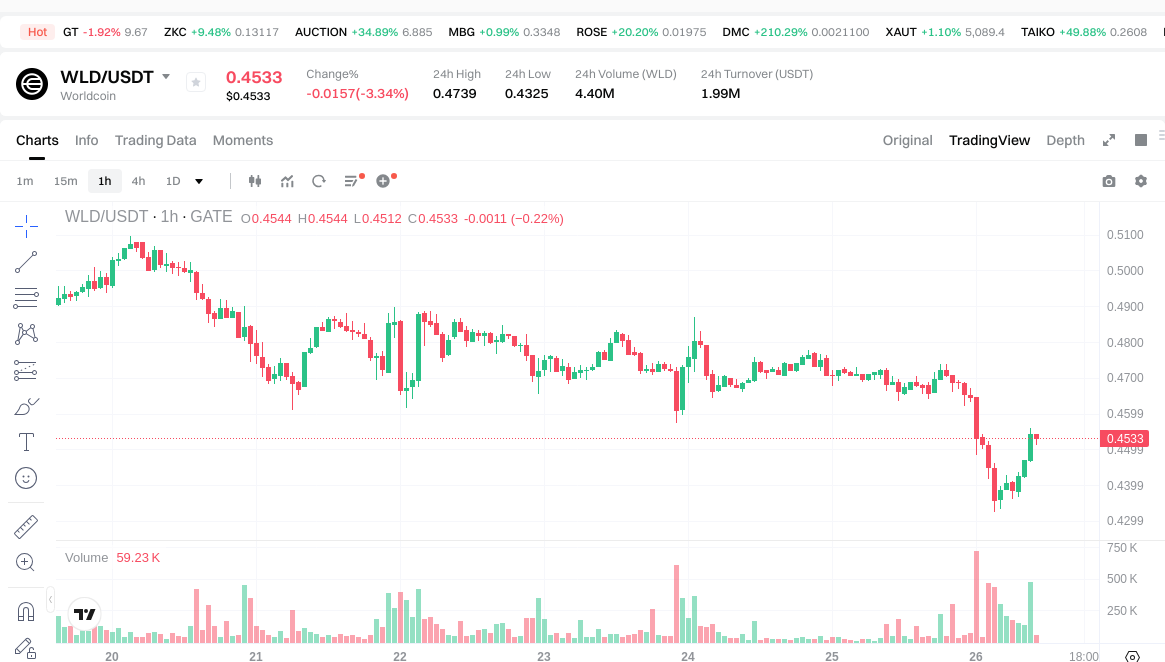
Click to view WLD USDT Price
Concept note: Circulating market cap equals price times circulating token amount; Fully Diluted Value (FDV) is price times maximum supply, representing valuation if all tokens are unlocked. The “circulating market cap” and “fully diluted market cap” figures above are identical, which may result from data methodology or the circulating supply used. Refer to official sources and authoritative market pages for the most accurate and updated figures.
Who Created Worldcoin (WLD) and When?
Worldcoin launched on July 23, 2023, with its ecosystem driven by the Worldcoin Foundation and development company Tools for Humanity. Notable representatives include Sam Altman and Alex Blania. The project’s founding vision is to offer a verifiable “proof of personhood” for global users, aiming to reduce bot activity and multi-account abuse while promoting fair participation in open networks.
Sources: Worldcoin Whitepaper and official blog (published in 2023), public media reports; research date: 2026-01-26.
How Does Worldcoin (WLD) Work?
Worldcoin’s architecture consists of World ID, biometric verification hardware, and the WLD token. Users scan their irises with a dedicated device that generates an encrypted fingerprint—only an irreversible hash is stored; original images are processed according to official protocol and not published on-chain. Users then receive a World ID powered by zero-knowledge proofs, allowing them to prove “I am a unique person” in applications without revealing biometric details or wallet specifics.
Zero-knowledge proof is a cryptographic technology that enables validation of a claim without disclosing the underlying private information. This mechanism allows applications to confirm eligibility (“one per person”) and reduce bot and sybil attacks.
WLD tokens are issued on Ethereum and serve as incentives for ecosystem participation, cover some in-app economic activities, and—pending governance framework development—will be used for proposals and voting per official governance rules.
What Can Worldcoin (WLD) Be Used For?
On the application side, World ID enables “one per person” qualification for registrations, voting, airdrops, rewards distribution, mitigating sybil attacks (where one user claims multiple accounts for unfair gains). Developers can integrate proof-of-personhood to fairly allocate points, discounts, or airdrops to genuine users.
For payments or settlements within apps, WLD functions as an incentive or fee asset. World ID can be integrated into login processes to reduce bot registrations that lead to spam or fraud.
What Are the Major Risks and Regulatory Considerations for Worldcoin (WLD)?
- Privacy & Data Compliance: Although the system claims only irreversible hashes are stored with zero-knowledge proof protection, biometric data collection, processing, and cross-border storage must comply with local privacy laws. Users should review local regulations and project compliance disclosures.
- Token Supply & Unlocks: WLD has a capped supply of 10 billion; future unlocks for ecosystem incentives or team/institution allocations may introduce selling pressure at certain stages. Follow official announcements and transparency reports.
- Technical & Contract Risks: Vulnerabilities or downtime in smart contracts, bridges, or client software may affect assets or functionalities. Always test with small amounts and verify contract addresses before key interactions.
- Market Volatility & Liquidity: Crypto assets experience significant price swings; short-term moves may not reflect fundamentals. Low liquidity can cause slippage—orders executing at prices far from expectations.
- Geographic & Usage Restrictions: Some jurisdictions have stricter rules on biometrics or token distribution/marketing that could impact product availability or secondary market sentiment.
- Platform & Self-Custody Risks: Tokens held on exchanges face operational and security risks; with self-custody wallets, lost private keys or seed phrases mean assets cannot be recovered.
Where Does Worldcoin (WLD)'s Long-Term Value Come From?
Long-term value depends on three factors: First, whether demand creates stable infrastructure for “one person one vote” and anti-sybil protection widely adopted across social apps, airdrops, voting, and e-commerce rewards. Second, whether supply-side management—including transparent unlocks and allocations—balances ecosystem incentives with secondary market resilience. Third, how governance and compliance evolve regarding privacy, data handling, and geographic restrictions.
If developer adoption rises, genuine user growth continues, and unlocks remain predictable, WLD’s network effects are likely to strengthen; conversely, privacy controversies, limited integration, or regulatory obstacles will hinder value realization.
How Do I Buy and Safely Store Worldcoin (WLD) on Gate?
Step 1: Register and complete identity verification. Visit Gate’s website to create an account; complete KYC (identity verification), enable Google Authenticator and withdrawal whitelist features, and set up anti-phishing codes.
Step 2: Deposit funds. Use the “Buy Crypto” section to purchase USDT with fiat currency or transfer USDT/WLD from another wallet to Gate—carefully verify network routes and addresses character by character.
Step 3: Place spot orders. Go to the spot trading area and search for “WLD/USDT.” Choose limit orders (set your own price—order executes when reached) or market orders (execute immediately at current prices).
Step 4: Control costs and risks. Confirm fees and acceptable slippage before trading; during high volatility consider averaging entries rather than buying all at once.
Step 5: Withdraw to a self-custody wallet (optional). For long-term holding, transfer WLD to a non-custodial wallet. As WLD is an Ethereum ERC-20 token, select Ethereum (ERC-20) as the withdrawal network. Double-check the destination address and ensure sufficient ETH for gas fees.
Step 6: Key security tips. Store your seed phrase and private keys securely offline—never screenshot or upload to the cloud. Use hardware wallets for significant holdings; separate small hot wallets from large cold storage for regular use.
Pro tip: Always test with small transfers first; beware of phishing sites or fake support links.
How Is Worldcoin (WLD) Different from Bitcoin?
Purpose: Bitcoin aims to be a decentralized scarce digital asset and store of value; Worldcoin focuses on proof-of-personhood within identity layers and uses WLD for ecosystem incentives.
Issuance & Supply: Bitcoin supply is algorithmically distributed via mining with halving events every four years—capped at 21 million coins; WLD’s maximum supply is 10 billion with emphasis on allocation/incentives—unlock schedules have more direct impact on price.
Technology & Mechanism: Bitcoin’s mainnet uses proof-of-work prioritizing censorship resistance and robustness; Worldcoin builds on Ethereum’s token standards and identity verification systems with zero-knowledge proofs for one-time validation per person.
Use Cases: Bitcoin is primarily used as a store of value and for cross-border payments; Worldcoin focuses on anti-sybil registration, unique airdrop eligibility, voting, and other person-centric applications.
Risk Profile: Bitcoin faces macroeconomic and policy volatility; Worldcoin contends with additional risks around biometric privacy and jurisdictional compliance.
Summary of Worldcoin (WLD)
Worldcoin introduces “proof of human uniqueness” by combining zero-knowledge proofs with digital identity—WLD acts as an incentive asset and prospective governance tool. Current market data shows price and market cap under pressure (as of 2026-01-26). Investors should understand the distinction between circulating and fully diluted market cap while monitoring future unlock schedules.
Click to view WLD Futures Open Interest
Medium-to-long-term value depends on real-world adoption rates, user growth trajectory, regulatory progress, and transparency in governance. If buying through Gate, follow best practices for security setup, manage slippage/fees carefully, prioritize self-custody options, and safeguard your mnemonic phrases. All investment decisions should be grounded in personal research and risk tolerance.
FAQ
What Is the Total Supply of WLD? Is There Unlimited Minting?
The total supply of WLD is capped at 10 billion tokens—it cannot be minted indefinitely. A portion is reserved for future claims; the rest is allocated through mining rewards, early investor distributions, and team allocations. This fixed supply model helps maintain token scarcity—similar in concept to Bitcoin’s 21 million cap.
What Are the Main Use Cases for WLD Tokens?
WLD primarily facilitates payments and governance within the Worldcoin ecosystem. Users pay fees with WLD when accessing services or receive discounts in official applications; WLD also enables participation in community voting on project decisions. As the ecosystem expands, use cases continue to grow—currently most activity centers around official Worldcoin apps.
What Are the Requirements and Safety Considerations for Claiming WLD?
To claim WLD tokens you must complete identity verification via iris scanning—the cornerstone of Worldcoin’s protocol. While iris scanning raises privacy concerns for some users, Worldcoin employs cryptographic storage and privacy safeguards. Nonetheless, users should review their local policies before participating—certain regions may restrict biometric data collection.
What Makes WLD Tokens Different from Other Airdrop Tokens?
Unlike typical airdrop tokens distributed purely for promotion or speculation, WLD is backed by a robust application ecosystem and technical team. Worldcoin is building a global identity/payments network—not just conducting token giveaways. The value of WLD derives from actual ecosystem demand rather than speculative hype alone.
How Can I Safely Store WLD After Buying on Gate?
For maximum security after purchase, transfer WLD to a self-custody wallet such as MetaMask—especially for larger holdings. Smaller amounts intended for short-term holding can remain in your Gate account. It’s recommended to enable two-factor authentication, check your account regularly, avoid trading on public networks, and protect your private keys against leaks.
Glossary of Key Worldcoin (WLD) Terms
- Biometric Verification: Identifying users via iris scans or other biometric features—Worldcoin’s core innovation.
- Orb: Worldcoin’s proprietary biometric device used for iris scans to acquire WLD tokens.
- Digital Identity: A unique identifier established via biometrics to prevent sybil attacks and guarantee “one person one vote.”
- Privacy Protection: Zero-knowledge proof technology used by Worldcoin to validate identity while safeguarding user data.
- Universal Basic Income: Worldcoin’s vision includes providing basic economic support globally through token distribution.
- Anti-Sybil Attack: Biometric verification ensures each natural person can claim tokens only once—preventing malicious repeat claims.
Worldcoin (WLD) References & Further Reading
-
Official Website / Whitepaper:
-
Development / Documentation:
-
Authoritative Media / Research: