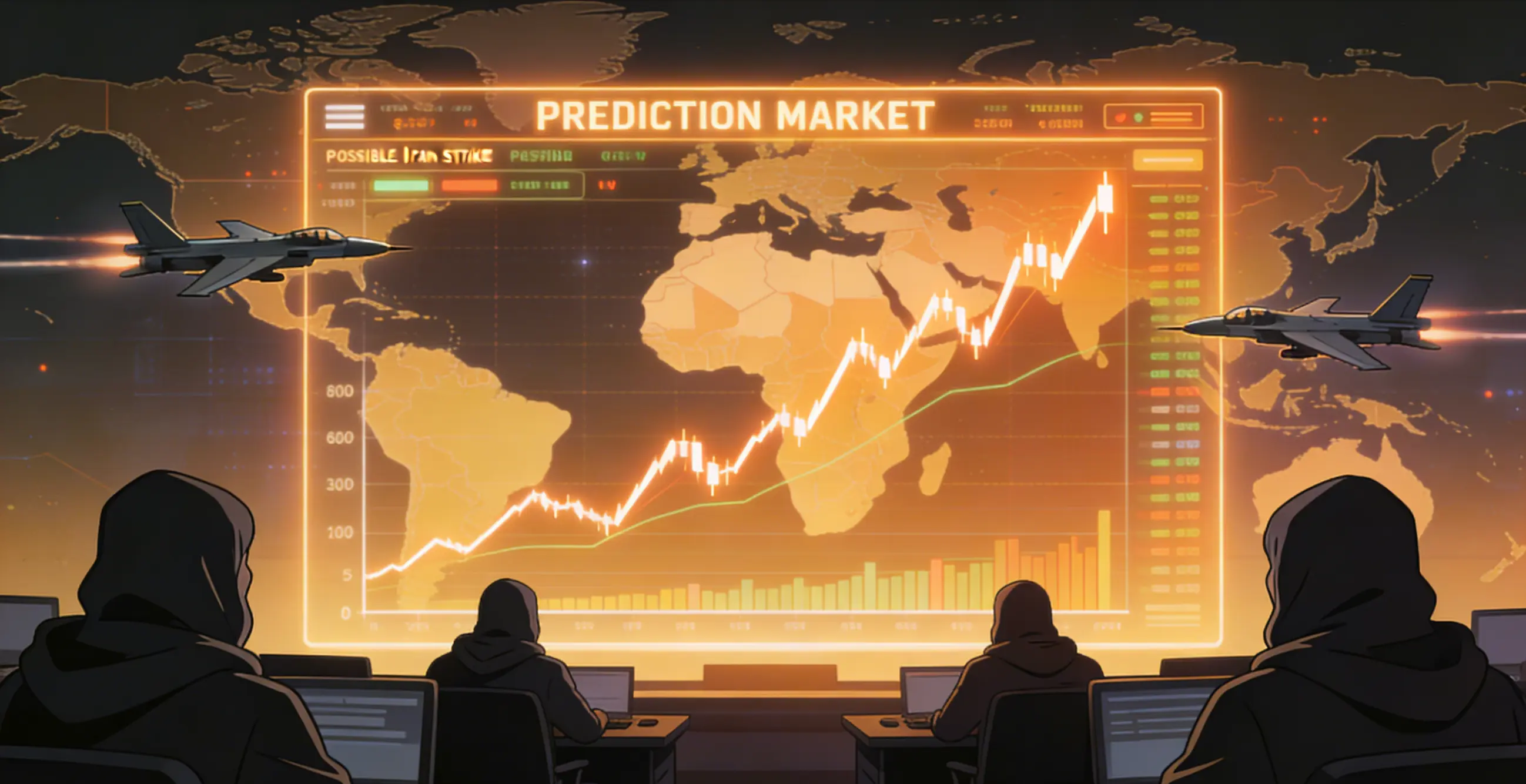
 A group of anonymous traders collectively made millions of dollars on the prediction market platform Polymarket by correctly betting on the timing of U.S. and Israeli strikes on Iran in late February 2026, prompting accusations of insider trading and urgent calls from U.S. lawmakers for a ban on wagering on military actions.
Analysis revealed that over 150 accounts placed bets of at least $1,000 in the 24 hours before the strikes, with at least 16 accounts profiting by more than $100,000, leading to multiple proposed bills in Congress aimed at restricting or prohibiting event contracts tied to war, assassination, and regime change.
Suspicious Betting Patterns and Insider Trading Allegations
Pre-Strike Wagering Surge
In the days leading up to the February 28, 2026, U.S. and Israeli strikes on Iran, prediction market Polymarket experienced a significant surge in betting activity on contracts related to the timing of military action. According to data analysis, more than 150 accounts placed bets of at least $1,000 in the 24 hours before the strikes, wagering a total of approximately $855,000 that an attack would occur the following day. These last-minute wagers proved highly accurate when the strikes were launched on February 28.
Blockchain analytics firm Bubblemaps identified a cluster of six newly created wallets that generated approximately $1.2 million in profits by betting on the exact date of the U.S. attack. The firm noted that these accounts were created in February and focused their trading activity specifically on contracts predicting U.S. strikes on Iran, with some bets placed just hours before the bombs fell in Tehran.
Magnitude of Profits
At least 16 accounts profited by more than $100,000 from the Iran strike contracts, while 109 accounts recorded profits exceeding $10,000. One contract dated February 27 attracted over $25 million in volume, with a single $26,513 wager resulting in more than $174,000 in profit for its owner.
The total trading volume on Polymarket for contracts tied to U.S. strikes on Iran exceeded $529 million since late 2025, with the February 28 contract alone drawing approximately $90 million in trading volume.
Expert Concerns
Dartmouth College economics professor Eric Zitzewitz, who has studied prediction markets, stated that the surge in last-minute betting “makes it look like someone knew something about the timing” of the attack. Nicolas Vaiman, CEO of Bubblemaps, noted that conflicts and wars, combined with user anonymity, create “incentives for informed participants to act early.”
Kalshi Faces Similar Controversy Over Iran Leadership Contract
Market on Supreme Leader’s Status
Rival prediction platform Kalshi, which is regulated by the Commodity Futures Trading Commission, faced its own controversy over a contract asking whether Iran’s Supreme Leader Ali Khamenei would be “out as Supreme Leader” by a certain date. The market attracted significant attention when Khamenei was killed in the first wave of strikes on February 28.
According to reports, Kalshi had promoted the Khamenei market as its “featured market” throughout the day of military strikes, encouraging speculation on war or death. After Khamenei’s death was confirmed, the platform initially indicated that some users would receive payouts, leading to accusations that traders were profiting from death.
Refunds and Policy Clarification
Kalshi subsequently announced that it would refund all users on the affected market, citing regulations barring wagers directly tied to death. The company stated it “doesn’t allow markets directly tied to death” and acknowledged that its rules had been unclear. The platform froze approximately $54 million in related transactions and returned principal and potential losses, absorbing the costs itself.
Regulatory Response and Proposed Legislation
Bipartisan Congressional Action
The suspicious betting activity has galvanized U.S. lawmakers from both parties to propose stricter regulations on prediction markets. Democratic Senators Chris Murphy and Mike Levin introduced a bill that would restrict or prohibit betting on military actions, regime change, or deaths that could incentivize conflict or reward access to classified information.
Senators John Hickenlooper and Jack Reed sent a letter to CFTC Chairman Michael Selig urging the agency to “prohibit event contracts tied to U.S. military operations” and investigate potential insider trading related to the Iran strike contracts. The senators argued that such contracts are “so dangerous to the national security of the United States and so offensive to U.S. values that they far outweigh any legitimate risk-management purpose.”
Blumenthal-Kim Legislation
Senators Richard Blumenthal and Andy Kim introduced the “Prediction Markets Security and Integrity Act,” a wide-ranging bill that would prohibit individuals or prediction market operators from using “material, nonpublic information” in wagering and prevent listings that present conflicts of interest. The bill would also restrict operators from offering listings susceptible to manipulation or fraudulent activities like war, death, or military action, and would bar prediction markets from operating in states unless authorized under a state wagering program.
Merkley-Klobuchar Proposal
Senators Jeff Merkley and Amy Klobuchar introduced the End Prediction Market Corruption Act, which would bar the president, vice president, members of Congress, and their immediate families from trading event contracts on prediction platforms, imposing fines and profit clawbacks for violations. The measure specifically cites well-timed wagers on U.S. strikes and Iranian leadership changes that netted some traders hundreds of thousands of dollars.
CFTC Authority and State Oversight Debate
The Commodity Futures Trading Commission has asserted its jurisdiction over prediction markets, with Chairman Mike Selig stating that the agency has “exclusive jurisdiction over these derivative markets.” However, some lawmakers are seeking to return regulatory oversight of prediction markets to the states, which could create tension with the CFTC’s authority.
The CFTC has proposed rules that would bar regulated exchanges from listing event contracts tied to war, terrorism, assassination, and other activities deemed contrary to the public interest. Chairman Selig has indicated that the Commission plans to issue clearer guidance on prediction markets in the near future.
Ethical Concerns and Public Debate
Commodification of Violence
Public health and gambling experts have raised ethical concerns about allowing betting on military conflicts. Dr. Louise Francis, a public health and gambling expert at Curtin University, stated that “when gambling operators turn war and human suffering into a betting market, it risks trivializing events that involve real loss of life, displacement and long-term trauma for affected communities.”
Prediction market analyst Dustin Gouker commented on nuclear weapon-related markets, stating: “Even if understanding the probability of such an event provides some value, it is far outweighed by the negative impact of allowing speculation on such outcomes. If market trading is thin, it could send false signals. Not to mention that using insider information to profit from it is inherently repugnant.”
Conflict of Interest Concerns
Senator Chris Murphy raised concerns about potential conflicts of interest, stating: “The Iran War is fueling a new kind of corruption: White House officials secretly profiting off war. It’s disgusting. We need to ban it.” He further suggested that “some people making decisions about war are placing bets in these markets and creating a financial interest in the outcome. That’s even worse than insider trading.”
Former SEC official Amanda Fischer warned that “if people can profit from predicting someone’s death, it creates dangerous incentive structures.”
Polymarket’s Position and Previous Controversies
Offshore Operations
Polymarket operates its main international exchange offshore, beyond the direct jurisdiction of U.S. regulators, though it is planning a separate CFTC-regulated U.S. version of its platform. The platform allows users to trade anonymously using cryptocurrency, making it difficult to trace individual identities despite transactions being recorded on public blockchain ledgers.
History of Suspicious Bets
This is not the first time Polymarket has faced insider trading allegations. In January 2026, a trader profited approximately $400,000 by betting on the capture of Venezuelan President Nicolás Maduro, placing wagers shortly before the U.S. operation that led to his arrest.
In February 2026, Israeli authorities indicted two citizens—an army reservist and a civilian—for allegedly using classified military information to place Polymarket bets on the timing of Israel’s opening strike on Iran during June 2025’s 12-day war.
Nuclear Detonation Markets Removed
Amid the controversy, Polymarket removed long-running markets that allowed users to bet on the likelihood of a nuclear weapon detonating by specific dates. The contracts had at times implied risks as high as 19 percent and attracted millions in volume, with the 2025 contract alone recording more than $1.7 million in trading activity.
The removal came after the company reportedly posted—and later deleted—odds on X showing roughly a 22 percent probability of a nuclear detonation by year-end, sparking online outcry.
FAQ: Polymarket Iran War Betting Investigation
Q: How much did traders profit from the Iran strike bets?
A: At least 16 accounts profited by more than $100,000, with six newly created wallets generating approximately $1.2 million in total profits. A total of 109 accounts earned over $10,000 from the February 28 strike contracts.
Q: What evidence suggests insider trading rather than lucky guesses?
A: Blockchain analysis revealed suspicious patterns: accounts were newly created shortly before the strike, funded within 24 hours of placing wagers, traded exclusively on Iran strike contracts, and placed bets just hours before the attack when probability estimates were between 7 and 26 percent.
Q: What legislative actions are being proposed in response?
A: Multiple bills have been introduced, including measures to ban betting on military actions, prohibit government officials from trading event contracts, restrict platforms from offering war-related markets, and give states authority to regulate prediction markets.
Q: How did Kalshi handle its Iran leadership market?
A: Kalshi initially indicated some users would receive payouts on its contract asking whether Iran’s Supreme Leader would remain in office, but later refunded all users, citing regulations barring wagers directly tied to death. The company froze approximately $54 million in transactions and absorbed the costs itself.


