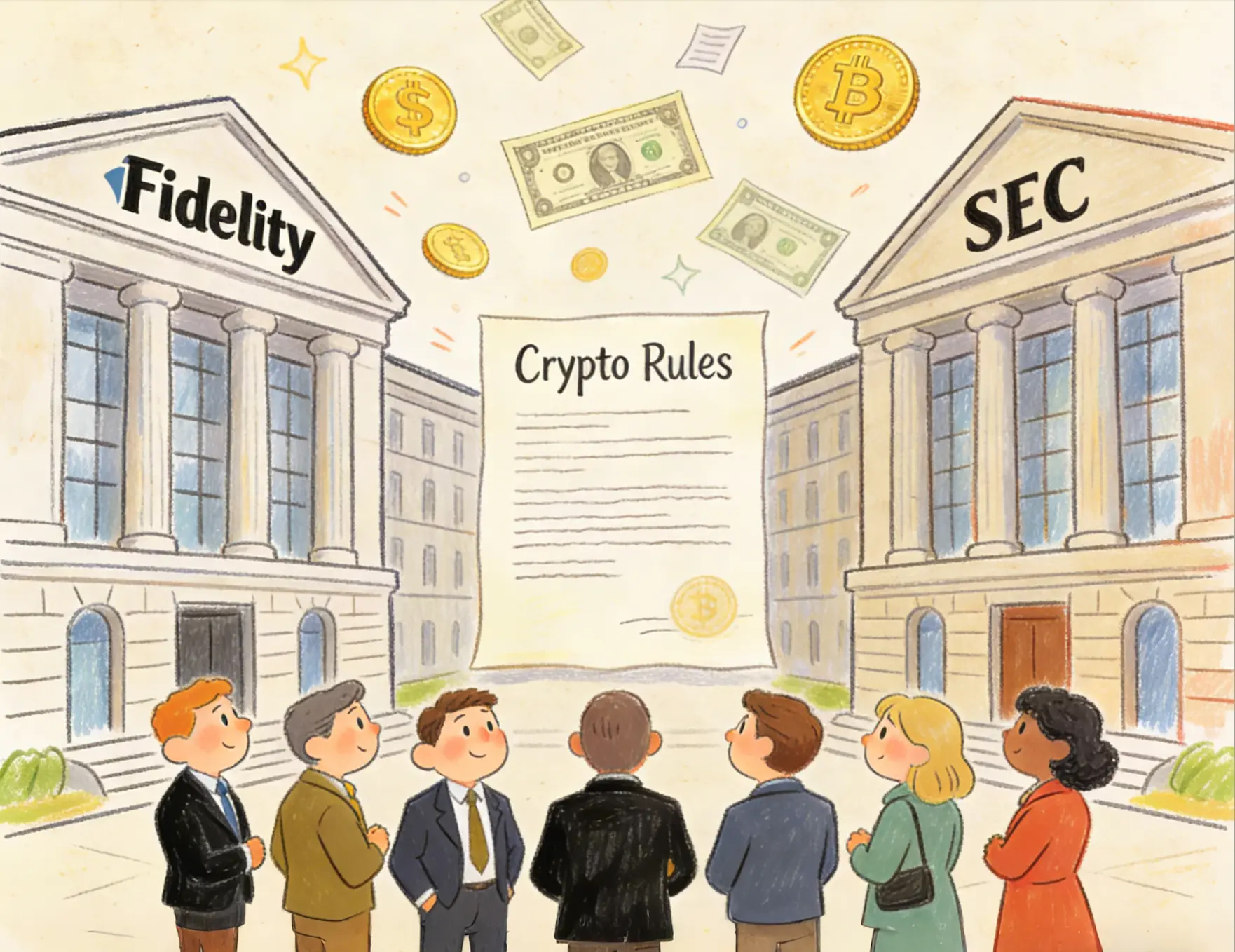
 Fidelity Investments submitted a letter to the U.S. Securities and Exchange Commission (SEC) Crypto Task Force on March 20, 2026, urging the agency to refine rules for broker-dealers handling crypto assets and to establish clearer standards for tokenized securities trading on alternative trading systems (ATS).
The letter, responding to Commissioner Hester Peirce’s December 2025 request for information on how national securities exchanges and ATS platforms should handle crypto asset trading, outlined four key recommendations including continued regulatory development for broker-dealers, clearer rules for tokenized securities, guidance for on-chain settlement, and frameworks for coexistence between traditional intermediaries and decentralized venues. Fidelity emphasized the need to preserve investor protection, transparency, and market integrity while integrating digital assets into existing market structures.
Fidelity’s Key Recommendations
Broker-Dealer Guidance
Fidelity pointed to recent SEC guidance clarifying that broker-dealers may custody both crypto asset securities and non-security digital assets, calling it a “welcome” step but noting that further clarity is still needed for trading and custody practices. The firm stated: “[We] look forward to additional guidance on a number of other areas critical for broker-dealers to offer, custody, and trade crypto assets and facilitate crypto-security trading pairs.”
The letter builds on a series of incremental moves by the SEC. In recent months, the agency has clarified how broker-dealers can maintain custody of crypto assets and issued guidance on tokenized securities, signaling a gradual shift toward accommodating blockchain-based financial infrastructure.
Tokenized Securities on ATS Platforms
A central focus of Fidelity’s letter is the need for clearer rules governing tokenized securities on ATS platforms. The firm argued that the SEC should “provide brightline standards that permit ATSs to facilitate secondary market trading in tokenized securities created by third parties.”
Fidelity noted that broker-dealers must be able to rely on how a tokenized asset is classified—whether as a traditional security or a more complex instrument like a securities-based swap—without bearing excessive legal risk: “This clarity is critical because the regulatory status of a tokenized instrument depends on its economic realities, key facts that may not be fully knowable to a broker-dealer.”
The firm also called for confirmation that tokenized versions of traditional securities should generally carry the same regulatory status as their underlying assets, which could help reduce fragmentation between on-chain and traditional markets.
On-Chain Settlement and Blockchain Recordkeeping
Operational Frictions
Fidelity highlighted operational challenges in adopting distributed ledger systems within current rules, particularly around recordkeeping and settlement definitions. The firm argued that clarity is needed to avoid unintended regulatory burdens when broker-dealers support blockchain-based transactions: “Confirmation on this point is critical to enable broker-dealers to support on-chain settlement activity without regulatory uncertainty and to facilitate the orderly development of these markets.”
Clearing Agency Classification
Fidelity recommended that the SEC allow broker-dealers to use blockchain for recordkeeping and clarify that facilitating on-chain settlement would not classify them as clearing agencies, a designation that carries additional regulatory requirements and operational burdens.
Coexistence of Traditional and Decentralized Venues
Fidelity urged the SEC to consider how traditional intermediated markets and decentralized, or “disintermediated,” trading venues can coexist. While blockchain-based platforms may offer benefits such as faster settlement, lower costs, and increased transparency, the firm noted that they may lack the safeguards imposed on regulated intermediaries.
The firm encouraged regulators to evaluate coexistence frameworks that preserve investor protections while allowing broader market participation.
Regulatory Context and SEC Engagement
Peirce’s Open Stance
Commissioner Hester Peirce, who leads the SEC’s Crypto Task Force, has repeatedly encouraged firms exploring tokenization to engage directly with regulators, underscoring a more open stance compared to prior enforcement-heavy approaches. The December 2025 request for information that prompted Fidelity’s response sought industry input on how national securities exchanges and ATS platforms should handle crypto asset trading.
Fidelity’s Support
Fidelity expressed broad support for the SEC’s efforts to adapt legacy frameworks to emerging technologies, stating: “We commend the Task Force’s proactive efforts with stakeholders and its commitment to fostering responsible innovation while safeguarding market integrity and investor protection.”
Frequently Asked Questions
Why is Fidelity engaging with the SEC on crypto rules?
Fidelity aims to shape clearer regulations that enable compliant crypto trading and custody within traditional financial systems. The firm submitted its recommendations in response to the SEC Crypto Task Force’s request for information on how national securities exchanges and alternative trading systems should handle crypto asset trading.
What is the biggest regulatory concern highlighted in Fidelity’s letter?
Uncertainty around token classification and broker-dealer responsibilities remains a key barrier to adoption. Fidelity emphasized that broker-dealers must be able to rely on how a tokenized asset is classified without bearing excessive legal risk, and called for confirmation that tokenized versions of traditional securities should carry the same regulatory status as their underlying assets.
How could these rule changes impact crypto market growth?
Clearer rules could accelerate institutional participation and expand regulated trading infrastructure. Fidelity noted that blockchain-based platforms offer benefits such as faster settlement and lower costs, but require updated oversight frameworks to scale safely. Clarity on on-chain settlement and recordkeeping would enable broker-dealers to support these activities without regulatory uncertainty.
Disclaimer: The information on this page may come from third parties and does not represent the views or opinions of Gate. The content displayed on this page is for reference only and does not constitute any financial, investment, or legal advice. Gate does not guarantee the accuracy or completeness of the information and shall not be liable for any losses arising from the use of this information. Virtual asset investments carry high risks and are subject to significant price volatility. You may lose all of your invested principal. Please fully understand the relevant risks and make prudent decisions based on your own financial situation and risk tolerance. For details, please refer to
Disclaimer.


