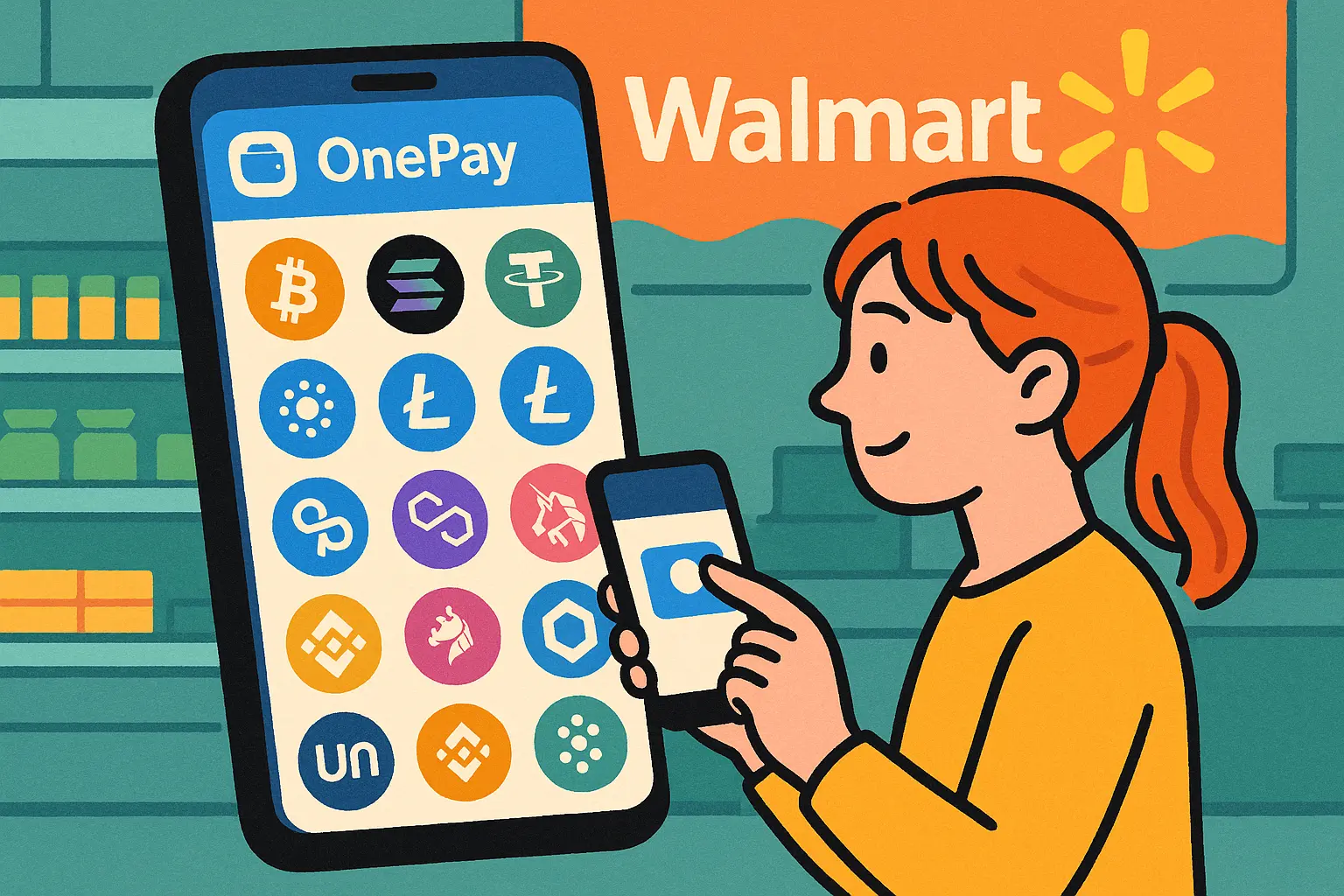
Walmart’s financial technology platform OnePay added Polygon, Arbitrum, and SUI on Thursday. This follows the recent listing of ten tokens, including Solana, Cardano, and PAX Gold, significantly expanding its cryptocurrency asset support beyond Bitcoin and Ethereum. The platform currently observes a particularly notable participation from new cryptocurrency users.
OnePay Token Expansion Strategy: Selective Standards and Avoiding Trend Chasing
Ron Rojany clearly stated in a statement that OnePay’s crypto strategy takes a “steady expansion” approach rather than chasing market trend assets. He pointed out, “We focus more on providing a carefully curated set of assets that align with how customers actually use and think about money.”
Currently, the main tokens supported by OnePay include:
Public Chain Ecosystem: Solana (SOL), Polygon (POL), Arbitrum (ARB), SUI, Cardano (ADA)
Asset Tokenization: PAX Gold (PAXG) — a token pegged to physical gold
Base Assets: Bitcoin (BTC) and Ethereum (ETH)
Ron Rojany declined to disclose specific adoption rate data for the crypto features, only stating that the platform has recorded strong participation among “customers who are new to cryptocurrency and looking for simple entry points,” indicating that the initial user targeting focuses on lowering the entry barriers to cryptocurrency rather than servicing seasoned traders.
OnePay Super App Positioning: Emulating WeChat’s Localization Path
OnePay explicitly benchmarks itself against China’s WeChat, aiming to integrate diverse financial services within a single application. The platform currently offers high-yield savings accounts, credit cards and financial cards, personal loans, wireless communication packages, and a digital wallet that can be used directly for checkout at Walmart stores and on the official website.
Walmart’s net sales in the U.S. market for fiscal year 2025 are projected to reach $462.4 billion, and the vast existing consumer network gives OnePay a scale advantage in reaching new cryptocurrency users that other pure crypto applications find difficult to replicate. Compared to emerging platforms that start from scratch in building user bases, OnePay can cross-introduce crypto services while customers complete their daily shopping.
Super App Race Heats Up: Coinbase, Startale, and Regulatory Synchronization
OnePay is not the only organization actively laying out plans for super apps. Coinbase CEO Brian Armstrong announced plans to build a crypto super app in September last year, expected to integrate credit cards, payments, and Bitcoin reward mechanisms, directly competing with traditional banking services. Japan’s Startale Group, after completing a $50 million Series A funding round, also announced the development of an integrated platform that combines payments, asset management, and on-chain services.
The regulatory attitude is also favorable. SEC Chair Paul Atkins expressed support for platforms that provide various financial services under a unified regulatory framework and has instructed staff to develop further guidelines, allowing platforms to operate in a “super app” model, facilitating the trading, lending, and staking of digital assets under a single framework, providing a clear direction for the standardized development of the entire sector.
Frequently Asked Questions
What is OnePay and what is its relationship with Walmart?
OnePay is Walmart’s financial technology platform, positioned as the U.S. version of a “super app,” integrating various financial services such as bank savings, credit cards, loans, and cryptocurrency assets. The digital wallet can be used directly for checkout in Walmart shopping scenarios, leveraging Walmart’s customer base to achieve scalable financial service reach.
What are OnePay’s token selection criteria?
According to Ron Rojany, General Manager of Crypto Business, OnePay’s token selection criteria cover four core dimensions: user demand, market liquidity, regulatory clarity, and long-term utility. The platform clearly adopts a selective strategy rather than chasing popular assets, prioritizing the listing of mainstream tokens that align with the usage habits of new cryptocurrency users.
What does SEC support for the super app model mean for the crypto industry?
SEC Chair Paul Atkins has expressed support for platforms that integrate various financial services under a unified regulatory framework and has instructed staff to develop corresponding guidelines. This provides a clear policy direction for financial institutions to offer crypto trading, lending, and staking services under compliance, helping to reduce regulatory uncertainties for traditional financial institutions entering the crypto business.
Disclaimer: The information on this page may come from third parties and does not represent the views or opinions of Gate. The content displayed on this page is for reference only and does not constitute any financial, investment, or legal advice. Gate does not guarantee the accuracy or completeness of the information and shall not be liable for any losses arising from the use of this information. Virtual asset investments carry high risks and are subject to significant price volatility. You may lose all of your invested principal. Please fully understand the relevant risks and make prudent decisions based on your own financial situation and risk tolerance. For details, please refer to
Disclaimer.


