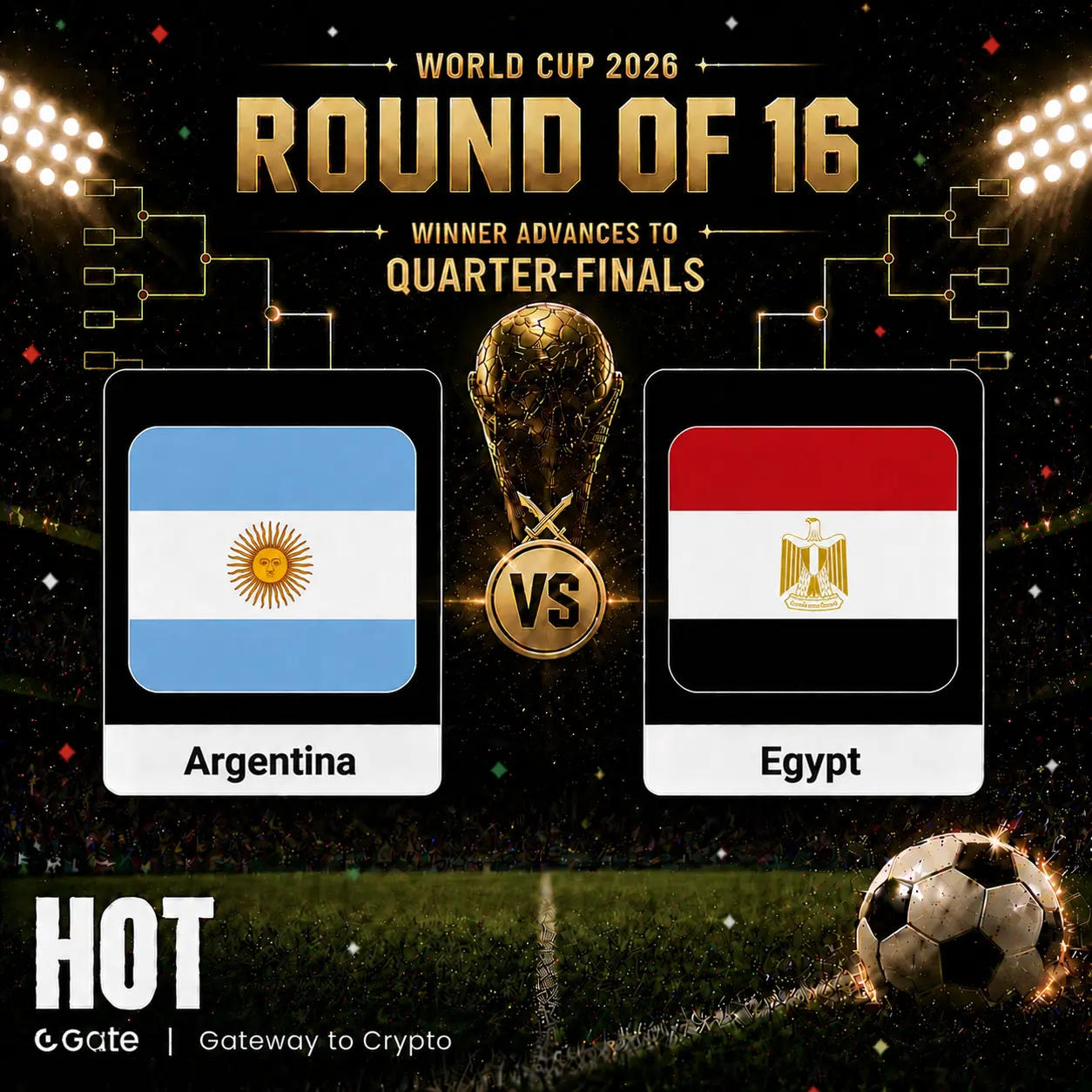
The core logic of prediction markets has never been about judging "who is stronger," but rather about judging "whether the current price already reflects all known information." Examining the Argentina vs. Egypt matchup from this angle may yield answers more valuable than "Can Argentina win?"
Why has the market given Argentina a 73% win probability?
A 73% win probability is an extremely high pricing level in the knockout stage. Horizontally comparing other Round of 16 matches in the same period, France's win probability against Paraguay is about 84%, the highest single win probability of the round; Argentina's 73% ranks among the top in the eight Round of 16 matchups, significantly higher than traditional powerhouses such as Brazil (about 54%) and England (about 40%) in the same round.
The market's assignment of this win probability is based on several verifiable logical pillars.
Overwhelming dominance in group stage performance. Argentina won all three group stage matches, scoring 8 goals and conceding none. Messi scored 6 goals in the group stage, performing at an extremely high level. After advancing to the first knockout round (Round of 32), Argentina defeated Cape Verde 3-2 in extra time, pushing Messi's personal total World Cup goals to 20, setting a new historical record. As of before the Round of 16, Argentina has scored a total of 11 goals in four matches, with Messi alone accounting for 7.
Generational gap in knockout experience. Before this World Cup, Egypt had only one knockout stage experience in their history (1934). Argentina, on the other hand, is a three-time World Cup champion (1978, 1986, 2022) and has reached the quarterfinals three times in the last four World Cups. In modern football's knockout rounds, this experience gap often translates to more stable psychological resilience and more mature in-game adjustments.
Asymmetry in squad depth. Argentina boasts multiple attacking options including Messi, Lautaro Martínez, and Julián Álvarez, with midfield control ranking among the top tier of the entire tournament. Egypt relies more on Mohamed Salah's individual ability and the overall defensive system. When a team's attacking threat is concentrated on a few players, the market usually gives it a lower ceiling expectation.
However, while these logics support the rationality of Argentina as the favorite, whether the 73% win probability has already fully incorporated all variables remains a question that requires further dissection.
What does the $2.35 million trading volume mean?
The $2.35 million trading volume makes this match one of the most capital-concentrated events in the Round of 16. Horizontally comparing other matchups in the same period, the trading volume for Paraguay vs. France is about $2.35 million — on par with Argentina vs. Egypt; Canada vs. Morocco has a trading volume of about $2.57 million, slightly higher than this match; while Portugal vs. Spain has only about $170,000. The trading volume of Argentina vs. Egypt ranks among the top in the eight Round of 16 matches, indicating a high degree of uncertainty and strong market attention on the match result.
The first implication of high trading volume is the manifestation of market divergence. When large amounts of capital flow into the same market, it usually means that bulls and bears have different judgments on pricing. The 73% win probability is not the market's consensus expectation, but an equilibrium price after bulls and bears have played out — someone buys Argentina at this price, and someone sells at the same price.
The second implication of high trading volume is the improvement of price discovery efficiency. The pricing quality of prediction markets is positively correlated with trading depth. Liquidity of $2.35 million means the price has undergone relatively sufficient gaming, and a single capital direction cannot significantly distort pricing in a short time. From this perspective, the 73% win probability at least represents the market's collective judgment under existing information.
But high trading volume also brings a noteworthy paradox: popular teams in prediction markets tend to attract a disproportionate amount of retail capital. Retail traders are more inclined to follow narratives — defending champions, Messi's last dance, Egypt's "dark horse" label — and these narrative-driven capital inflows may push the win probability away from fundamental-based pricing. Some analytical models give Argentina a win probability in regular time of about 69.1%, lower than the market's 73%. This gap of about 3 percentage points may be the space for narrative premium.
It is worth mentioning that Gate prediction market has launched a "每日焦点赛事" prediction challenge during the Round of 16 knockout stage. Argentina vs. Egypt, as the highlight match of the day, has been included in the event's designated match. Users who participate in predictions have a chance to share the prize pool. The high concentration of market funds resonates with the incentive mechanism of the platform activity, further amplifying the trading activity of this match.
73% win probability does not equal "sure win"
This is a basic common sense that prediction market participants most easily overlook: probability is not certainty.
A 73% win probability means that if this match were repeated 100 times under the same conditions, Argentina would be expected to win about 73 times, Egypt about 9 times, and 20 times would go to extra time or penalties. A 20% draw probability in the knockout stage is a number that cannot be ignored — it means there is more than a one-in-five chance that the match cannot be decided within 90 minutes.
The pricing logic of the draw probability can be understood from several dimensions:
Egypt's defensive resilience. Egypt recorded 1 win and 3 draws in the group stage (including a draw against Australia in the Round of 32), finishing second in the group with 5 points. They held Belgium and Iran to draws in the group stage, showing excellent defensive organization. In the Round of 32 against Australia, Egypt drew 1-1 after 120 minutes and eventually advanced via a 4-2 penalty shootout. This team has repeatedly proven it can drag opponents into stalemates in high-intensity matches.
Argentina's fitness concerns. In the Round of 32 against Cape Verde, Argentina endured a tough extra-time battle, with the team's expected goals (xG) in 90 minutes at only 1.67 — not ideal for a team with a 73% win probability. The team was equalized twice, and only secured victory with a deflected goal in the 111th minute of extra time. Messi himself publicly stated after the match that fatigue affected the team's pressing efficiency in attack. From the end of the Round of 32 to the start of the Round of 16, the two teams have only 3 to 4 days of recovery time. The degree of fitness recovery will directly impact Argentina's pressing intensity up front and Egypt's defensive concentration.
Structural risk of knockout tournaments. The nature of single-elimination determines that the probability of upsets is inherently higher than in league or group stages. One defensive error, one controversial call, one wonder goal — any of these can change the direction of the match within 90 minutes. The pricing logic of prediction markets is probabilistic estimation based on extensive information and data, not a deterministic prophecy of the match result.
What market changes should be monitored before the match?
As match time approaches, several key market indicators are worth continuous tracking:
Whether Argentina's win probability continues to rise. If within 6 to 12 hours before the match, Argentina's win probability climbs from 73% to over 75%, it may mean the market is repricing some bullish information (e.g., confirmation of a key Egyptian player absence, Argentina's starting lineup exceeding expectations). Conversely, if the win probability falls below 70%, it may reflect growing market concerns about Argentina's fitness or tactical setup.
Direction of change in draw probability. The 20% draw probability is a variable easily overlooked in the current pricing structure. If the draw probability rises to 23%-25% before the match, it means the market is pricing an increased likelihood of "match going to extra time" — this is usually associated with the market recognizing Egypt's defensive strategy, or doubts about Argentina's attacking efficiency.
Abnormal signals in capital flows. One advantage of prediction markets is the ability to observe capital flows in real time. If there is sustained capital flow toward Egypt at the large-trade level, even if the win probability itself does not change significantly, it may mean "smart money" is betting on a deviation in market pricing. Egypt's "advance" contract on Polymarket was once as low as 15 cents (implied probability about 15%), which shows a certain gap from the probability given by some data models. This spread itself does not mean one side is definitely correct, but it provides an observation window between market pricing and model pricing.
A concept that needs special distinction is "Argentina wins within 90 minutes" versus "Argentina advances." The former is 73%, while the latter (including wins in extra time or penalties) is usually higher — some platforms imply an advance probability of about 80%. The difference between these two probabilities (about 8 percentage points) is essentially the portion of the 20% draw probability where Argentina advances via extra time or penalties. Understanding this distinction is a prerequisite for correctly interpreting prediction market pricing.
FAQ
Q: Is a 20% draw probability high in the knockout stage?
In the World Cup knockout stage, the probability of a draw within 90 minutes is usually between 20% and 30%. 20% is within the normal range, but considering Argentina's strength advantage as the defending champions, this probability reflects the market's recognition of Egypt's defensive resilience. Egypt's draws against Belgium and Iran in the group stage provide fundamental support for this probability.
Q: How to participate in Gate prediction market's daily featured match event?
Step 1: Enter the Gate prediction market event page and click "立即参与" to register for the event. Step 2: Select the World Cup daily featured match (e.g., Argentina vs. Egypt) to make a prediction. Step 3: Complete a prediction trade of no less than 50 USDT to qualify for the day's 10 USDT reward; the prediction result does not affect reward eligibility. Limited to the first 100 users each day on a first-come, first-served basis. New users who participate for the first time with a trade of no less than 20 USDT can also receive an additional 10 USDT newcomer bonus.
Q: What changes might occur in Argentina's win probability before the match?
Mainly affected by three types of factors: starting lineup announcement (e.g., whether Messi starts, whether Egypt has key injuries), pre-match sentiment (e.g., signals from coach interviews), and directional inflows of large capital. If news of a key Egyptian player's confirmed absence emerges before the match, Argentina's win probability may rise further.
Q: Does Egypt's 9% win probability mean they have no chance at all?
A 9% probability is not negligible in a single-elimination match. It means that under similar conditions, Egypt would win about 1 out of every 11 matches within 90 minutes. The low-scoring nature of football determines that the actual frequency of low-probability events is often higher than people's intuitive expectations.