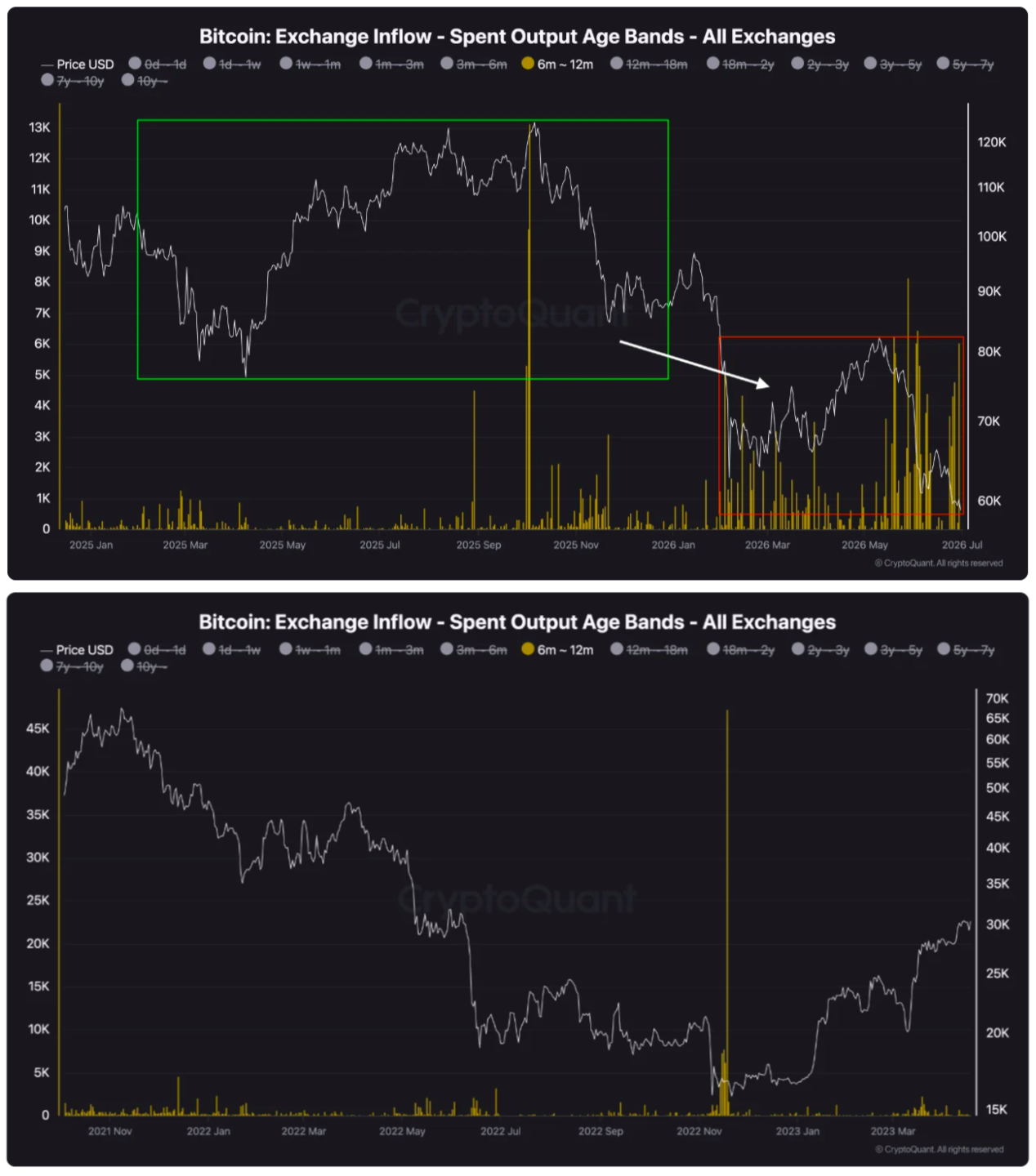
Bitcoin fell to $58,531 on July 1, with a cumulative decline of nearly 20% in Q2. CryptoQuant analyst Crypto Sunmoon posted on Quicktake, stating that after Bitcoin fell below $70,000, the inflow of tokens held for 6 to 12 months to exchanges surged, consistent with the pattern of capitulation selling by buyers at the cycle top in 2018 and 2022.
Q2 Major Market Performance Comparison
According to Bloomberg data cited by Kobeisi Letter on X platform, the performance of major markets in Q2 is as follows:
Bitcoin (BTC): Q2 decline of nearly 20%, temporarily reported at $58,531 on July 1
S&P 500 Index: Up about 14% in Q2, its best quarterly performance since 2020, and the second-largest quarterly gain since the recovery from the 2008 financial crisis
Nasdaq 100 Index: Up about 25% in Q2, on track for its best quarterly performance in 5 years and the second-best in 25 years
USD/JPY: Reached 162.50 on July 1, the highest level since the mid-1980s
CryptoQuant: Exchange Inflow of Tokens Held for 6 to 12 Months Rises Sharply
 (Source: CryptoQuant)
CryptoQuant analyst Crypto Sunmoon explained in a Quicktake article that a large number of tokens bought 6 to 12 months ago (i.e., accumulated near cycle highs) are flowing into exchanges, with holders exhibiting on-chain behavior characterized by "stopping losses and exiting rather than holding through the decline."
Crypto Sunmoon noted that this pattern is consistent with capitulation by cycle top buyers, and based on historical observations from 2018 and 2022, such capitulation selling has historically coincided with long-term bottom formations, but this is a statement of historical patterns rather than a judgment of specific trends.
Trader Exitpump observed a significant increase in open interest on X, noting that "large longs are entering during this dip, and the market is about to get intense"; Daan Crypto Trades said he is watching which boundary breaks first.
USD/JPY Rises to 162.50: Pressure on USD-Denominated Debt Chain
Analyst George Gammon stated on X platform that the rise of USD/JPY to 162.50 puts pressure on institutions holding USD-denominated debt to sell assets, covering Japan, India, South Korea, and Strategy (MSTR).
George Gammon explained: "You have USD-denominated debt, but you don't have enough USD. So you have to sell assets to get USD, which puts downward pressure on asset prices—these assets may be denominated in yen, rupee, won, or Bitcoin."
Additionally, Bloomberg reported on July 1 that US-Iran negotiators Jared Kushner and Steve Witkoff are advancing technical consultations in Doha, Qatar, and recent escalations in conflicts in the Strait of Hormuz have disrupted global energy supplies, adding geopolitical uncertainty as an additional background pressure on the market.
FAQ
What is the data source for Bitcoin's nearly 20% Q2 decline?
This data was cited by Kobeisi Letter from Bloomberg data, published on X platform, corresponding to the cumulative performance of Q2 2026 (April to June). Bitcoin was temporarily reported at $58,531 on July 1, with data from TradingView.
What on-chain data is CryptoQuant's "capitulation selling" signal based on?
CryptoQuant analyst Crypto Sunmoon based it on the following on-chain observations: Since Bitcoin fell below $70,000, exchange inflows have risen sharply, mainly from tokens held for 6 to 12 months (bought near cycle highs), characterized by selling behavior not aimed at profit. Crypto Sunmoon also stated that this pattern has historically (2018, 2022) often coincided with long-term bottom formation, but this is a historical pattern rather than a judgment of specific trends.
What is the direct impact mechanism of USD/JPY rising to 162.50 on Bitcoin?
George Gammon explained on X platform that institutions holding USD-denominated debt face liquidity pressure when the dollar strengthens, potentially forcing them to sell risk assets, including Bitcoin, to obtain USD, creating selling pressure on non-USD-denominated assets. This is one of the external pressure factors for Bitcoin's decline on July 1, independent of Bitcoin's own on-chain dynamics.


