
According to CCN on May 7, BlackRock, on the deadline for the public comment period for the GENIUS Act, submitted a 17-page public letter to the U.S. Office of the Comptroller of the Currency (OCC), requesting that the OCC remove the proposed 20% cap on the proportion of tokenized reserve assets allocated to stablecoin issuers. In the letter, BlackRock directly stated that this restriction has nothing to do with the OCC’s “safety and stability considerations.”
BlackRock’s five core demands
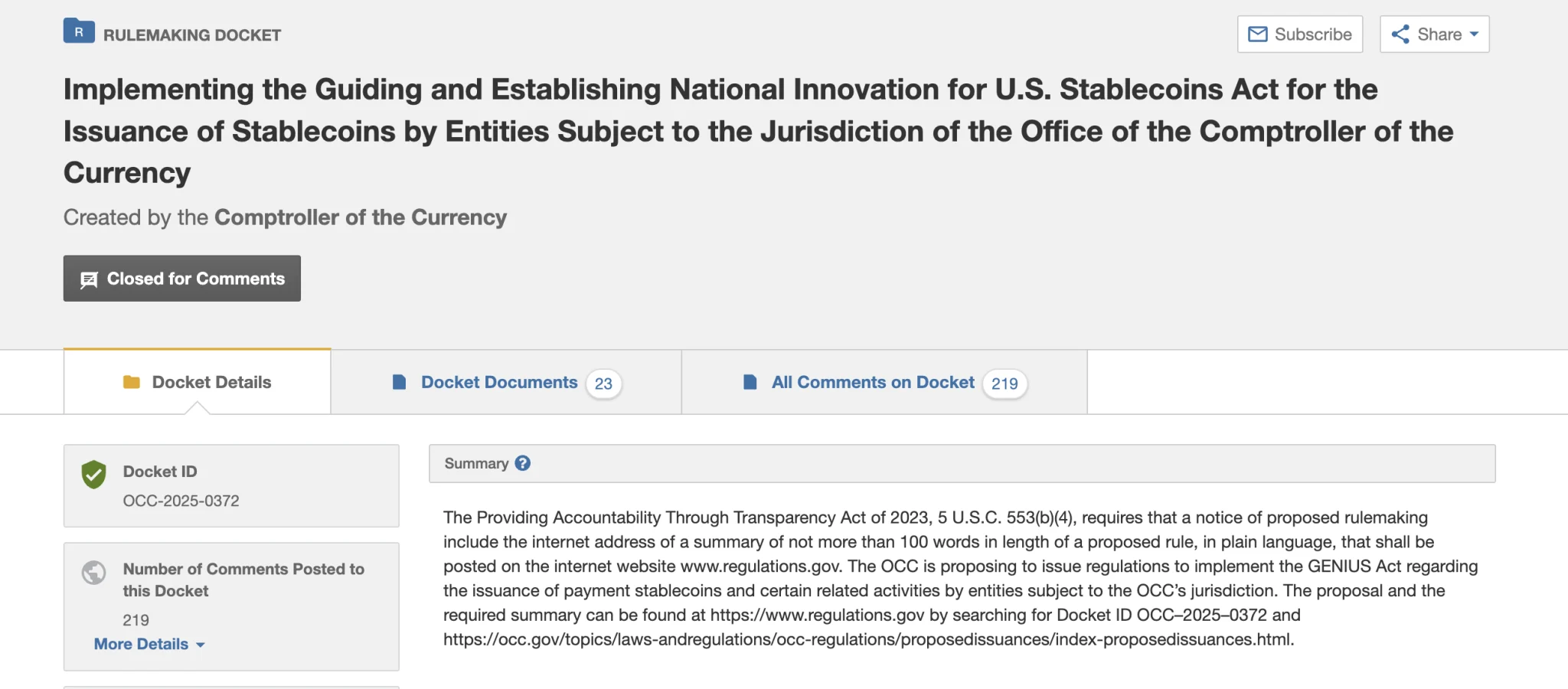
(Source: Regulations.gov)
Based on the public letter submitted by BlackRock to Regulations.gov, the company put forward the following five specific requests:
· Clearly identify U.S. Treasury ETF investments in eligible assets as reserves
· Expand the scope of the safe harbor protections to a level similar to that of government money market funds
· Include short-term U.S. Treasury floating-rate notes (with maturities not exceeding two years) in the list of eligible assets
· Introduce optional safe harbor provisions based on principles, replacing mandatory guidance
· Establish a transparent reserve asset approval process
OCC draft background: The GENIUS Act legislative framework and the basis for the 20% cap
According to CCN, the OCC draft rules are formulated based on the GENIUS Act passed in July 2025, which establishes reserve requirements for personal stablecoins (PPSI) and a federal legislative framework; the deadline for OCC’s final guidance is January 2027. In late February 2026, the OCC published draft rules covering specific requirements for federally regulated stablecoin issuing entities regarding reserve composition, liquidity, capital, and custody.
According to CCN, the OCC positions the 20% cap as a system-level risk management mechanism intended to prevent stablecoin issuers from becoming overly concentrated in a single tokenized instrument. The goal is to ensure diversification of reserve assets and to mitigate new risks such as smart contract vulnerabilities, settlement finality, and operational risk; its logic is similar to regulatory principles in traditional banking that limit exposure to counterparty risk from a single counterparty.
BUIDL fund size and tokenized Treasury market data
According to RWA.xyz data (as of May 2026), BlackRock’s BUIDL fund running on Ethereum (a dollar-denominated institutional digital liquidity fund launched in 2024) has an asset size approaching $8B, providing institutional investors with on-chain exposure to short-term U.S. Treasuries, and serving as a key reserve support for Ethena’s USDtb and Jupiter’s JupUSD (stablecoin on the Solana chain).
Based on the same data source, Circle’s USYC leads the tokenized Treasury market with a size of about $8B. According to CCN, as of early 2026, the total market capitalization of tokenized U.S. Treasuries has surpassed $15 billion.
FAQ
Which regulatory draft item did BlackRock formally object to at the OCC?
According to the public letter submitted by BlackRock to Regulations.gov, BlackRock opposed the 20% tokenized reserve cap proposed by the OCC in the draft implementation rules for the GENIUS Act, arguing that the restriction is unrelated to the OCC’s safety considerations and that risks should be determined by the characteristics of the underlying assets rather than blockchain applications.
When was the GENIUS Act passed, and what is the deadline for OCC’s final guidance?
According to CCN, the GENIUS Act was passed in July 2025, and the deadline for OCC’s final guidance is January 2027, with the draft rules published in late February 2026.
What is the current size of BlackRock’s BUIDL fund?
According to RWA.xyz data (as of May 2026), BlackRock’s BUIDL fund has an asset size of nearly $2.6B on Ethereum, providing institutional investors with on-chain exposure to short-term U.S. Treasuries and offering reserve support for multiple stablecoin projects based on Solana.


