This surge was not driven by a synchronized rise in the bitcoin price—in fact, bitcoin did not show wild, proportional fluctuations during this period. The key driver behind the spike in IREN’s share price was major progress on a series of AI cloud services contracts disclosed by the company in an SEC filing.
IREN said it has raised its annualized run-rate revenue (ARR) target for its AI cloud business at the end of 2026 from the prior $3.7 billion to more than $4.0 billion, while disclosing that the total value of recently signed multi-year cloud service contracts is $2.8 billion. About 85% of the new ARR target is secured by contracts already signed. The customer roster includes Microsoft, NVIDIA, Perplexity, Figure AI, Together AI, Fluidstack, Fireworks AI, Fal AI, and Hume AI, among other leading AI companies.
IREN’s case is not isolated. Around the same time, another bitcoin miner, Hut 8, announced that it had signed a 15-year AI data center leasing agreement worth $9.8 billion, with its share price rising in tandem. Both companies began with bitcoin mining business and then accelerated their transition to AI infrastructure and cloud computing amid weakening mining economics.
Behind this rally, capital markets are answering a core question: Are bitcoin miners obtaining a new valuation logic for AI infrastructure?
$2.8 billion in contracts and a $4.0 billion ARR target: IREN’s key milestone in its AI transition
The basis for IREN’s ARR target increase is a batch of newly signed multi-year cloud service contracts. According to the company’s disclosure, these contracts total $2.8 billion in value, with a weighted average contract term of about four years. About 85% of the new target has already been covered through signed agreements.
IREN’s customer mix reflects its positioning along the AI compute supply chain. Publicly disclosed customers include Microsoft, NVIDIA, Perplexity, Figure AI, Together AI, Fluidstack, Fireworks AI, Fal AI, and Hume AI. In addition, the company added another unnamed major AI developer. The contracts cover two types of business models: bare-metal infrastructure and managed cloud services.
From a financial structure perspective, these contracts include a feature worth noting: some customers have agreed to pay upfront amounts, with the upfront payment roughly equal to 45% of the GPU capital costs involved in their deployments. This arrangement directly reduces the amount of capital IREN must put in before it generates revenue from the services, improving the company’s cash-flow matching efficiency.
On capacity planning, co-CEO Daniel Roberts said the company plans to deliver 480MW of AI cloud computing capacity in 2026—a roughly order-of-magnitude jump versus about 3MW in 2025—and plans to reach 1.2GW in 2027. As of June 30, 2026, the company held approximately $7.6 billion in cash and cash equivalents.
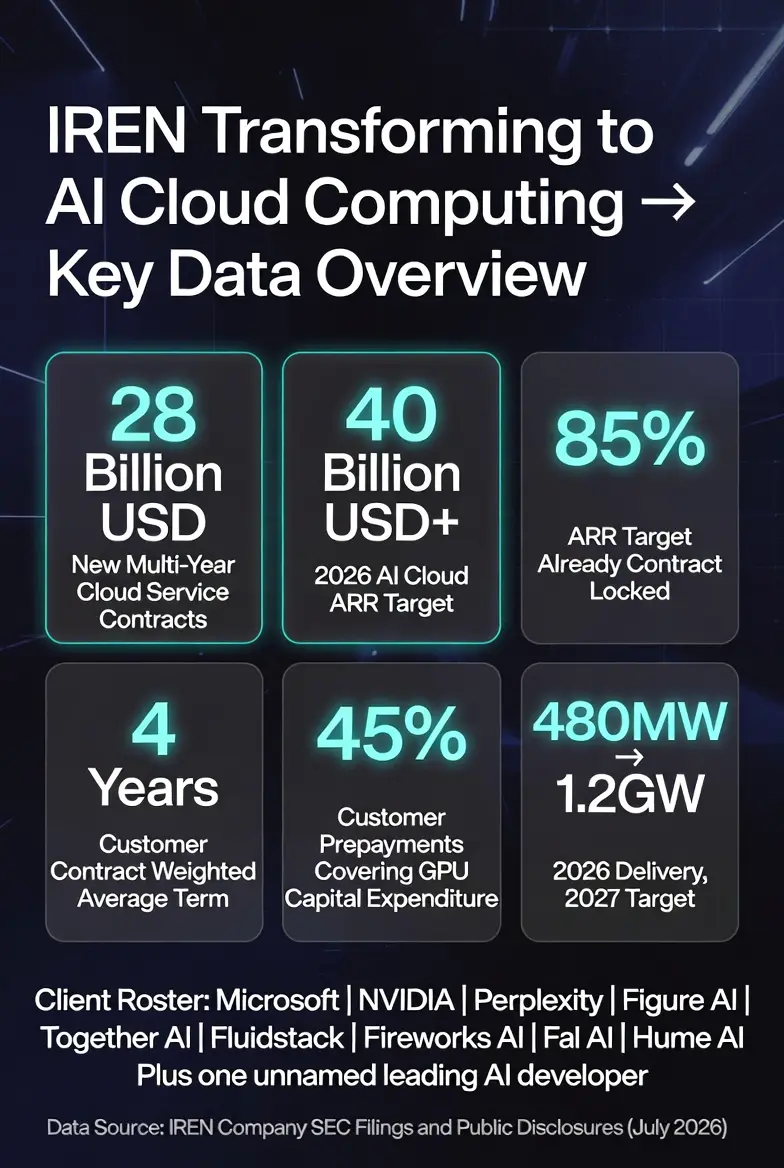
IREN key transition data at a glance—contracts, revenue, and capacity
On the analyst side, Freedom Capital raised its rating for IREN stock from “Hold” to “Buy” earlier this month, maintaining a $58 price target. Based on consensus ratings from 16 analysts, IREN’s average rating is “Buy,” with a 12-month target price of $80.93. Bernstein analyst Gautam Chhugani maintained a Buy rating and a $100 price target.
The underlying logic of bitcoin miners entering the AI compute market
IREN’s transition is not an isolated example, but a structural trend in which the bitcoin miner industry is collectively turning toward AI. To understand this trend, it is necessary to trace the overlap between miners’ core asset composition and AI data centers’ core requirements.
The core assets of traditional bitcoin miners include three layers: power resources (low-cost, large-scale grid interconnection capability), land resources (physical space suitable for building large-scale campuses), and data center infrastructure (including substations, cooling systems, network connectivity, and more).
These three categories of assets form precisely the scarcest combination for AI data centers in the AI era. PJM data shows that AI projects launched in 2025 typically take seven years on average: three years to obtain interconnection agreements and four years waiting for grid connection. Bitcoin miners already have the power access, land rights, and infrastructure in place.
The core logic behind miners’ AI transition can be summarized as a shift along a value chain:
Previously: power → mining machines → BTC mining → block reward revenue.
Now: power → data centers → GPU compute → AI cloud services revenue.
The underlying resource inputs overlap substantially, but the output-side revenue model differs significantly: bitcoin mining revenue is strongly cyclical, affected by both coin price volatility and whole-network hash-rate difficulty; whereas AI cloud services revenue is based on long-term contracts, with higher visibility.
This reuse of resources is not simply “equipment replacement.” Miner data centers typically have high-density racks, liquid-cooling systems, and redundant power configurations—features that fit the needs of GPU-intensive AI training workloads.
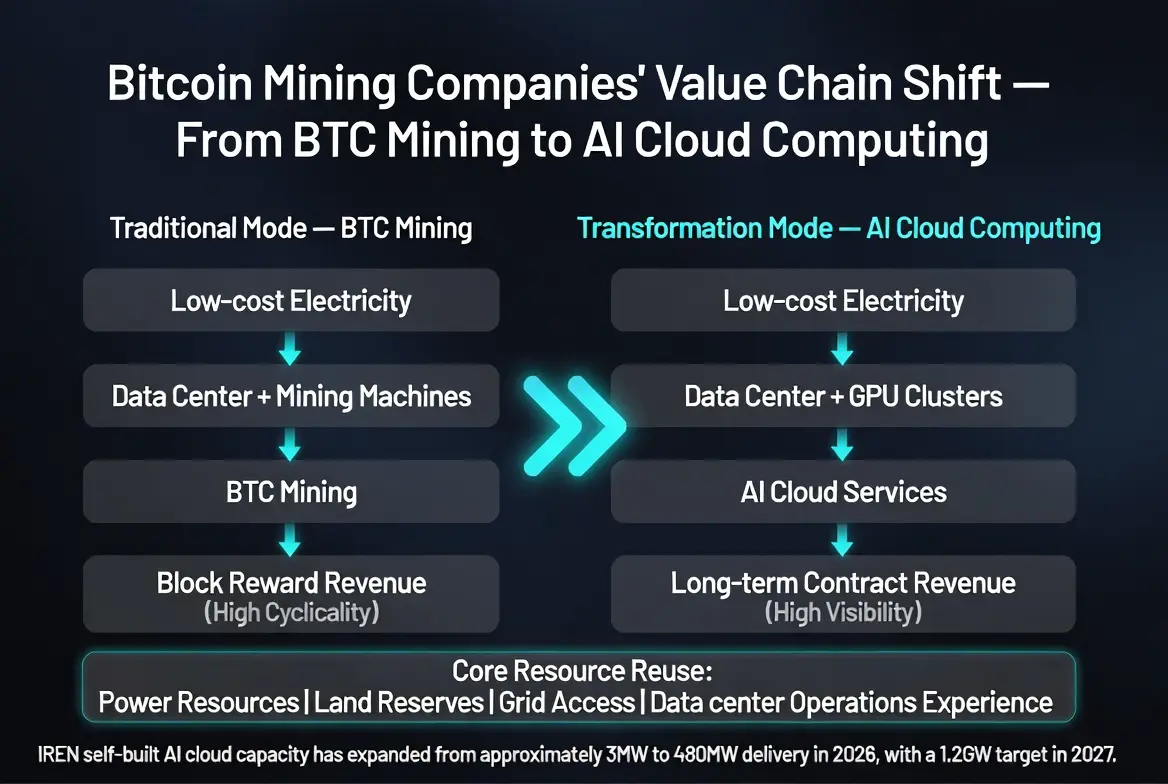
Shifting the value chain of bitcoin miners—from BTC mining to AI cloud computing
Rebuilding valuation logic: from “bitcoin shadow” to “compute infrastructure”
The valuation logic for shares of bitcoin miners is undergoing a fundamental rebuild. A report from 10x Research clearly points out that bitcoin miners are now deeply tied to AI themes, and the pricing anchor for miner stocks is shifting from bitcoin prices to sentiment swings in the AI and semiconductor sectors.
The micro-level evidence for this shift is fairly clear. Since April 2026, the stock performance of leading miners represented by Riot Platforms has shown significantly stronger correlation with the Philadelphia Semiconductor Index (SOX). The long-standing positive correlation between miners and BTC has been broken. As of July 2026, bitcoin is down about 29% year-to-date, while Riot is still up about 80% year-to-date, and MARA is up about 44%.
Market pricing is moving from “how many bitcoins this company can mine” to “how much AI compute infrastructure this company can provide.” Bernstein estimates that the AI revenue of the bitcoin miners it covers will grow from $1.2 billion in 2026 to $10.7 billion in 2030. CoinShares’ report predicts that by the end of 2026, AI-related revenue will account for 30% to 70% of miners’ total revenue.
Changes in financing structure are also driving this valuation-logic switch. Miners are increasingly adopting financing tools such as project-level debt financing, triple-net leases (triple-net), and take-or-pay terms (pay regardless). This shift makes their revenue model more similar to traditional data center REITs, prompting the capital markets to reprice them—from commodity-cycle companies to infrastructure assets with more stable cash flows.
Risk factors: the transition is not risk-free
Although the narrative for miners transitioning to AI is strong, it is not without risks. The market has already priced this trend fairly well, and execution challenges are building up.
A funding gap is the primary constraint. Blocksbridge Consulting estimates that the entire industry still needs to invest another $50 billion to achieve its AI transition vision, with IREN’s funding gap the largest at about $21.1 billion. A report from VanEck also notes that bitcoin miners’ transition to AI infrastructure faces a short-term funding gap of about $50 billion, with long-term capital needs of about $221 billion.
Customer concentration creates revenue risk. Although IREN’s customer list includes multiple leading AI companies, 85% of its ARR target relies on a small number of already-signed customers. If any of those customers reduce purchasing volume or delay deployments, it will materially affect achieving the revenue target.
Project execution has uncertainty. Miners must retrofit existing bitcoin mining facilities into high-density data centers suited for GPU workloads—an effort that involves upgrading power systems, reworking cooling solutions, and rebuilding network architectures. Industry baseline returns are relatively low, and the projects face multiple challenges including financing, regulatory approvals, and tenant quality.
Valuation is affected by volatility in the AI narrative. As miner stocks’ linkage with the semiconductor sector strengthens, downside pressure on miner stocks will be amplified when AI sector sentiment weakens. In July 2026, miner stocks saw about a 20% pullback—an expression of this exposure. Current market valuation is based on future successful delivery, and any execution delays could trigger valuation adjustments.
Conclusion
IREN’s nearly 20% gain on the day is an immediate “vote” by the capital markets on the narrative that “bitcoin miners are becoming AI infrastructure providers.” The $2.8 billion contracts, the $4.0 billion ARR target, and 85% contract coverage—these figures form the micro-level foundation for IREN’s valuation reshaping.
But from a more macro perspective, IREN’s case reflects a deeper industry shift: bitcoin miners’ valuation anchors are moving from crypto asset prices to AI compute demand. The power resources, land reserves, and data center capabilities held by miners create a window of opportunity for reassessment in the AI era.
Whether this reassessment can sustain depends on validation across three layers: whether contracts can be converted into actual revenue as planned, whether capacity expansion can be delivered on time, and whether AI compute demand can absorb miners’ supply increases over a longer time horizon. Until then, the premium given by the market is essentially an advance pricing of “infrastructure scarcity,” rather than confirmation of realized cash flows.
FAQ
Q1: How much did IREN’s stock price specifically rise on July 21, 2026?
IREN’s stock closed at $40.20 that day, up $6.58 from the prior trading day’s close of $33.62, for a gain of 19.57%. The stock briefly reached a high of $41.10 intraday.
Q2: What is IREN’s AI cloud business revenue target after the increase?
IREN raised its annualized run-rate revenue (ARR) target for AI cloud business at the end of 2026 to more than $4.0 billion, up from the previous $3.7 billion target. About 85% of the new target has been locked in through signed contracts.
Q3: Which companies are included among IREN’s AI cloud service customers?
Publicly disclosed customers for IREN include Microsoft, NVIDIA, Perplexity, Figure AI, Together AI, Fluidstack, Fireworks AI, Fal AI, and Hume AI. In addition, there is one unnamed major AI developer. The contracts cover two business types: bare-metal infrastructure and managed cloud services.
Q4: What are the main risks for bitcoin miners transitioning to AI?
Main risks include: a funding gap of about $50 billion (with IREN’s gap about $21.1 billion), overly high customer concentration, difficulty executing facility retrofits, and valuation sensitivity to volatility in AI sector sentiment.
Q5: How much AI cloud computing capacity does IREN plan to deploy in 2026 and 2027, respectively?
IREN plans to deliver 480MW of AI cloud computing capacity in 2026, a significant increase from about 3MW in 2025, and plans to reach 1.2GW in 2027.