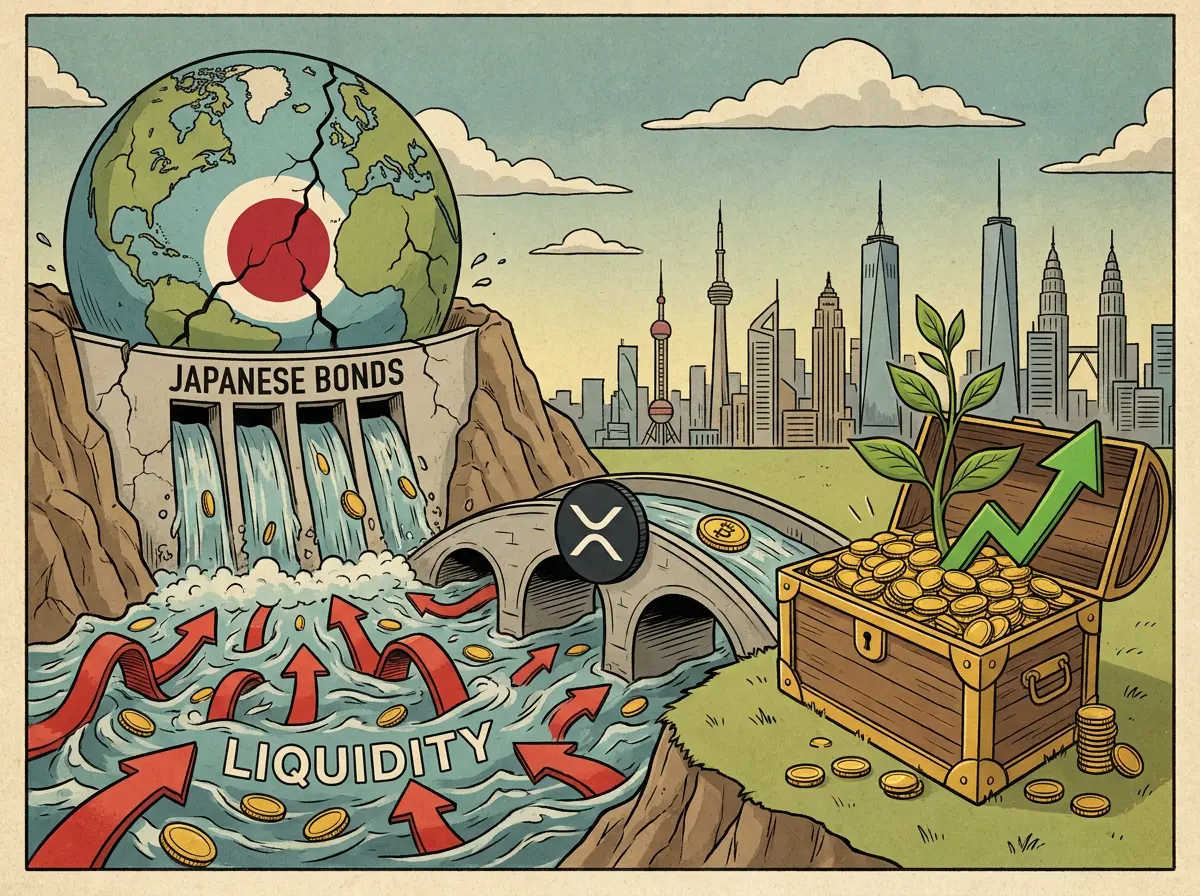
Japan’s 30-year government bond yield broke above 4% in May, the first time since 1999. In the first quarter of 2026, Japanese investors sold about $29.6 billion worth of U.S. Treasuries. Market analyst Catalina Castro warned on X that Japan’s selling of U.S. Treasuries could trigger a domino effect: the XRP cross-border settlement mechanism could, in theory, release an estimated $27 trillion to $37 trillion of trapped funds in global accounts.
Japan bond market pressure: confirmed market data
Japan 30-year government bond yield: Breaks 4% (May 2026, first time since 1999; expected to be close to 4.2%)
Japan 10-year government bond yield: Hovering near the highest level since the late 1990s
Japan’s U.S. debt selloff in Q1 2026: About $29.6 billion (the largest quarterly selloff since 2022)
U.S. 30-year Treasury yield: Touched 5% this week
Background: The Bank of Japan’s rate hikes are unraveling the decades-long “yen carry trade” — a global capital operating model that borrows cheap yen and invests in high-yield assets
Castro’s chain-reaction analysis (attributed to her personal views)
On X, Castro confirmed her analytical framework: “Domino effect: Japan sells U.S. bonds → U.S. Treasury yields rise further → mortgage rates increase → credit costs rise → the entire U.S. financial system faces pressure. The pressure in Japanese bonds turns into pressure in U.S. bonds.”
She noted that since Japan is a major creditor country of the U.S., rising domestic yields accelerate capital repatriation, which could further push up U.S. Treasury yields and create cross-market pressure transmission.
Ripple ODL’s technical claim: XRP as a liquidity bridging tool
Global nostro/vostro account problem (industry estimates): In the global banking system, an estimated $27 trillion to $37 trillion sits idle in nostro/vostro accounts and cannot circulate in the real economy.
Ripple’s confirmed technical claim: Using XRP on-demand liquidity (ODL) as the bridging asset, converting local currency to XRP, completing the transfer within seconds, and then converting back to the target currency; no need to pre-fund nostro/vostro accounts. Ripple said that in pilot tests it achieved 40% to 70% fee savings compared with SWIFT, and settlement time was cut from days to minutes.
Castro’s additional analysis (her personal views): The released liquidity could theoretically flow back into productive activities such as buying bonds, lending, and investing. Castro also confirmed: regulatory policy clarity and institutional trustworthiness remain the main obstacles to scaling XRP’s technical application across the traditional global financial system.
FAQ
Why does Japan’s selloff of U.S. Treasuries create pressure on the U.S. financial system?
Japan is one of the largest overseas holders of U.S. Treasuries. Large-scale selling directly pushes up U.S. Treasury yields. Higher yields mean higher financing costs for the government and corporations, which then transmit downward to mortgages and credit. According to Castro’s analysis, this is a potential systematic transmission chain.
What are the main technical differences between Ripple ODL and SWIFT?
Based on Ripple’s technical claim, SWIFT requires transfers through multiple correspondent banks (1 to 5 business days); Ripple ODL uses XRP as the bridging asset, reducing settlement to seconds to minutes, and does not require pre-funding nostro/vostro accounts. Ripple said it achieved 40% to 70% fee savings in pilot tests.
What are the main obstacles to large-scale XRP adoption in the global financial system?
Based on Castro’s analysis and industry observations, the main obstacles include: clarity of regulatory policy (especially in major markets); institutional trust; and building large-scale interoperability and liquidity depth. Castro, in her analysis, confirmed that these factors still limit the current scale of XRP’s adoption.


