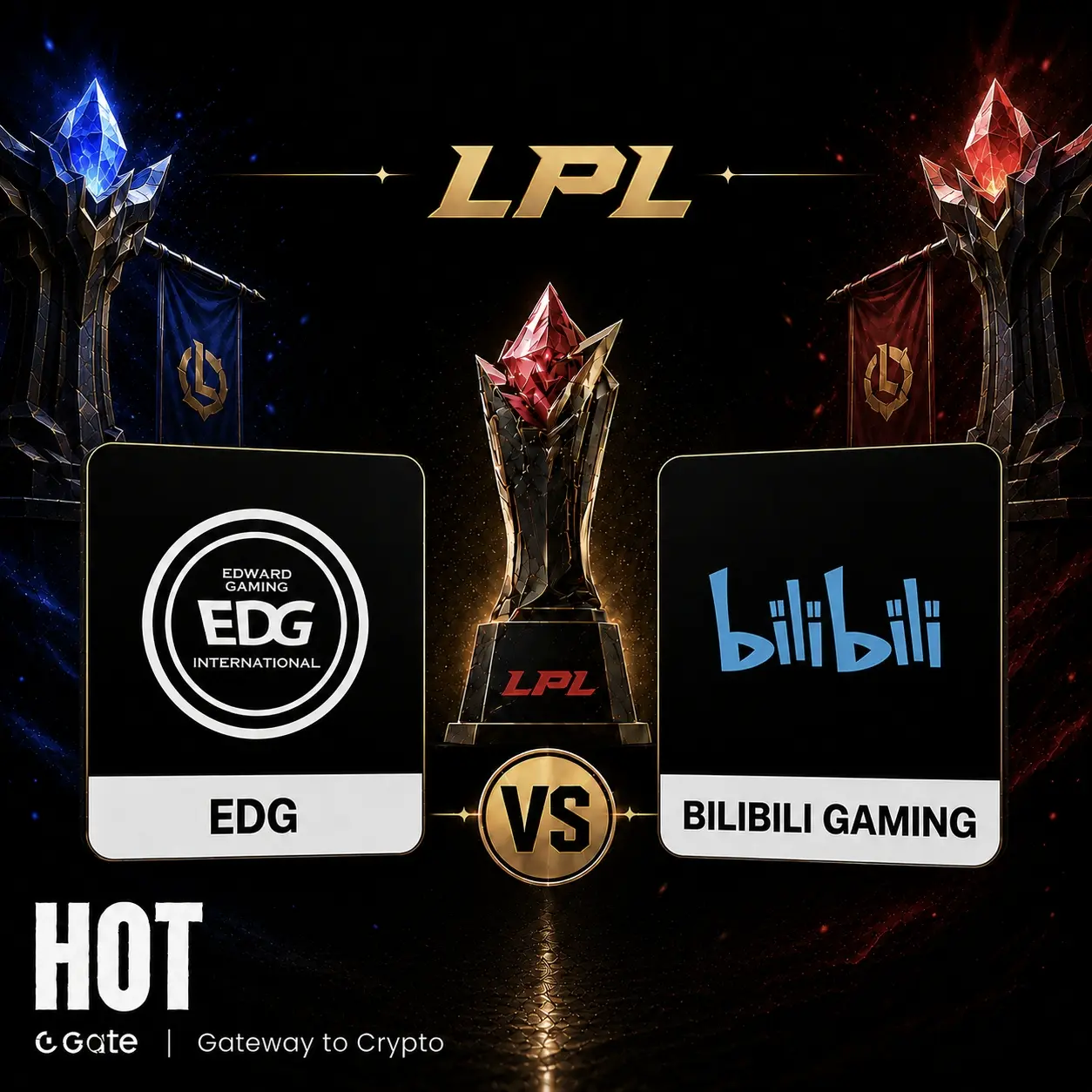
The 2026 esports midsummer season is now underway, with major events like EWC, LPL, and LCK constantly rolling. Popular esports titles such as LoL, Dota 2, Counter-Strike, and Valorant are launching one after another. Gate has introduced the “电竞巅峰交易季” limited-time campaign, predicting esports showdowns worldwide and splitting up 200,000 USDT.
Seven-game winning streak and three years without a win—how do head-to-head results affect market expectations
The teams’ head-to-head record is the most direct entry point for understanding the probability gap shown by the prediction market. BLG has already put together a seven-game winning streak against EDG. EDG’s last victory over BLG dates back to Feb. 12, 2023, during the LPL Spring regular season. Since then, EDG has gone winless against BLG for three years.
The most recent encounter took place in the 2026 LPL Stage 2 playoffs, where BLG swept EDG 3:0 and sent them home immediately. Going further back: in the 2025 Stage 2 group stage, BLG defeated EDG 1:0; in the 2025 Stage 1 group stage, BLG defeated EDG 3:0; in the 2024 Spring regular season, BLG defeated EDG 2:0; and in the 2023 Summer regular season, BLG defeated EDG 2:1. For an entire three years, EDG’s head-to-head record versus BLG has shown a one-sided pattern of dominance.
In prediction market pricing logic, historical head-to-head data is one of the most basic dimensions for risk assessment. When one team keeps a perfect win record against another team for as long as three years, the market systematically raises the expected probability of the former’s victory. The massive 86% vs. 15% gap shown by Gate’s prediction market is built first on this long-term suppression relationship.
Stage 3’s bad opener—what issues does EDG’s new lineup expose
In Stage 3, EDG went through a major roster overhaul—Bulldog replaced Angel in the mid lane, and Parukia returned to the starting lineup as support. However, judging from the opening match on July 22 against LGD, the new lineup’s cohesion was far from ready. EDG was swept by LGD 0:2.
The problems exposed during the match were quite specific. In Game 1, Leave’s Gnar (Jinx?) repeatedly whiffed ultimates; in Game 2, Lucian was instantly deleted in a crucial teamfight, ruining a situation that still had a chance to be salvaged. EDG’s current starting lineup—Zdz, Xiaohao, Bulldog, Leave, Parukia—failed to show stable competitive form across all five positions against LGD. After Leave was eliminated by BLG 3:0 in Stage 2, he had said, “No matter what, I think I’ll play better than I am now,” yet there was still a clear gap between that expectation and his performance in the opener.
By contrast, although BLG also made roster changes—top laner Bin temporarily stepped away from the stage due to poor form, with rookie Wenbo taking over in the starting role—its double-carry setup in mid and bot (Knight, Viper, and ON) remains an LPL top-tier configuration. Wenbo completed his LPL debut and won against TT on July 23. Even though TT is not a strong team, a debut win at least signals baseline stability for the squad.
Gate prediction market pricing mechanisms absorb these fundamentals in real time. EDG’s poor opener performance and BLG’s smooth rookie debut together form an important basis for the market’s probability adjustment gap.
From Nirvana to Ascension—how does the Stage 3 format amplify the probability gap
The 2026 LPL Stage 3 format structure adjustment provides another analytical framework for understanding the prediction probabilities for this match. Both EDG and LGD were teams promoted from the Nirvana Group to the Ascension Group. Overall, the Ascension Group’s competitive strength is significantly higher than that of the Nirvana Group, meaning that after promotion, EDG needs to face opponents at a higher level.
BLG’s situation is completely different. According to the LPL points rules, before Stage 3 began, BLG were already leading the standings with 190 points. If they reach the top eight of the playoffs during Stage 3, their total points will rise to 205, locking in the LPL second seed with a direct ticket to the 2026 Global Finals. This means the pressure BLG carries on a psychological level is far less than EDG’s—they don’t need to fight for life-and-death to secure a Worlds spot, so they can handle the regular season more comfortably.
Differences in format are often underestimated in prediction market pricing, but they are an invisible variable that affects the direction of a match. When a team has a more relaxed psychological environment, its stability in-game performance is usually higher. The 86% win probability reflected by Gate’s prediction market already discounts, to some extent, this format “bonus.”
Why is the market one-sided? Pricing from emotion to information
The core feature of a prediction market is this: it’s not a public poll about “who is stronger,” but a pricing mechanism that expresses judgment with real money. Gate Polymarket allows users to buy “Yes” or “No” shares for an event result, and the market price reflects the collective assessment of the probability of the event occurring in real time.
When Gate’s prediction market shows EDG’s win probability at 15% and Bilibili’s at 86%, the numbers behind them represent the sum of trading decisions made by countless participants based on their respective information sets. This information includes, but is not limited to: historical head-to-head data, recent performance, player form, roster changes, scrim rumors, format impact, and more. The market integrates all this scattered information into a single unified probability judgment through price.
It’s worth pointing out that prediction market probabilities are not precise prophecies about the future, but reflections of the collective judgment of market participants. A 15% probability does not mean EDG is “certain to lose,” but rather that under all the given known conditions, EDG’s chance of winning is about one in seven. That probability already includes the possibility of an EDG upset—it’s just that the market considers that possibility relatively low.
How prediction markets change the way we observe esports
Gate integrates prediction markets into a centralized exchange platform, allowing users to participate in event predictions directly through familiar trading interfaces—without managing external wallets or dealing with complex blockchain operations. From July 20 to August 10, 2026, Gate launched the esports trading season campaign, covering major esports events such as EWC, LPL, and LCK, with a total prize pool of 200,000 USDT.
Prediction markets provide esports events with an entirely new perspective. Traditionally, viewers’ understanding of matches mainly relies on caster analysis, official team information, and discussions on social media—sources that often come with subjective viewpoints or information delays. The price signals from prediction markets, however, provide a real-time, quantified consensus backed by money. When the market prices a team’s chance of winning extremely low, that itself is information worth examining—it suggests that many participants with good information believe that team’s chances of winning are not high.
For esports investors and enthusiasts, understanding the pricing logic of prediction markets is as important as understanding the tactical game within the matches themselves. Together, they form a complete closed loop of information and value in the esports ecosystem.
Under such lopsided probabilities, are there any variables being underestimated?
Although Gate’s prediction market shows a disparity of 15% versus 86%, in any competitive sport, probability is never equal to certainty. The following variables are worth continuous attention:
First, BLG top-lane rookie Wenbo has only one LPL experience. Facing TT and facing EDG are two completely different levels of matchup. If Wenbo makes mistakes in a high-pressure environment, BLG’s top lane could become a breakthrough point.
Second, with EDG coming off a seven-game losing streak, will they trigger a “desperate soldiers must win” psychological effect? In competitive sports, teams that keep losing for a long time often experience a rebound at some point—though that point cannot be predicted precisely.
Third, the BO3 format itself gives weaker teams more room for an upset. Compared with BO5, BO3 has a smaller sample size and higher randomness. EDG only needs to perform above average in two games to potentially change the direction of the match.
These variables do not negate the current prediction market pricing, but they remind readers: a 15% probability means upsets are a low-probability event, yet low-probability events do happen across sufficiently many repeated trials.
Frequently Asked Questions (FAQ)
Q: How are probabilities in the Gate prediction market calculated?
A: The Gate prediction market uses an order book matching mechanism. Users buy “Yes” or “No” shares for a given event outcome, and the execution price reflects the market’s collective judgment of the event’s probability in real time. The probability is not calculated solely by the platform, but determined jointly by all participants’ buying and selling behavior.
Q: Does a 15% win probability mean EDG has absolutely no chance?
A: No. A 15% probability means the market estimates EDG’s win chance is about one in seven. In competitive sports, low-probability events do occur. The prediction market probability reflects market consensus rather than a deterministic prophecy about the future.
Q: How is the data from the Gate prediction market different from other prediction platforms?
A: Gate is one of the platforms that integrates Polymarket into a centralized exchange, allowing users to use USDT directly within the Gate ecosystem to participate in prediction trading, without managing an external wallet or handling cross-chain operations.
Q: What impact does the result of this match have on LPL playoff positioning?
A: BLG currently leads the standings with 190 points. If they enter the top eight of the playoffs, they will lock in the LPL second seed with a direct ticket to the global finals. EDG, meanwhile, needs more wins to accumulate points and fight for a playoff spot. Therefore, this match has a bigger impact on EDG’s season direction.
Q: Where can I view real-time data for the Gate prediction market?
A: Users can log in to the Gate platform, go to Polymarket’s esports section, and check real-time prediction market data and probability changes for LPL and other esports events.