As of June, among the many emerging themes, “Will the US confirm the existence of aliens in 2026?”—because it combines the attribute of scientific exploration with political disclosure variables—has become one of the most narrative-tension long-tail topics in prediction markets.

A prediction market is a mechanism that aggregates dispersed information into quantifiable probabilities through financial incentives. Participants place bets on event outcomes with real money, so market prices reflect the likelihood of a “collective judgment” occurring. A report jointly released by Keyrock and Dune notes that the price signals of prediction markets perform significantly better than traditional polls and expert judgment in complex events involving politics, economics, and more.
In 2025, the crypto prediction market segment saw explosive growth. According to data from PredictionIndex.xyz, total annual trading volume reached approximately $50.25 billion. Trading volume for economic events grew 10x year-over-year, while technology and science events grew 17x, becoming the two fastest-growing segments. Prediction markets have expanded from election-driven niche applications to become a comprehensive information infrastructure covering sports, technology, culture, and even astrophysics events.
Do the US government’s currently disclosed UFO files point to extraterrestrial life
The White House officially launched the UFO file disclosure process on May 8, 2026. The first batch publicly released 161 records covering documents, videos, photos, and witness statements. Sources include the FBI, NASA, the Department of War, and the State Department, spanning from the 1940s to 2026. Subsequent versions are scheduled to be released in batches every Monday.
However, these disclosures do not provide direct evidence that extraterrestrial life exists. After multiple rounds of investigation, the Department of Defense’s All-domain Anomaly Resolution Office (AARO) stated that there is currently no evidence indicating that UAP events are related to aliens. The office’s former director, Sean Kirkpatrick, explicitly said that there are “no shocking revelations” in government records, and the public should not expect direct evidence that aliens exist.
Experts take a rational stance. Astrophysicist Neil deGrasse Tyson, responding to the disclosure of UAP files, said these materials “contain nothing new,” and unexplained phenomena should not be directly attributed to aliens. Academic researchers’ view is: “For die-hard fans, it’s almost impossible to get satisfaction (from the files). So no matter what gets released this time, disappointment is basically guaranteed.”
Why does the prediction market bet on alien confirmation for 2026
As of June 8, 2026, Gate’s prediction market data shows the market is pricing in a 1% probability of confirming alien existence by June 30, 7% by September 30, and 14% by December 31.
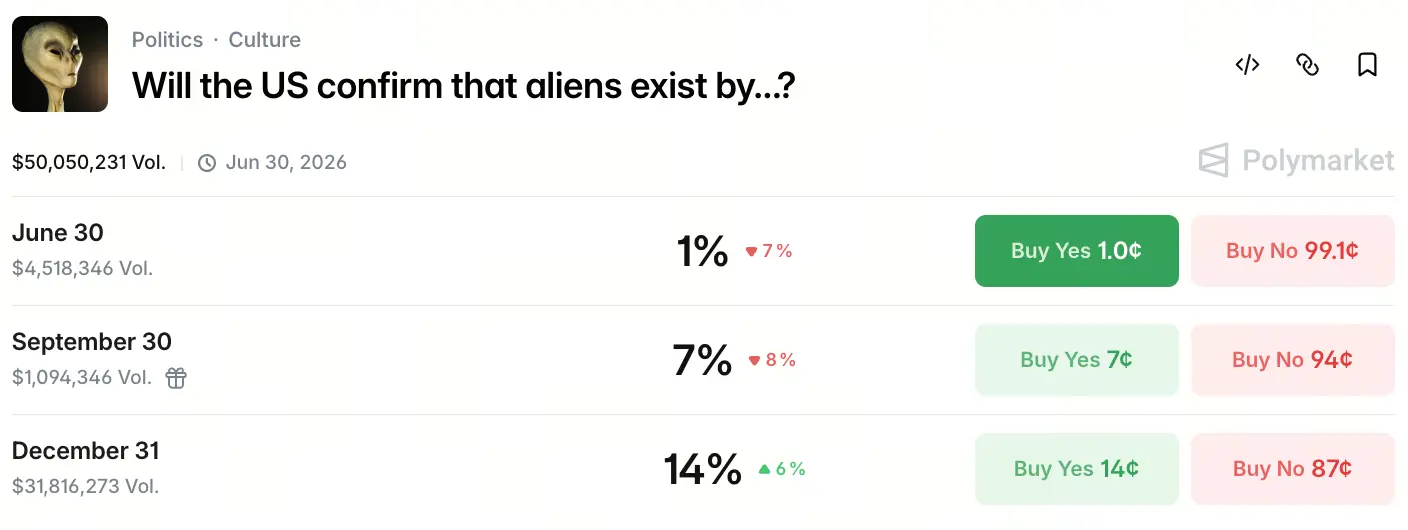
The probability by June 30 is only 1%, indicating the market does not expect any major breakthrough disclosures within the next three weeks. The 7% probability by September 30 suggests expectations rise after entering the second half. The 14% probability by December 31 implies there is still a certain confirmation window within the year, but overall likelihood remains low. The incremental step of about 7 percentage points across the three time nodes shows the market’s expectation of the disclosure process is asymptotic rather than jump-like.
In terms of trading volume, the topic’s total completed volume is $50 million. In a sector with total annual trading volume exceeding $50 billion, a single topic at $50 million falls within the long-tail market category; however, it already surpasses the average trading depth of most technology and science markets. The Keyrock report notes that although long-tail “black swan” events account for 31% of all prediction market outcomes, they only attract 3% of trading volume, showing that market resources allocated to extremely low-probability events are relatively rational.
How event-driven information arbitrage affects prediction market depth
The core value of prediction markets lies in information discovery rather than speculation. During the 2024 US election, trading volumes on Polymarket and Kalshi increased by 3186% in five months, rising from $140 million to $4.6 billion. The driver of this growth was not fund-chasing, but price convergence formed by traders arbitraging based on differences in information. Hotcoin Research analysis points out that only betting on the correct outcome can be profitable; this “voting with money” mechanism encourages participants to use information cautiously and improves prediction accuracy.
The UFO disclosure event has the following characteristics in terms of information structure: official information is released in batches at a weekly frequency, there is policy uncertainty in the disclosure timeline, and the likelihood of scientific explanations for each batch of new documents is unpredictable. This multi-stage information flow structure fits the prediction market’s core function framework—after each new batch of documents is released, the market can reprice, and information increments continuously inject depth into the market.
Keyrock’s research data shows that the convergence of price signals in prediction markets improves as the event approaches, with errors narrowing significantly. But what is unique about UFO disclosure is that the “probability of confirming alien existence” itself is the target, not an intermediate variable being dynamically revised. The market’s repricing depends on whether each batch of documents contains new information beyond the scope of scientific explanations.
What potential variables do continuous DoD document disclosures create for UAP prediction topics
Two major core variables are disclosure continuity and substantive breakthroughs in content. In terms of continuity, the White House has committed to pushing disclosure forward in weekly batches, but resistance remains within Congress. Whether the Trump administration’s transparency directives can be carried out with consistent intensity throughout 2026 involves policy continuity risk.
In terms of content breakthrough, among the archives already made public: in 2019, infrared footage over the Persian Gulf showed three unidentified flying objects flying in formation; in 2021, an object over Syria disappeared in a “sudden acceleration” manner. Although these phenomena lack scientific explanations, there remains a fundamental gap to “confirmation of extraterrestrial life.” Anna Paulina Luna, chair of the working group of the US House Oversight Committee, said AARO’s response to UAP sightings is “not sufficient.” The military has received at least 757 UAP reports, but it has only traced conventional explanation sources for 118 of them.
NASA and independent scientists have also pointed out that many widely circulated UFO incidents ultimately get classified as optical distortions, atmospheric phenomena, or sensor malfunctions. From the official perspective, the issue framing has shifted from “whether extraterrestrial life exists” to national security concerns. Pentagon officials emphasize that the core issue is not alien visits, but objects that cannot be quickly identified and categorized while operating near sensitive facilities.
Why does the flow of funds into prediction markets show polarity differences in betting
The distribution of fund flows reveals traders’ risk-preference structure. The Keyrock report shows that high-probability events (probability >80%), while accounting for only 14% of the total number of markets, contribute 35% of the trading value. Conversely, long-tail “black swan” events make up 31% of the number of markets but attract only 3% of trading volume. This means mainstream users use prediction markets as a risk-management tool for low-volatility events rather than chasing high-odds speculation on extremely low-probability outcomes.
The UFO confirmation topic is a typical low-probability, high-narrative theme. The 14% probability by December 31 falls into the mid-to-lower probability range among prediction market products, and the $50 million trading volume reflects that market attention and capital allocation remain within a rational range. The market is not overpricing merely due to narrative heat, nor is liquidity collapsing due to the topic’s “counterintuitive” nature.
In terms of category mix, in 2025 sports markets led with a 58% share of trading volume, politics ranked second at 20%, crypto ranked third at 11%, and culture ranked fourth at 3%. Although technology and science events have the fastest growth rates, their share of total trading volume remains relatively limited. As science markets continue to grow, trading depth for astrophysics topics like UFO may keep improving over the medium term.
How will regulatory games shape the trajectory of UAP prediction topics
Significant progress on the CFTC’s compliance positioning for prediction markets was made in 2025. It defined prediction markets as legally recognized commodity derivatives rather than gambling activities. This clear compliance positioning is one of the key prerequisites for prediction market trading volume to grow from about $500 million in 2024 to nearly $3 billion in 2025.
However, unlike political elections and sporting events, UFO topics involve tiered management of national security information and disclosure authority. The congressional oversight working group requires AARO to provide additional video records, but AARO’s response has been assessed as “not sufficient.” The information tension between government agencies and the legislative branch creates unique legal and regulatory constraints for UAP prediction topics.
From the perspective of US defense policy, the core concern of UAP is national security rather than extraterrestrial life. The military attributes most UAP reports to balloons, drones, atmospheric effects, or sensor anomalies. This means that even if information disclosure continues to progress, official framing will very likely remain “identified but not of extraterrestrial origin” in the foreseeable future. Prediction markets need to maintain this clarity, and market participants must distinguish between two logically distinct events: “increased information disclosure” and “confirmation of extraterrestrial life.”
Green Turf Oracle: Gate’s limited-time World Cup event for the prediction market
While focusing on whether aliens exist, Gate prediction market (Gate Polymarket) simultaneously launches a limited-time 2026 World Football extravaganza event called “Green Turf Oracle.” The total prize pool exceeds 500,000 USDT, running from June 4, 2026 to July 21. Users can sign up to receive prediction coupons for free. Completing tasks such as spot, contracts, CFD, and VIP upgrades earns additional prediction market experience coupons and prediction coupons to participate in predicting football matches. The top 100 in the prediction points leaderboard can split 30,000 USDT and win limited jersey gift boxes, and the champion prediction prize pool is additionally set at 5,000 USDT. VIP users can also enjoy exclusive registration rewards and jersey gift boxes. Log in to Gate now and join the World Cup prediction fun on the prediction market.
Frequently Asked Questions (FAQ)
Q1: What is the trading volume for the “US confirms the existence of aliens” topic on the Gate prediction market?
As of June 8, 2026, the topic’s total trading volume is $50 million. Out of the approximately $50.25 billion total trading volume for the crypto prediction market segment in 2025, this topic falls into the long-tail market category, but it already exceeds the average trading depth of most technology and science markets.
Q2: Do the UFO files currently disclosed by the US government prove that aliens exist?
Not currently. After multiple rounds of investigation, the Department of Defense’s All-domain Anomaly Resolution Office (AARO) confirmed that there is no evidence indicating UAP events are related to aliens. The publicly released files include multiple segments of infrared footage and pilot testimonies; many phenomena have not yet been found with scientific explanations, but “unexplained” does not equal “extraterrestrial origin.”
Q3: Why is the probability of confirming aliens by December 31 14%, instead of higher or lower?
A 14% probability is a price signal formed by market participants after betting based on existing information (the ongoing disclosure cadence, government agency positions, and the analysis judgments of the scientific community). This probability is relatively low, reflecting that the market’s expectation for incontrovertible evidence of extraterrestrial life appearing in government disclosure files is not strong.
Q4: Will UFO file disclosure cause Meme token prices tied to the UFO concept to rise?
Historical data suggests there is a positive correlation. On May 8, 2026, the day the US Department of War launched file disclosure to the public, UFOPEPE (UFO) on the Solana chain recorded a 24-hour increase of 44.68%. However, price fluctuations of such tokens are driven by narrative attention and community heat, and the topic pricing in prediction markets is logically independent—volatility of the former is significantly higher than that of the latter.
Q5: Is the probability pricing by prediction markets for “alien confirmation” accurate?
The effectiveness of prediction markets in information aggregation has been validated by multiple studies. The Keyrock and Dune joint report shows that Polymarket’s final prediction accuracy for event outcomes is consistently between 90% and 95%. But for special topics like UFO disclosure that involve government information management and scientific verification, the prediction market’s accuracy also depends on the completeness and continuity of information disclosure.