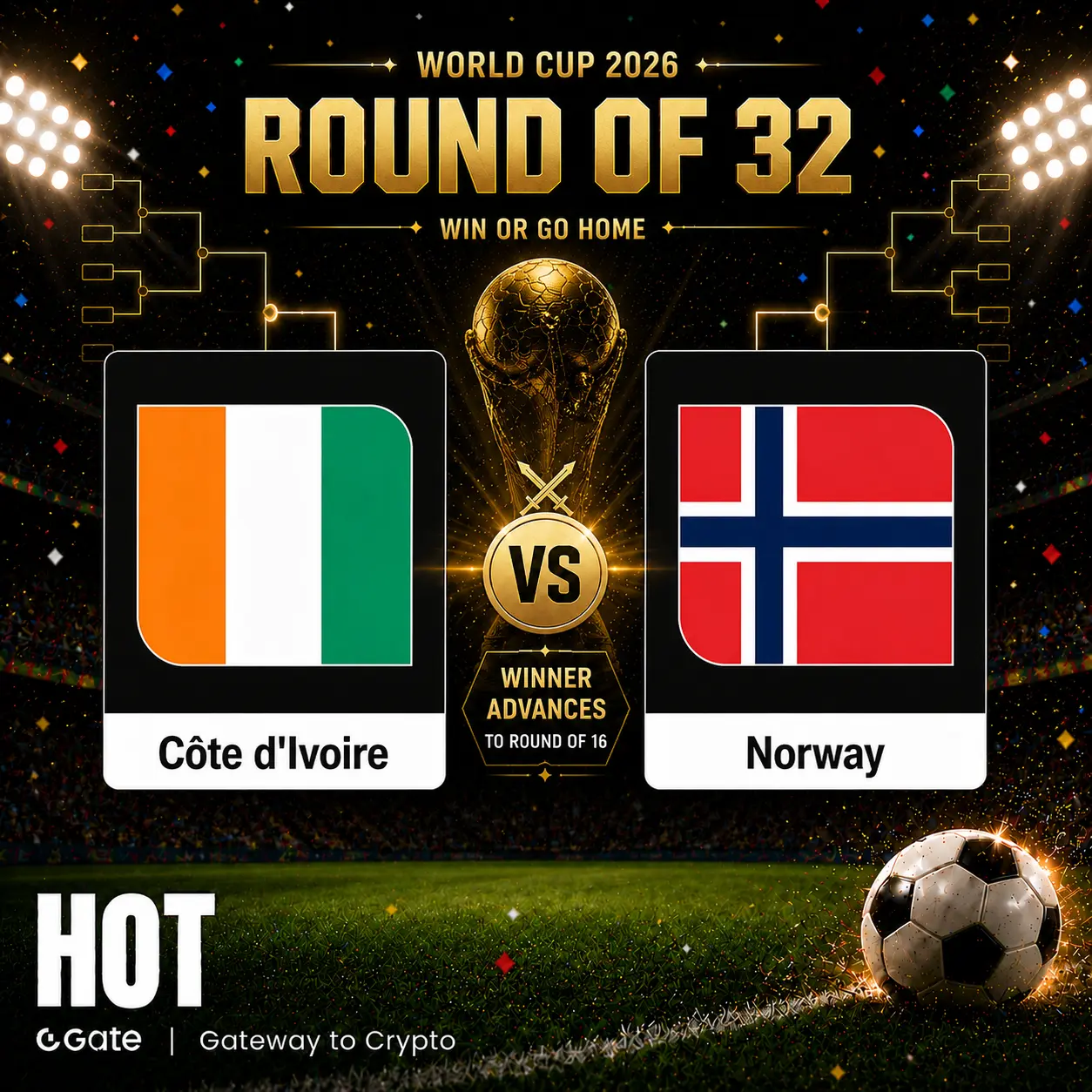
A 46% win probability pricing means the market sees Norway as a clear favorite, but not overwhelmingly so. What market logic does this probability distribution reflect? How are funds choosing between two teams with such contrasting styles?
What does the prediction market's 46% pricing reveal about knockout-stage expectations?
A 46% win probability is moderately above average confidence in a single-elimination match. For reference, this figure is significantly higher than Côte d'Ivoire's 27%, but it also means the market believes there is more than a 50% chance that the match will not end with a Norway win in regular time — the draw probability of 29% is the second most likely outcome after a Norway victory.
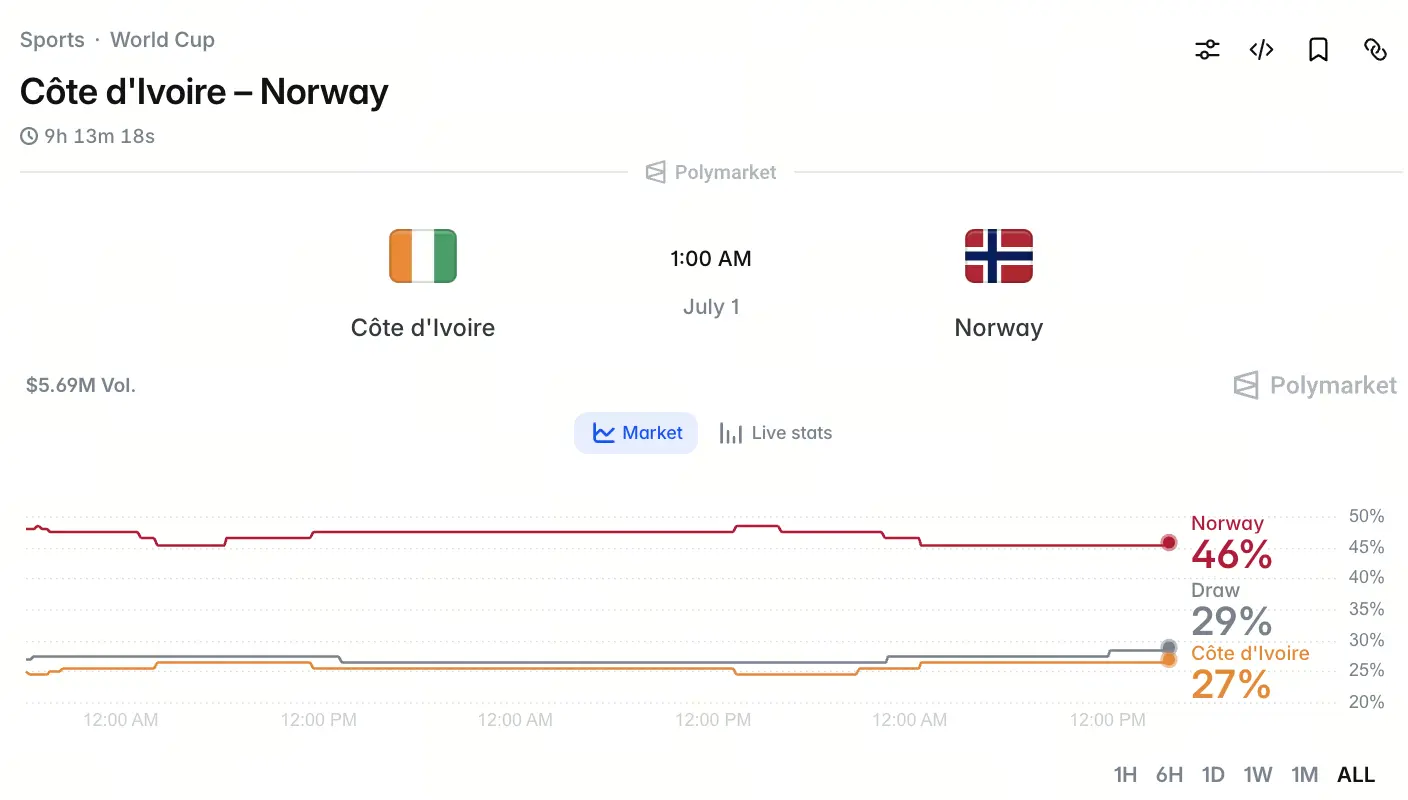
This probability distribution signals several noteworthy points. First, the market's favor for Norway is based on a clear offensive advantage, not an expectation of total dominance. Norway won all eight qualifying matches, scoring 37 goals, and netted a combined 7 goals in their first two group matches against Iraq and Senegal — their attacking firepower has been well proven. Second, the 29% draw probability is not low in a knockout context, reflecting the market's recognition of Côte d'Ivoire's defensive resilience. Côte d'Ivoire conceded only 2 goals in three group matches, including a narrow 1-2 loss to Germany, demonstrating their ability to compete with strong teams.
Notably, Gate's prediction market data shows 24-hour trading volume for this match exceeds $9 million, indicating high capital participation and a certain degree of market consensus behind the pricing. However, the prediction market's probabilities are essentially a mapping of participants' collective judgment, not a deterministic prediction of the match outcome.
Can Côte d'Ivoire's defensive system and counter-attacking threat offset the talent gap?
Côte d'Ivoire is one of the most intriguing dark horses of this World Cup. This is the first time the team has advanced to the knockout stage; in their three previous appearances (2006, 2010, 2014), they were eliminated in the group stage. Under head coach Faye, the team is built around the core of their African Cup of Nations champions, constructing a game system based on physicality, defensive discipline, and wing speed.
From a data perspective, Côte d'Ivoire's defensive performance carries significant weight. They conceded zero goals in six African qualifying matches, and only 2 goals against Ecuador, Germany, and Curaçao in the group stage. The team scored first in all three group matches, trailing for a cumulative total of just 3 minutes and 29 seconds. Captain Kessié anchors the midfield alongside Sangaré in a double pivot, while the front line features Pepe, Zaha, and Adingra, all capable of one-on-one breakthroughs, posing a counter-attacking threat.
However, Côte d'Ivoire faces two serious structural issues. First, weak midfield ball possession and a lack of attacking options in settled play. Once Norway stabilizes the rhythm and compresses the counter-attack space, Côte d'Ivoire's offensive efficiency will drop sharply. Second, the defense has been hit by injuries — starting center-back Ndicka is confirmed out, and starting full-back Singe is questionable with a hamstring injury. This means the team may field a makeshift backline against the "aerial bombardment" duo of Haaland and Sørloth, creating a glaring mismatch.
How does Norway's attacking system and rotation strategy shape market confidence?
Norway returns to the World Cup after 28 years, with a total squad value of €502 million. Head coach Solbakken has built a tactical system almost entirely around Haaland, with Ødegaard serving as the attacking midfield hub. This dual-core structure has proven highly effective in qualifying and the early group stage — eight straight wins in qualifying with 37 goals, and Haaland scoring braces in each of the first two group matches.
Norway's most strategically valuable move came in the final group match. Having already secured qualification, Solbakken rotated 10 starters against France, resting Haaland, Ødegaard, Sørloth, and other key players. The 1-4 loss looked like a heavy defeat on the surface, but from a strategic perspective, Norway's starters have a clear fitness advantage entering the knockout stage. Côte d'Ivoire fielded their full-strength lineup in all three group matches, with captain Kessié carrying a muscle strain concern. In the latter stages of a single-elimination game, the fitness gap could become a decisive variable.
Norway's tactical shortcomings are also clear. Full-backs Ryerson and Wolfe have defensive vulnerabilities, and could struggle against the wing threats of Zaha and Adingra. The center-back pairing of Østigård and Ajer, while physically strong, are slow to turn, making them vulnerable to Côte d'Ivoire's counter-attacking speed. Additionally, Norway conceded 4 goals to France in the final group match, exposing defensive fragility — a problem that could be magnified in the knockout stage.
Does Haaland's individual ability and historical record constitute a premium overvaluation?
Haaland is the biggest individual variable in this match. He has scored 4 goals in this World Cup, and 59 goals in 52 international appearances. If he scores again, he will become the first player since Hungarian legend Kocsis in 1954 to score in each of his first three World Cup matches.
From a tactical standpoint, Haaland's value goes beyond his goal tally. His presence forces opponents to adjust their defensive focus and compress their defensive line, creating space for Ødegaard's midfield orchestration and wingers' cutting inside. Côte d'Ivoire's defensive injury crisis further amplifies this advantage — when the 1.94m Haaland competes for headers in the box, a makeshift backline can barely contain him effectively.
However, whether the market's pricing of Haaland has fully accounted for his impact is a question worth asking. The 46% win probability means the market believes Norway's chance of winning in regular time is less than half. If Haaland's form and Norway's system advantage are so clear, why isn't the win probability higher? The answer may lie in the inherent unpredictability of knockout football — the single-game format naturally compresses the impact of talent gaps, and Côte d'Ivoire's defensive discipline and counter-attacking efficiency are enough to make any opponent uncomfortable.
The value and limitations of prediction markets as information aggregation tools
The core value of a prediction market is to aggregate dispersed information through capital voting. The $3.66 million trading volume and 46%-29%-27% probability distribution for this match essentially represent the collective judgment of market participants after weighing factors such as team form, tactical matchups, injuries, and fitness reserves.
But prediction market probabilities should not be equated with factual predictions. First, the composition and size of market participants may affect pricing accuracy — directional bets with large capital can temporarily distort probabilities. Second, prediction markets reflect "what the market thinks will happen," not "what will actually happen." Random events in a knockout match — red cards, penalties, injuries — can cause the actual result to deviate significantly from the probability distribution.
From an information integration perspective, the 46% win probability provides a valuable reference anchor: the market believes Norway is the more likely winner, but the gap is not wide. This assessment broadly matches the fundamental comparison — Norway has stronger attacking firepower and a more complete tactical system, but Côte d'Ivoire's defensive resilience and counter-attacking threat are enough to keep the match within a relatively close competitive range.
FAQ
Q1: How are the probabilities formed in Gate's prediction market?
The probabilities in the prediction market are determined by the buying and selling behavior of participants. Participants place bets based on their own judgment of the match outcome, and the market price reflects the collective expectation of all participants in real time. As of June 30, 2026, Gate's prediction market data shows Norway win probability 46%, draw 29%, Côte d'Ivoire win probability 27%.
Q2: What is the difference between prediction market probabilities and traditional betting odds?
Prediction market probabilities are formed by market supply and demand dynamics, reflecting participants' collective judgment; traditional odds are set by bookmakers based on models and risk control. Both are forms of information expression, but their formation mechanisms differ. The advantage of prediction markets lies in the transparency and real-time nature of capital voting.
Q3: How much does Haaland's form affect Norway's win probability?
Haaland is the core focal point of Norway's tactical system. He has scored 4 goals in this World Cup and could set a historical record with another goal. His presence forces opponents to adjust their defensive strategy, creating space for teammates. However, football is a team sport; Norway's win probability also depends on midfield control, defensive stability, and Côte d'Ivoire's counter-attacking efficiency, among other factors.
Q4: How likely is Côte d'Ivoire to pull off an upset?
Gate's prediction market assigns Côte d'Ivoire a 27% win probability. While lower than Norway's, this probability is not low in a single-elimination match. Côte d'Ivoire's three pillars for an upset are defensive discipline, wing speed, and set-piece threat. The injury situation in their backline will be a key variable determining their upset probability.
Q5: Why is the draw probability as high as 29%?
The 29% draw probability in a knockout context reflects two market judgments: first, that Côte d'Ivoire's defensive resilience is enough to drag the match into a stalemate; second, that both teams may prioritize defense and avoid mistakes under the pressure of a single-elimination game. A draw means the match would go to extra time and potentially penalties, making it one of the most uncertain outcomes in a knockout match.