#USNetCapitalInflowsHitRecord884B
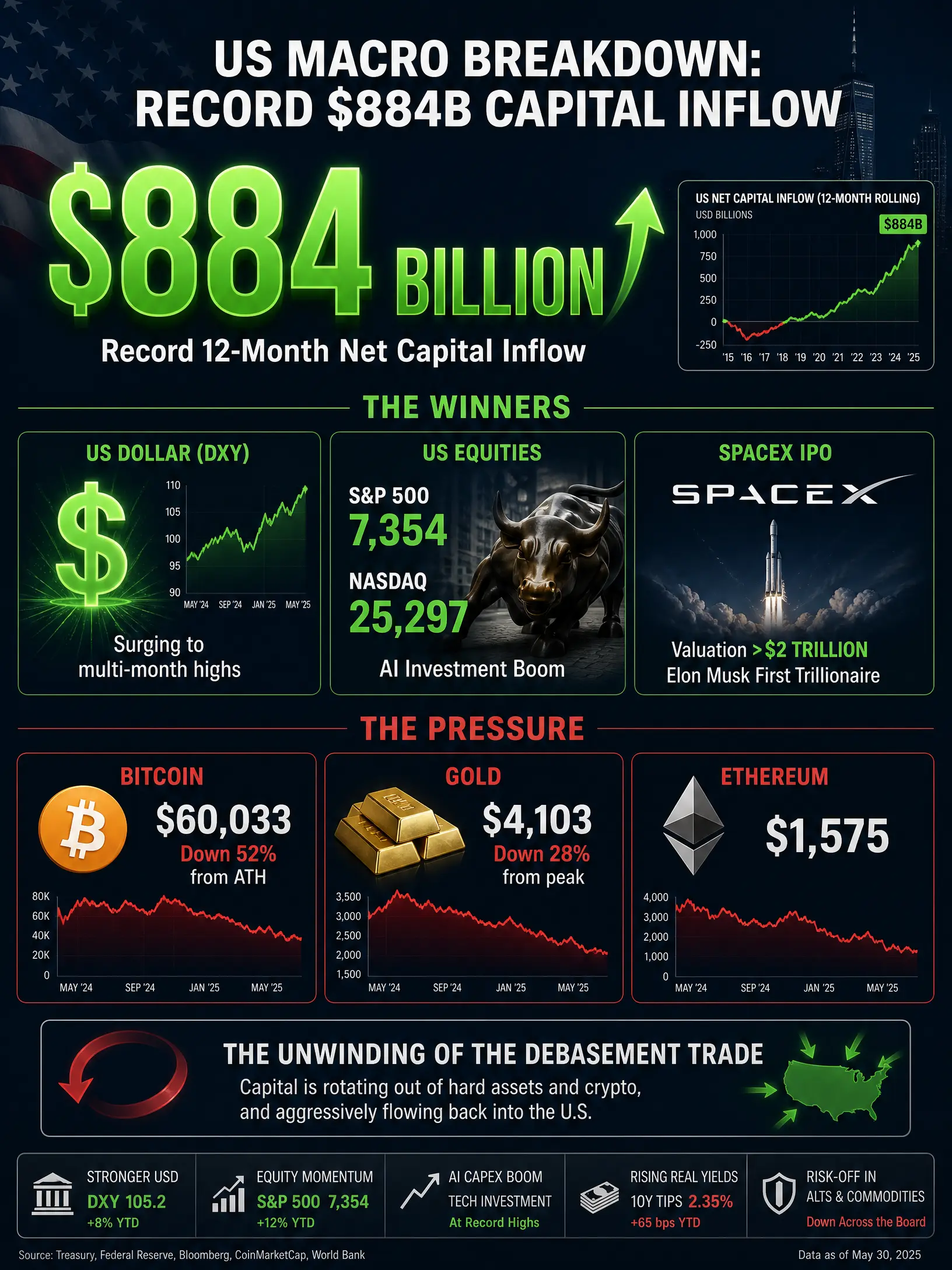
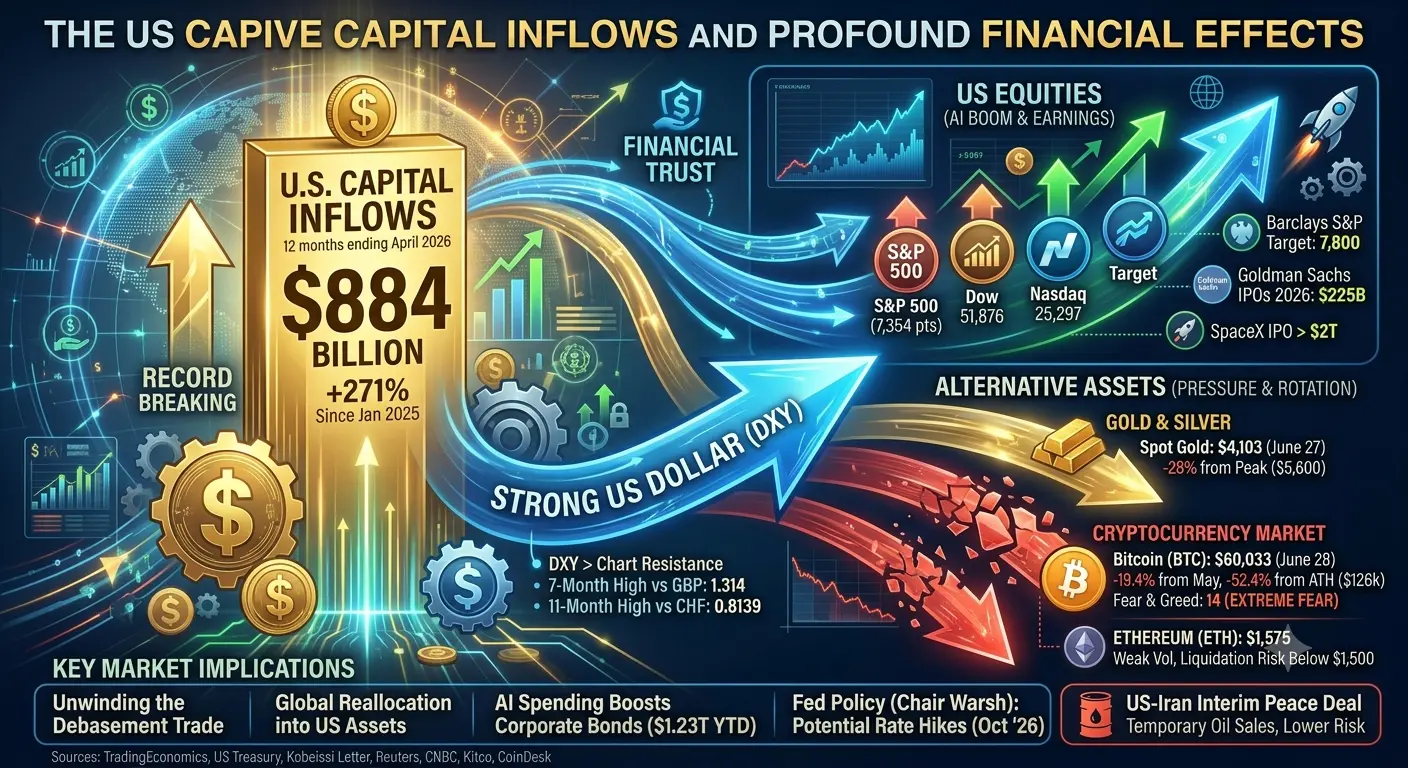
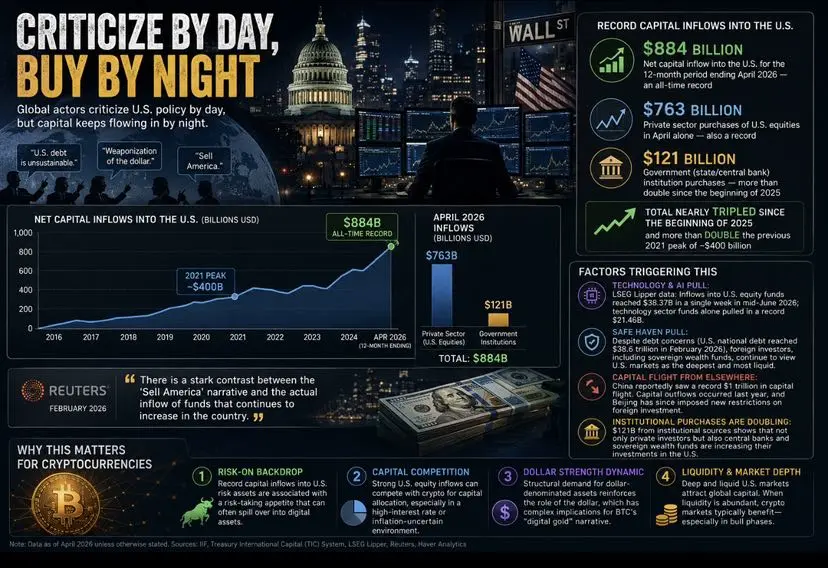
The United States is witnessing one of the largest waves of foreign investment in modern financial history. According to the latest Treasury International Capital (TIC) report, net capital inflows into the United States reached a record $884 billion over the twelve months ending April 2026, a figure that has nearly tripled since the beginning of 2025.
The April report alone showed $26.1 billion in net inflows, with private foreign investors purchasing $164.4 billion in long-term US securities and foreign official institutions adding another $41.6 billion. According to The Kobeissi Letter, private purchases of US equities climbed to an all-time high of $763 billion, while official institutions accumulated a record $121 billion.
This is not simply another economic data release. It represents a major shift in global capital allocation and signals where the world's largest investors currently see the best combination of growth, liquidity, stability, and returns.
Why Capital Is Flooding Into the United States
Global investors are increasingly concentrating capital in the United States because of several powerful macroeconomic trends occurring simultaneously.
The US economy remains relatively resilient compared with many other developed economies. Corporate earnings continue exceeding expectations, labor markets remain stable, productivity growth is accelerating, and the artificial intelligence revolution is creating entirely new investment opportunities across technology, cloud computing, semiconductors, software, robotics, and data-center infrastructure.
At the same time, higher US interest rates continue attracting global capital into Treasury securities and dollar-denominated assets.
Investors seeking both yield and safety are finding the US market increasingly attractive.
Foreign institutions are effectively voting with their money, and that vote is overwhelmingly favoring American assets.
The Dollar Is Becoming the Biggest Winner
When hundreds of billions of dollars flow into the United States, demand for the US dollar naturally increases.
The Dollar Index (DXY) has already broken above several key technical levels and is approaching its strongest monthly performance in almost a year. The dollar recently reached multi-month highs against major global currencies, highlighting the scale of international demand.
This matters because the dollar sits at the center of nearly every global financial market.
A stronger dollar generally supports US financial assets while creating challenges for commodities, emerging markets, and speculative investments. As global investors convert foreign currencies into dollars to purchase US assets, additional upward pressure can develop across the currency market.
Historically, periods of significant dollar strength often coincide with tighter financial conditions worldwide.
US Equities Continue Absorbing Global Liquidity
US stocks remain one of the primary beneficiaries of this enormous capital migration.
The S&P 500 is trading around 7,354, the Dow Jones Industrial Average near 51,876, and the Nasdaq Composite around 25,297.
Wall Street remains highly optimistic.
Barclays recently increased its S&P 500 target to 7,800 while projecting earnings-per-share of $337 for 2026. Some analysts now expect the index could approach 8,800 during 2027 if current growth trends continue.
Technology remains the dominant sector attracting capital.
US equity funds attracted approximately $38.37 billion in a single week, while technology-focused funds absorbed a record $21.46 billion.
The AI boom continues driving unprecedented spending on chips, cloud infrastructure, software development, and advanced computing systems.
Corporate bond issuance has already surpassed $1.23 trillion this year as major technology firms continue raising capital to finance AI expansion.
Gold Is Losing Some of Its Momentum
One of the clearest consequences of these capital inflows has been pressure on precious metals.
Gold currently trades around $4,103 per ounce, significantly below its January 2025 peak near $5,600. Silver has also retreated from previous highs and remains below $59 per ounce.
The reason is relatively straightforward.
When investors can earn attractive returns from equities, Treasury securities, and dollar assets, the urgency to hold defensive assets often decreases. Stronger dollar performance also creates additional resistance for commodity prices because most global commodities are priced in US dollars.
Despite recent weakness, many analysts still expect long-term support for gold from central-bank buying, inflation concerns, reserve diversification, and geopolitical uncertainty.
What Does This Mean for the Crypto Market?
This is where the story becomes particularly important for cryptocurrency investors.
Historically, Bitcoin and the broader crypto market tend to perform best when global liquidity is expanding, financial conditions are easing, and investors are actively seeking higher-risk assets.
The current environment is almost the opposite.
A stronger dollar, higher interest rates, record capital inflows into US equities, and persistent institutional demand for Treasury securities all create competition for investment capital that might otherwise flow into cryptocurrencies.
Every dollar moving into US stocks, bonds, or money-market funds is a dollar not immediately flowing into Bitcoin, Ethereum, or alternative digital assets.
This helps explain why Bitcoin has struggled despite continued institutional adoption.
Bitcoin Remains at a Critical Decision Point
Bitcoin is currently trading around $60,033, approximately 19.4% below its May high of $74,524 and more than 52% below its October 2025 all-time high near $126,000.
The most important support zone remains between $59,000 and $60,000.
This area has become the line separating a potential stabilization phase from the possibility of further downside movement.
Key resistance levels remain:
• $61,500-$62,000
• $64,000-$68,000
• $72,000-$75,000
Major support levels remain:
• $59,000-$60,000
• $56,500-$55,500
• $52,000-$50,000
ETF flows continue playing a major role. Recent Bitcoin ETF outflows, combined with weaker market sentiment and reduced speculative activity, have limited recovery attempts.
As long as capital continues favoring US equities and dollar assets, Bitcoin may struggle to regain sustained momentum.
Ethereum and Altcoins Face Even Greater Pressure
Ethereum is currently trading near $1,575, while Solana remains around $68, XRP near $1.03, and Dogecoin around $0.074.
Historically, altcoins tend to outperform only after Bitcoin establishes a strong and stable uptrend. Since Bitcoin itself remains under pressure from macroeconomic conditions, capital flows into higher-risk crypto assets have remained limited.
If the dollar continues strengthening and global liquidity remains constrained, altcoins could continue underperforming relative to both Bitcoin and traditional financial assets.
The Key Indicator Every Crypto Trader Should Watch
The most important chart in global markets right now may not be Bitcoin.
It may be the US Dollar Index (DXY).
If DXY continues rising alongside strong capital inflows and firm Federal Reserve policy expectations, risk assets could remain under pressure.
However, if dollar strength begins fading, Treasury yields stabilize, and ETF inflows return, Bitcoin could benefit significantly from renewed liquidity.
This is why monitoring capital flows has become just as important as monitoring crypto-specific metrics.
l
The record $884 billion flowing into the United States represents one of the strongest votes of confidence in American financial markets in recent years. Global investors continue favoring US stocks, Treasury securities, technology companies, and dollar-denominated assets over most alternatives.
For crypto investors, this creates a challenging but highly informative environment.
As long as money continues rotating toward US equities and the dollar, Bitcoin, Ethereum, gold, and other alternative assets may face periodic pressure. However, market cycles eventually change, and capital allocation trends can shift rapidly once monetary conditions begin easing.
For now, the combination of record capital inflows, dollar strength, resilient US equities, and cautious institutional positioning remains one of the most important macro themes shaping the future direction of the cryptocurrency market.
@Gate_Square #USNetCapitalInflowsHitRecord884B
The United States is witnessing one of the largest waves of foreign investment in modern financial history. According to the latest Treasury International Capital (TIC) report, net capital inflows into the United States reached a record $884 billion over the twelve months ending April 2026, a figure that has nearly tripled since the beginning of 2025.
The April report alone showed $26.1 billion in net inflows, with private foreign investors purchasing $164.4 billion in long-term US securities and foreign official institutions adding another $41.6 billion. According to The Kobeissi Letter, private purchases of US equities climbed to an all-time high of $763 billion, while official institutions accumulated a record $121 billion.
This is not simply another economic data release. It represents a major shift in global capital allocation and signals where the world's largest investors currently see the best combination of growth, liquidity, stability, and returns.
Why Capital Is Flooding Into the United States
Global investors are increasingly concentrating capital in the United States because of several powerful macroeconomic trends occurring simultaneously.
The US economy remains relatively resilient compared with many other developed economies. Corporate earnings continue exceeding expectations, labor markets remain stable, productivity growth is accelerating, and the artificial intelligence revolution is creating entirely new investment opportunities across technology, cloud computing, semiconductors, software, robotics, and data-center infrastructure.
At the same time, higher US interest rates continue attracting global capital into Treasury securities and dollar-denominated assets.
Investors seeking both yield and safety are finding the US market increasingly attractive.
Foreign institutions are effectively voting with their money, and that vote is overwhelmingly favoring American assets.
The Dollar Is Becoming the Biggest Winner
When hundreds of billions of dollars flow into the United States, demand for the US dollar naturally increases.
The Dollar Index (DXY) has already broken above several key technical levels and is approaching its strongest monthly performance in almost a year. The dollar recently reached multi-month highs against major global currencies, highlighting the scale of international demand.
This matters because the dollar sits at the center of nearly every global financial market.
A stronger dollar generally supports US financial assets while creating challenges for commodities, emerging markets, and speculative investments. As global investors convert foreign currencies into dollars to purchase US assets, additional upward pressure can develop across the currency market.
Historically, periods of significant dollar strength often coincide with tighter financial conditions worldwide.
US Equities Continue Absorbing Global Liquidity
US stocks remain one of the primary beneficiaries of this enormous capital migration.
The S&P 500 is trading around 7,354, the Dow Jones Industrial Average near 51,876, and the Nasdaq Composite around 25,297.
Wall Street remains highly optimistic.
Barclays recently increased its S&P 500 target to 7,800 while projecting earnings-per-share of $337 for 2026. Some analysts now expect the index could approach 8,800 during 2027 if current growth trends continue.
Technology remains the dominant sector attracting capital.
US equity funds attracted approximately $38.37 billion in a single week, while technology-focused funds absorbed a record $21.46 billion.
The AI boom continues driving unprecedented spending on chips, cloud infrastructure, software development, and advanced computing systems.
Corporate bond issuance has already surpassed $1.23 trillion this year as major technology firms continue raising capital to finance AI expansion.
Gold Is Losing Some of Its Momentum
One of the clearest consequences of these capital inflows has been pressure on precious metals.
Gold currently trades around $4,103 per ounce, significantly below its January 2025 peak near $5,600. Silver has also retreated from previous highs and remains below $59 per ounce.
The reason is relatively straightforward.
When investors can earn attractive returns from equities, Treasury securities, and dollar assets, the urgency to hold defensive assets often decreases. Stronger dollar performance also creates additional resistance for commodity prices because most global commodities are priced in US dollars.
Despite recent weakness, many analysts still expect long-term support for gold from central-bank buying, inflation concerns, reserve diversification, and geopolitical uncertainty.
What Does This Mean for the Crypto Market?
This is where the story becomes particularly important for cryptocurrency investors.
Historically, Bitcoin and the broader crypto market tend to perform best when global liquidity is expanding, financial conditions are easing, and investors are actively seeking higher-risk assets.
The current environment is almost the opposite.
A stronger dollar, higher interest rates, record capital inflows into US equities, and persistent institutional demand for Treasury securities all create competition for investment capital that might otherwise flow into cryptocurrencies.
Every dollar moving into US stocks, bonds, or money-market funds is a dollar not immediately flowing into Bitcoin, Ethereum, or alternative digital assets.
This helps explain why Bitcoin has struggled despite continued institutional adoption.
Bitcoin Remains at a Critical Decision Point
Bitcoin is currently trading around $60,033, approximately 19.4% below its May high of $74,524 and more than 52% below its October 2025 all-time high near $126,000.
The most important support zone remains between $59,000 and $60,000.
This area has become the line separating a potential stabilization phase from the possibility of further downside movement.
Key resistance levels remain:
• $61,500-$62,000
• $64,000-$68,000
• $72,000-$75,000
Major support levels remain:
• $59,000-$60,000
• $56,500-$55,500
• $52,000-$50,000
ETF flows continue playing a major role. Recent Bitcoin ETF outflows, combined with weaker market sentiment and reduced speculative activity, have limited recovery attempts.
As long as capital continues favoring US equities and dollar assets, Bitcoin may struggle to regain sustained momentum.
Ethereum and Altcoins Face Even Greater Pressure
Ethereum is currently trading near $1,575, while Solana remains around $68, XRP near $1.03, and Dogecoin around $0.074.
Historically, altcoins tend to outperform only after Bitcoin establishes a strong and stable uptrend. Since Bitcoin itself remains under pressure from macroeconomic conditions, capital flows into higher-risk crypto assets have remained limited.
If the dollar continues strengthening and global liquidity remains constrained, altcoins could continue underperforming relative to both Bitcoin and traditional financial assets.
The Key Indicator Every Crypto Trader Should Watch
The most important chart in global markets right now may not be Bitcoin.
It may be the US Dollar Index (DXY).
If DXY continues rising alongside strong capital inflows and firm Federal Reserve policy expectations, risk assets could remain under pressure.
However, if dollar strength begins fading, Treasury yields stabilize, and ETF inflows return, Bitcoin could benefit significantly from renewed liquidity.
This is why monitoring capital flows has become just as important as monitoring crypto-specific metrics.
l
The record $884 billion flowing into the United States represents one of the strongest votes of confidence in American financial markets in recent years. Global investors continue favoring US stocks, Treasury securities, technology companies, and dollar-denominated assets over most alternatives.
For crypto investors, this creates a challenging but highly informative environment.
As long as money continues rotating toward US equities and the dollar, Bitcoin, Ethereum, gold, and other alternative assets may face periodic pressure. However, market cycles eventually change, and capital allocation trends can shift rapidly once monetary conditions begin easing.
For now, the combination of record capital inflows, dollar strength, resilient US equities, and cautious institutional positioning remains one of the most important macro themes shaping the future direction of the cryptocurrency market.
@Gate_Square #USNetCapitalInflowsHitRecord884B